 Sudden Valley Exterior
 Why South Hill Windows Take More Punishment Than You'd Expect
South Hill sits inside the weather pattern that defines Sudden Valley and the rest of Whatcom County: damp air moving in off the water, long stretches of driving rain, and a moss season that seems to start earlier every year. None of that is dramatic on its own, but windows are one of the few places on a house where a small gap or a slightly wrong installation choice turns into a slow, expensive problem instead of an obvious one.
Wood swells and shrinks with the humidity swings. Vinyl frames expand and contract with temperature. Sealants break down faster under constant UV-and-rain cycling than they would in a drier climate. And because South Hill homes see a lot of wind-driven rain rather than just straight-down rain, water gets pushed sideways into gaps that would stay dry in a calmer climate. A window that's "close enough" on installation in a dry region can be a chronic leak here within a few winters.
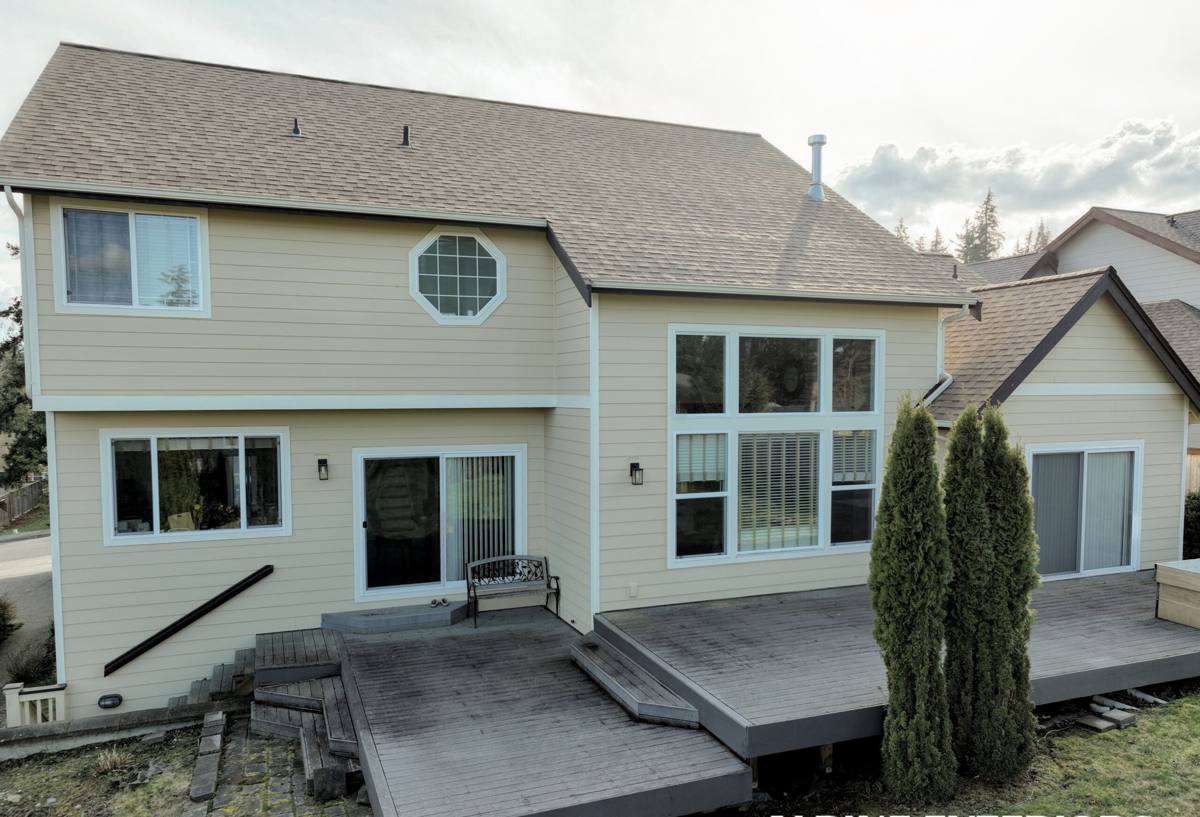
What "Correct" Actually Means for a Window Install in This Climate
A window installation is judged by what you can't see once the trim goes back on. The glass and frame matter, but the flashing, sealing, and drainage details around the opening are what decide whether the window performs for twenty years or starts showing water stains behind the drywall in five.
The details that matter most here
- Flashing sequenced correctly — water-resistive barrier, sill pan, and window flange all lapped so water sheds outward and down, never getting trapped behind the siding
- A sloped sill pan under every window, so any water that does get past the glass drains back outside instead of sitting against the framing
- Backer rod and sealant sized correctly at the exterior joint — too little sealant fails fast, too much can trap moisture instead of letting the assembly breathe where it's designed to
- Proper shimming and squaring so the sash operates smoothly and the weatherstripping seals evenly all the way around, not just at the corners
- Insulation in the gap between the frame and rough opening — not packed so tight it bows the frame, not left hollow where cold and moisture can collect
Skip any one of these and the window can still look fine on installation day. The failures show up later, as fogged glass, soft trim, or a musty smell near the wall — and by then the repair usually costs more than doing it right the first time would have.
Full-Frame Replacement vs. Insert (Pocket) Replacement
One of the first decisions on a South Hill window job is whether the existing frame stays or goes. Both approaches are legitimate — the right call depends on the condition of what's already in the wall, not on which one is cheaper to sell.
| Factor | Full-Frame Replacement | Insert (Pocket) Replacement |
|---|---|---|
| Best when | Existing frame shows rot, soft wood, or past water damage | Existing frame is square, dry, and structurally sound |
| Access to flashing/sill | Full access — old flashing removed and redone from scratch | Limited — relies on the existing flashing still being sound |
| Glass area | Can often be maximized since the new frame sets to the rough opening | Slightly reduced, since the new frame nests inside the old one |
| Typical cost | Higher — more labor, siding and trim disturbed | Lower — less demolition, faster install |
| Risk if wall has hidden rot | Low — rot is exposed and addressed during the job | Higher — rot can be sealed in behind the new window |
Given how much moisture this area sees, we lean toward recommending a full-frame replacement any time there's visible staining, soft trim, or a window that's been leaking for a while. An insert saves money, but only makes sense when we can confirm the wall behind it is actually dry.
How We Approach a South Hill Window Job
1. Inspection before quoting anything
We check the condition of the existing frame, sill, and the wall assembly around it — probing for soft wood, checking how the current unit was flashed, and looking at where water has actually been getting in versus where it's just showing up on the interior wall. This is what determines full-frame versus insert, not a standard sales script.
2. Removal without spreading damage
Old windows come out carefully so we're not tearing more siding or trim than necessary, especially on homes where matching existing exterior finishes matters.
3. Rebuild the opening if needed
Any rot or soft framing found during removal gets cut out and replaced before a new window ever goes in. Installing a new window into a compromised opening just delays the same problem.
4. Flash, set, and seal to a sequence — not a shortcut
Sill pan first, then the window, then the flange integrated with the water-resistive barrier in the correct shingle-lap order, then the exterior sealant. Each layer is there to move water in one direction: out.
5. Interior finish and function check
Trim goes back cleanly, and every sash gets operated and checked for a smooth seal before we call the job done.
Choosing Materials for the Conditions Here
Vinyl, fiberglass, and wood-clad windows all have a place, and none of them is a bad product across the board — the right choice depends on the specific wall, sun exposure, and how much upkeep an owner wants to sign up for.
Our general standard for this climate
We favor vinyl and fiberglass frames for most South Hill installs because they don't require repainting or refinishing to stay weathertight, which matters in an area with this much annual rain. Wood-clad units can look excellent and we'll install them when that's the priority, but we're upfront that the cladding and any exposed wood trim need more consistent maintenance here than they would in a drier climate — moss and mildew find bare or worn finishes fast, and a missed maintenance cycle can let moisture in behind the cladding before it's visible from outside. That's a maintenance trade-off, not a defect, and it's worth knowing before you choose.
Glass packages
Double-pane, low-E glass with argon fill is the standard for this region and handles the temperature swings and moisture load well. Triple-pane adds cost and is worth discussing for north-facing rooms or homes right along the exposed shoreline, but it's not a requirement for most South Hill installs.
Signs a South Hill Home Needs New Windows Now, Not Later
- Condensation or fogging between the panes — the seal has failed and the insulating gas is gone
- Soft, discolored, or bubbling trim around the frame, inside or out
- Visible gaps where you can see daylight or feel a draft with the window fully latched
- Difficulty opening, closing, or locking a sash that used to operate smoothly
- A musty smell near a window that doesn't go away with cleaning
- Moss or dark streaking building up on the sill or exterior casing faster than on the rest of the house
- Noticeably higher heating bills with no other explanation
Any one of these alone might just need a repair. Two or three together, especially on the same window, usually means the installation or the unit itself has failed and a repair will just delay the real fix.
Why It Matters That We Already Work South Hill
A window install that's correct in a dry inland climate can still be wrong for South Hill. Flashing details, sealant choice, and how tight to run a joint all shift depending on how much wind-driven rain and moss pressure a wall actually sees. A crew that installs windows across a lot of different climates has to relearn those details every time they show up somewhere new. A crew that works this specific area regularly already knows what fails here and builds every install to account for it from the start — not as an upsell, but as the baseline.
We're also familiar with the range of homes in this part of Whatcom County, from older construction with original wood-frame windows to newer builds that just need routine replacement on a normal upgrade cycle. That means a faster, more accurate quote and fewer surprises once we open up the wall.
After the Install: Keeping It Weathertight
A correctly installed window in this climate still benefits from basic upkeep:
- Rinse sills and tracks periodically to keep moss and organic buildup from holding moisture against the frame
- Check exterior caulking once a year, especially after a hard winter, and have any cracked sealant redone before it lets water behind the trim
- Keep gutters and downspouts clear so runoff isn't sheeting directly down over window heads
- Operate every sash a few times a year, even ones you rarely open, so seals and hardware don't seize up
None of this is a big time commitment, but skipping it is how a well-installed window ends up with the same problems as a poorly installed one, just a few years later.
If you're dealing with drafty, foggy, or failing windows in South Hill, we're happy to take a look and give you a straight answer on whether you need a full replacement, an insert, or just a repair — no pressure, no upsell script. Use the form below to request a free estimate.