 Sudden Valley Exterior
 Decking Built for Sehome's Wet Side of the Mountain
Sehome sits close enough to Bellingham Bay that salt-laden air reaches decks and railings even when the water isn't visible from the yard. Combine that with Whatcom County's long stretch of driving rain from fall through spring, and you get a climate that is hard on outdoor structures in ways that don't show up right away. A deck that looks fine in July can be hiding trapped moisture, early fastener corrosion, or a moss colony getting started underneath the boards by October.
Composite decking holds up well here when it's installed correctly, but "composite" isn't a magic word that solves moisture problems on its own. The board itself resists rot, but the substructure, drainage path, and airflow underneath still have to be built right, or you end up with the same failures homeowners see on old wood decks — just with a longer warranty on the part that wasn't the problem.
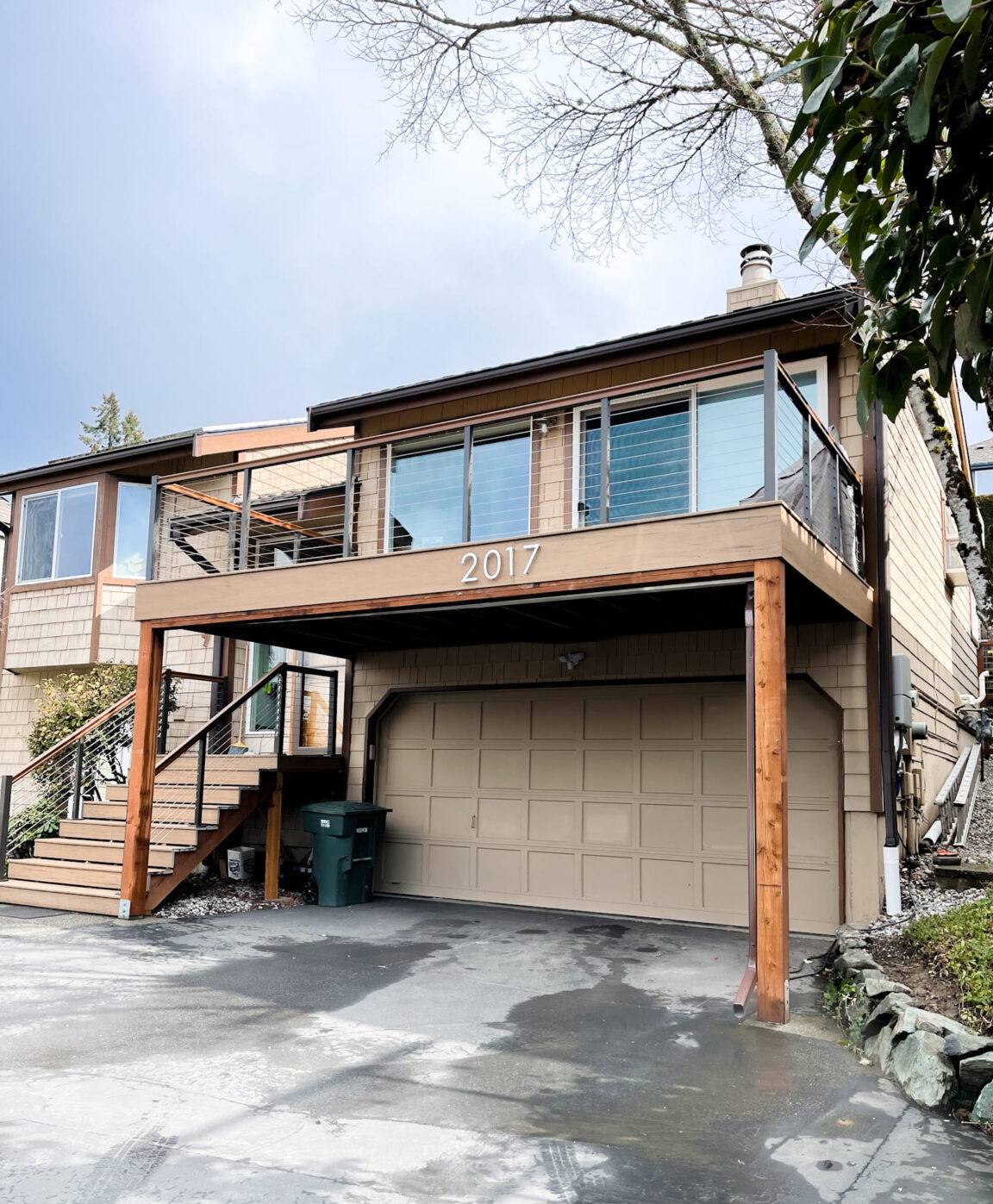
What Sehome's Climate Actually Does to a Deck
Driving Rain
Rain here rarely falls straight down. Wind off the water pushes it sideways into ledger boards, fascia, and any gap where a deck meets the house. Over a wet season, that sideways rain finds its way behind poorly flashed ledger connections and into end grain that wasn't sealed properly during framing.
Salt Air
Proximity to the bay means airborne salt settles on hardware, fasteners, and any exposed metal. Standard-grade screws and brackets corrode faster here than they would inland. It's a slow process, but a deck built with the wrong fastener spec will show rust streaks and weakening connections years before it should.
Moss Season
Whatcom County's moss season isn't a few weeks — it's most of the year. Anywhere on a deck that stays shaded and damp (north-facing sections, under railings, between boards with poor spacing) becomes a moss and algae host. On composite decking this mostly affects the surface finish and slip resistance rather than the board's structural integrity, but it still needs to be designed against, not just cleaned up after the fact.
What a Correct Composite Deck Installation Actually Involves
A composite deck is only as good as what's underneath it. The parts that never get seen after the ribbon-cutting are the parts that determine whether the deck is still solid in fifteen years.
- Ledger flashing: Proper metal flashing and self-adhering membrane at the house connection, installed so water sheds away from the wall rather than behind it.
- Joist protection: A joist tape or coating on top of the framing lumber so the composite boards aren't sitting on exposed, moisture-absorbing wood.
- Fastener spec: Stainless or coated hardware rated for coastal exposure, not the cheapest box on the shelf.
- Board spacing: Gapping set to the manufacturer's spec for expansion, drainage, and airflow — too tight and water pools; too wide and the deck feels loose underfoot.
- Ventilation underneath: Enough clearance and airflow beneath the deck so the framing can dry out between rain events instead of staying damp all winter.
- Ground-level drainage: Grading or gravel underneath low decks so water doesn't sit and wick moisture upward.
Skip any one of these and the composite boards themselves may still look fine while the structure underneath them is quietly failing — which is exactly the kind of hidden damage we get called out to diagnose on decks that are only a few years old.
Composite vs. the Alternatives for This Area
| Material | How It Handles Rain & Moss | Maintenance | Typical Lifespan Here |
|---|---|---|---|
| Composite decking | Doesn't absorb water into the board itself; surface can still grow algae/moss if not cleaned | Periodic wash; no staining or sealing | 25–30+ years with correct install |
| Pressure-treated wood | Absorbs moisture, prone to cupping and splintering in wet cycles | Annual staining/sealing recommended | 10–15 years before major repairs |
| Cedar | Naturally rot-resistant but still needs sealing against driving rain | Regular sealing/oiling | 15–20 years with upkeep |
| PVC/vinyl decking | Fully water-resistant board, but expands/contracts more with temperature swings | Low; occasional wash | 25–30 years |
We install composite decking as our standard recommendation for most Sehome projects because it strikes the best balance for this climate — it won't rot, warp, or splinter from the constant wet-dry cycling, and it doesn't need the annual staining schedule that wood requires to survive a Whatcom County winter. That said, board choice always depends on the specific deck, its exposure, and the homeowner's budget — we'll walk through the honest trade-offs on-site rather than pushing one product by default.
Our Process for a Sehome Composite Deck
- On-site assessment: We look at sun/shade exposure, drainage slope, proximity to the bay, and the condition of any existing structure before quoting anything.
- Framing and structural check: If we're replacing an old deck, we inspect the ledger, posts, and footings — composite boards on a compromised frame is a repair you'll be paying for twice.
- Moisture management build-out: Flashing, joist tape, and drainage path go in before a single composite board is placed.
- Fastener and hardware selection: Coastal-rated hardware specified for this location, not a generic inland spec.
- Board installation: Correct spacing and fastening pattern per the manufacturer, with attention to end-grain sealing at cut boards.
- Railing and finish work: Railing posts and connections get the same moisture attention as the deck surface — this is a common weak point on older builds.
- Final walkthrough: We go over care basics with the homeowner, including how to manage moss buildup through the wet months.
Living With Moss and Algae on a Composite Deck
Composite doesn't rot from moss the way wood does, but a neglected surface still gets slick, discolored, and unpleasant to walk on barefoot. In a climate with as long a wet season as this one, a little routine care goes a long way:
- Sweep debris off the deck regularly — wet leaves and needles trap moisture against the board surface and feed algae growth.
- Rinse or lightly scrub shaded, low-airflow areas a couple of times during the wet season, since these spots stay damp longest.
- Keep gutters and downspouts near the deck clear so runoff isn't dumping directly onto one section.
- Avoid pressure-washing at close range or high pressure — it can strip the surface finish on some composite boards; a garden hose and soft brush is usually enough.
- Trim back overhanging branches where practical to cut down on shade and debris buildup.
Common Issues We Find on Existing Decks in This Area
When we're called out to look at an older deck near Sehome or Sudden Valley, the same handful of problems show up again and again:
- Rusted or failing fasteners from hardware that wasn't rated for salt-air exposure.
- Soft or rotted framing hidden under decking that looked fine from the top.
- Ledger board leaks where flashing was missing or installed incorrectly at the house connection.
- Moss buildup in board gaps that were spaced too tight for water to drain through.
- Standing water underneath low decks due to poor grading, which keeps the framing damp for weeks after a storm.
None of these are unique to composite decking — they're the result of a build that didn't account for this specific climate, regardless of what material sits on top.
What Affects the Cost of a Composite Deck Project
| Factor | Why It Matters |
|---|---|
| Deck size and shape | More linear feet of framing, boards, and fastening; complex shapes add labor |
| Existing structure condition | Reusing sound framing costs less than a full tear-out and rebuild |
| Height above grade | Taller decks need more substructure work and railing code compliance |
| Board and railing tier | Composite lines vary in price, color options, and warranty terms |
| Site access | Tight lots or steep grades near the lake can add labor time |
We give real, itemized numbers after seeing the site — not a ballpark based on square footage alone, since the substructure condition usually matters more to the final cost than the decking material itself.
Why It Matters That We Already Work in This Area
A crew that only occasionally works this far into Whatcom County doesn't always know to spec coastal-rated hardware by default, or to plan for the specific way rain behaves against the Sehome side of the county versus a drier inland job. That's not a knock on any particular contractor — it's just what happens when a decking crew's daily experience is somewhere else. We build decks in this climate regularly, which means the moisture detailing, drainage planning, and hardware choices described above aren't an upsell — they're just how we build a deck meant to last here.
If you're weighing a new composite deck, a replacement, or want an honest look at what's happening under an existing one, we're glad to come take a look. The estimate is free, there's no pressure, and you'll get a straight answer about what your deck actually needs.