 Sudden Valley Exterior
 Exterior Work in Silver Beach: What the Climate Actually Does to a House
Silver Beach sits in the part of Whatcom County where the weather doesn't do anything dramatic — it just doesn't stop. Homes here spend most of the year under a low, wet sky, with long stretches of drizzle instead of hard storms, humid air off the water, and a growing season for moss and algae that can run eight or nine months out of twelve. None of that is unusual for this part of Washington. But it does mean that exterior materials which look fine on a spec sheet from a dry-climate state often underperform once they've spent a few winters here.
We work on homes throughout the Sudden Valley and greater Whatcom County area, and Silver Beach comes with its own particular mix of exposure: tree cover that keeps siding and roofs shaded and damp longer after a rain, driving rain events that push moisture sideways into wall assemblies, and a marine-influenced air that carries salt and moisture further inland than people expect. Add it up and you get an environment that rewards materials and installation practices built specifically for sustained wet exposure — and punishes anything installed with shortcuts.
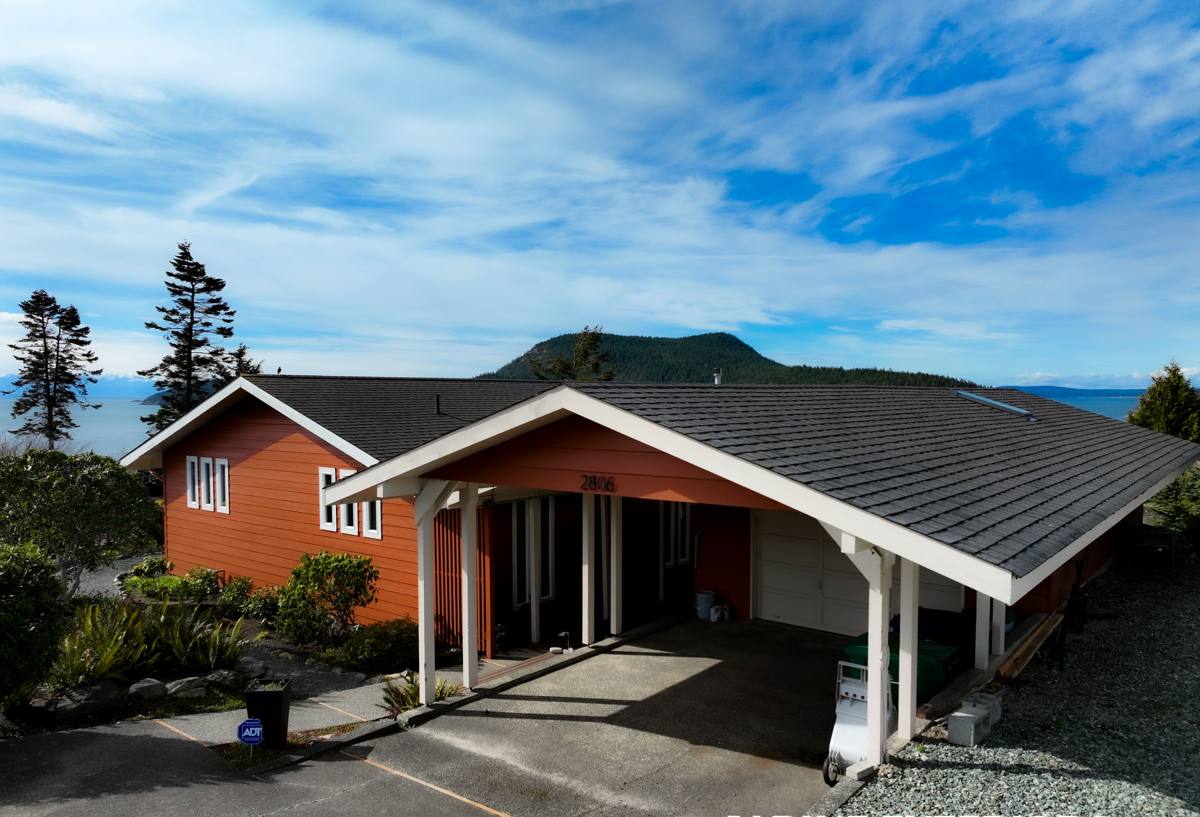
Siding: Why Material Choice Matters More Here Than Elsewhere
Siding is the single biggest factor in how a home in this climate ages. In a drier region, a mediocre siding installation might go a decade before problems show up. In Silver Beach, moisture finds the weak points much faster — caulked seams open up, paint fails at end grain, and anything that can absorb water eventually will.
What We Install — and Why
We install James Hardie fiber cement siding exclusively. We don't offer vinyl, LP SmartSide, Cemplank, Allura, or primed wood siding, and that's a deliberate standard, not a limitation of what we're capable of installing. Fiber cement is dense, non-combustible, and dimensionally stable in a way that wood-based and vinyl products aren't. It doesn't swell with moisture, it doesn't provide a food source for the mold and algae that thrive in this climate, and the factory-applied ColorPlus finish holds color and resists the chalking and fading that painted or primed siding shows after a few wet seasons.
Hardie also builds region-specific formulations — their HZ5 product line is engineered for the freeze-thaw and moisture cycling of the Pacific Northwest, which is exactly the exposure a Whatcom County home sees. That's not marketing language; it reflects a real difference in how the board is manufactured for our specific weather pattern versus, say, a hot, dry climate.
What Correct Installation Looks Like
Fiber cement performs the way it's supposed to only when it's installed to spec. In our climate that means:
- Proper rain-screen or drainage gap behind the siding so moisture that gets past the surface can drain and dry
- Correct fastener placement and spacing per Hardie's published installation guide
- Factory-cut and factory-primed edges wherever possible, with any field cuts properly sealed
- Flashing detail at every window, door, and penetration — this is where most siding failures actually originate, not the field of the wall
- Caulking only where Hardie's install guide calls for it, not as a substitute for proper flashing
A rushed or under-flashed installation will eventually fail no matter what material is on the wall. That's why we treat installation quality as inseparable from the material decision.
Roofing: Moss, Debris, and Long-Term Wear
Roofs in Silver Beach deal with two compounding problems: near-constant moisture and heavy tree cover in a lot of the neighborhood, which means moss, needle buildup, and shaded areas that never fully dry out between rain events. Moss isn't just cosmetic — its root structure lifts shingle edges and holds water against the roofing surface, which shortens the life of asphalt shingles and accelerates granule loss.
Good roofing work in this climate isn't just about the shingle brand. It's about details that matter more here than in drier regions: proper ventilation to keep the underside of the roof deck dry, ice-and-water shield at valleys and eaves, and flashing at every chimney, vent, and wall intersection sized for sustained rain rather than occasional storms. We also pay attention to how a roof edge interacts with the siding above it, since a poorly integrated transition is a common point where water works its way behind the exterior wall assembly.
Windows: The Quiet Source of Most Water Damage
If we trace exterior water damage back to its source, an outsized share of it starts at window openings — not roofs, not wall fields. Window flashing and integration with the siding plane is one of the most failure-prone details in residential construction, and it's especially unforgiving in a climate with sustained, driving rain.
When we replace windows or integrate new siding around existing windows, we pay close attention to:
- Head flashing that directs water out and away from the window, not into the wall cavity
- Proper sill pan installation so any water that does get past the window has somewhere to drain
- Correct sequencing of house wrap, flashing tape, and siding — layered so water always sheds outward, never inward
- Sealed but not over-caulked joints, since trapped moisture behind excess sealant causes its own problems
Energy performance matters too, but in this climate, keeping water out of the wall assembly is the more consequential job a window has to do.
Decks: Built for Wet Wood Exposure
Decks in Silver Beach take a different kind of punishment — horizontal surfaces hold standing water and debris far longer than a vertical wall does, and shaded decks under tree cover rarely get a full dry-out between rain events. That combination accelerates rot at ledger boards, joists, and any spot where two pieces of wood meet and trap moisture.
Whether we're building new or replacing an aging deck, the details that actually extend its life are: proper ledger board flashing where the deck meets the house (a very common rot point), joist tape on framing lumber, adequate gapping between deck boards for drainage and airflow, and hardware rated for coastal and high-moisture exposure. Material choice — wood versus composite — is a real conversation with trade-offs on both sides, and it's one we're happy to walk through honestly rather than push toward whatever has the highest margin.
Comparing Exterior Material Approaches
| Material | Common Weak Point in This Climate | Our Take |
|---|---|---|
| Vinyl siding | Warps/fades over time, seams can allow water intrusion behind panels | We don't install it; moisture management behind the panel is hard to guarantee long-term |
| Primed wood / cedar | Requires ongoing paint maintenance, prone to rot at end grain and fastener points | Beautiful when maintained, but the upkeep burden is real in constant moisture |
| LP SmartSide / engineered wood | Edge swelling and moisture sensitivity if flashing details aren't perfect | We've standardized away from it for the same reason — moisture forgiveness matters here |
| James Hardie fiber cement | Requires correct fastening and flashing, but the board itself doesn't rot or swell | What we install — dense, factory-finished, engineered for this exposure |
Signs a Silver Beach Home Needs Exterior Attention
- Green or black staining that returns quickly after cleaning, especially on north-facing or shaded walls
- Soft or spongy spots at deck ledgers, window sills, or siding bottom edges
- Paint that's peeling or bubbling rather than just fading
- Shingle granules collecting in gutters, or moss visibly established on roof slopes
- Gaps or separation at siding seams and trim joints
- Musty smell near exterior walls, which can indicate moisture intrusion behind the surface
Any one of these on its own isn't necessarily an emergency, but they're worth a professional look before the next wet season adds to the problem.
Why a Local Whatcom County Crew Matters
Exterior work done by a crew that only sees this climate occasionally tends to under-detail the parts that matter most here — flashing, drainage gaps, ventilation — because those details aren't as critical in a drier region. A crew that works Whatcom County and the Lake Whatcom area regularly has already seen how a rushed flashing job or an undersized drainage gap plays out two winters later on a nearby house. That local pattern recognition is worth more than a lower bid from a crew unfamiliar with how this specific climate behaves over time.
We also know the practical side of working in this area — permitting expectations, typical lot conditions around Silver Beach and the surrounding Sudden Valley communities, and how tree cover and terrain affect scheduling and access for roofing and siding projects.
What to Expect When You Work With Us
We start with an honest look at the exterior — siding, roofline, window flashing, and any deck structure — and tell you what actually needs attention versus what can wait. We don't upsell products we don't believe in, and since we only install James Hardie siding, that recommendation isn't influenced by whichever manufacturer is offering the best margin that month. For roofing, window, and deck work, we walk through material trade-offs plainly, including where a lower-cost option is genuinely a reasonable choice.
If you're weighing a full exterior update or just want a second opinion on something you've noticed, we're glad to come take a look. The estimate is free, there's no pressure, and you'll get a straight answer about what your home in Silver Beach actually needs.