 Sudden Valley Exterior
 Exterior Work in Happy Valley: What the Climate Actually Does to a Home
Homes in Happy Valley sit in a part of Whatcom County where the exterior of a house works harder than most homeowners realize. Between the salt-laden air moving in off the Sound, long stretches of driving rain through fall and winter, and a moss season that can run six months or more under tree cover, the outside of a house is under near-constant pressure. None of this is dramatic on any single day. It's the accumulation — years of moisture cycling in and out of siding, roofing that never fully dries between storms, and moss holding water against surfaces it shouldn't touch — that eventually shows up as rot, staining, premature paint failure, or a roof that needs replacing years before it should.
We work on homes throughout this part of Whatcom County, and the patterns repeat from one property to the next. Understanding what's actually happening to a home's exterior — rather than just reacting to a stain or a soft spot after it appears — is the difference between a repair that lasts and one that's a stopgap.
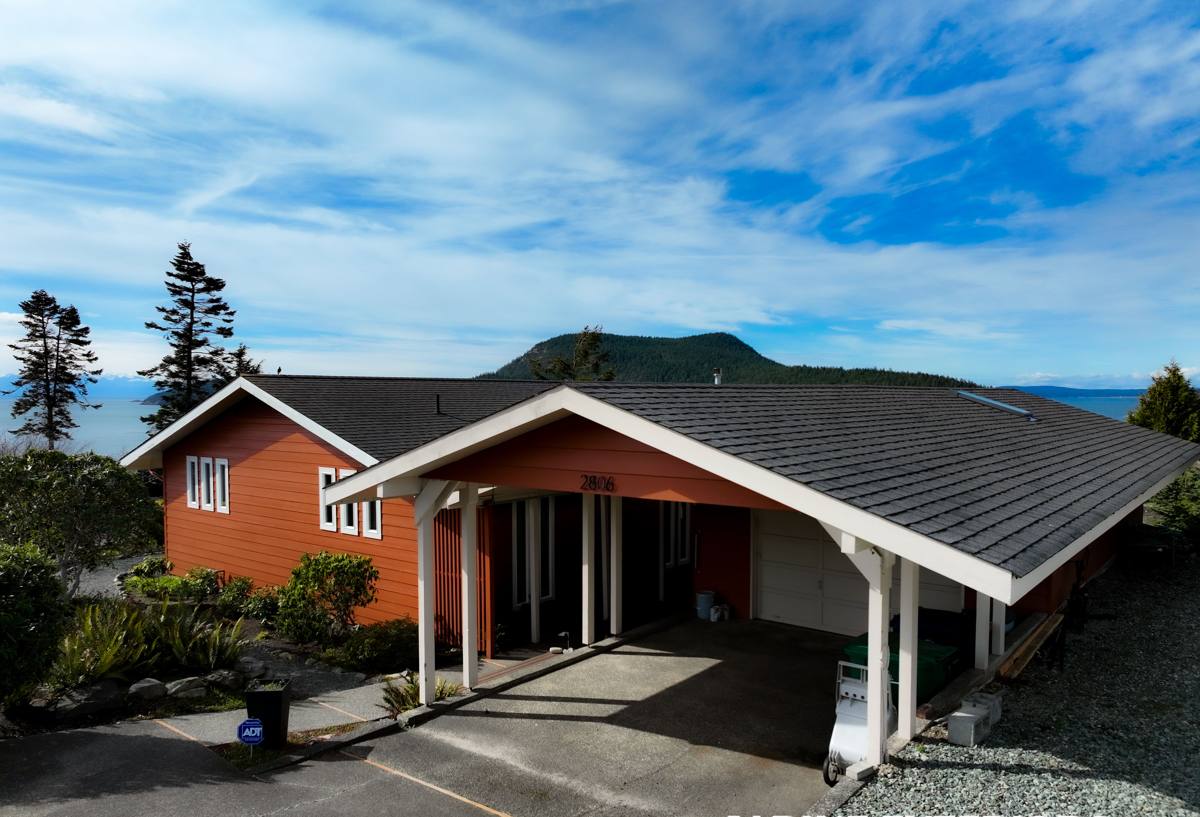
Siding in Happy Valley: What Holds Up and What Doesn't
Siding is the first line of defense against everything the climate throws at a house, and it's also the component most likely to fail quietly. Wood-based products — cedar, primed spruce, and engineered wood siding like LP SmartSide — all share one vulnerability: they're organic materials, and organic materials absorb moisture. In a climate with this much sustained dampness and shade, that absorption cycle rarely gets a real chance to fully dry out before the next rain arrives. Over time that leads to swelling at seams, paint that fails from the inside out, and in the worst cases, rot that isn't visible until it's already structural.
Vinyl siding handles moisture differently — it doesn't absorb water — but it has its own weak points here. It expands and contracts with temperature swings, its seams and panels can loosen over years of wind exposure, and in areas with salt air it tends to show chalking and fading faster than homeowners expect. It also isn't a great match for the look most homes in this area are going for.
Why We Only Install James Hardie Fiber Cement
We made a decision as a company to install James Hardie fiber cement siding exclusively, and it comes directly from what we see on job sites in exactly this kind of climate. Fiber cement is non-combustible, doesn't swell or rot the way wood-based products can, and holds its factory-applied ColorPlus finish far longer than field-applied paint on wood or vinyl trim. Hardie also engineers specific product lines (their HZ5 line, for example) for climates with sustained moisture exposure, which is a meaningfully different approach than a one-size-fits-all siding product. That doesn't mean fiber cement is maintenance-free — it still needs to be installed to spec, with correct clearances, flashing, and caulking — but it removes the moisture-absorption problem that drives most of the siding failures we get called out to inspect.
Siding Material Comparison
| Material | Moisture Behavior | Finish Longevity | Typical Maintenance |
|---|---|---|---|
| Cedar / primed spruce | Absorbs and releases moisture; prone to swelling and rot over time | Field paint typically needs attention every 3-7 years | Regular repainting, caulking, and moisture checks |
| LP SmartSide (engineered wood) | Resists moisture better than solid wood but seams and cut edges remain vulnerable | Factory finish holds reasonably well; edge treatment matters | Sealing cut edges, seam inspection |
| Vinyl | Doesn't absorb water but can trap moisture behind panels; expands/contracts | Color fades and chalks over years, especially with salt air exposure | Cleaning, occasional panel replacement |
| James Hardie fiber cement | Non-combustible, dimensionally stable, engineered for wet climates (HZ5) | Factory ColorPlus finish backed by a separate finish warranty | Periodic cleaning and caulk inspection |
Roofing for a Wet, Mossy Climate
Roofs here rarely fail because of one bad storm — they fail because moss and organic debris hold moisture against shingles for months at a stretch, especially on north-facing slopes and anywhere tree cover keeps a roof shaded. That trapped moisture breaks down shingle granules faster than manufacturer warranties assume, and moss root structures can actually lift shingle edges over time, creating a path for water intrusion that's easy to miss from the ground.
A roofing job in this area needs to account for that from the start — proper ventilation to let a roof dry between rain events, ice-and-water shield in vulnerable areas, and flashing detail around any valley, chimney, or penetration where water tends to concentrate. We also look at what's overhanging the roof, since trimming back tree cover is often the single most effective thing a homeowner can do to slow moss growth, independent of what roofing material is up there.
Windows: Sealing Out Wind-Driven Rain
Wind-driven rain is a specific problem for windows in this part of Whatcom County — it's not just rain falling straight down, it's rain being pushed sideways and upward into gaps that would never see water in a calmer climate. Older windows with degraded seals, or windows that were never properly flashed during a past installation, are a common source of hidden water damage around window openings, often showing up as staining or soft framing well before the glass itself shows any problem.
When we replace windows, the flashing and integration with the surrounding siding matter as much as the window unit itself. A high-quality window installed with poor flashing will leak; a modest window installed correctly usually won't. That detail work is where most of the long-term performance actually comes from.
Decks: Building for Constant Moisture
Decks take a different kind of punishment — standing water, shaded areas that never fully dry, and ledger board connections where the deck meets the house, which is one of the most common failure points on any deck in a climate like this. Fasteners, flashing at the ledger, and drainage underneath the deck surface all need to be handled with this moisture load in mind, not treated as an afterthought to the visible decking material.
Composite decking has become a popular choice locally because it doesn't absorb water the way wood does and doesn't need refinishing, though it still requires correctly engineered substructure and drainage to perform well long-term. Wood decking can absolutely work here too, but it needs a realistic maintenance commitment — sealing, cleaning, and inspection on a schedule that fits how much moisture the deck actually sees.
What Working With a Local Crew Looks Like
A crew that works this area regularly isn't guessing at how a house will perform — they've already seen how moss builds up on a north-facing roof, how salt air affects a fastener over a decade, and which parts of a property tend to hold moisture longest. That local pattern recognition shows up in small decisions: where extra flashing gets added, which side of a house needs a different approach, how much clearance siding gets at grade. Those decisions are hard to get right from a generic spec sheet, and they're the difference between an install that holds up and one that needs attention again in a few years.
What to Expect From an Estimate Visit
- A walk-around of the exterior looking specifically at moisture exposure, shade patterns, and existing damage or wear
- A straightforward explanation of what's driving any problem we find — not just what to replace, but why it happened
- Clear options for siding, roofing, window, or deck work, with honest trade-offs explained rather than a single hard sell
- A written scope of work before anything is scheduled, so there's no ambiguity about what's included
Vetting a Contractor for Exterior Work in This Climate
Because so much of what determines long-term performance here is installation detail rather than the material itself, the contractor matters as much as the product. A homeowner evaluating bids should ask specifically how a contractor handles flashing, clearances, and ventilation — not just what brand of siding or roofing they're proposing. A contractor who can answer those questions in specific terms, rather than general reassurances, is usually the one who's actually thought through how a house in this climate behaves over time.
It's also worth asking directly about licensing, insurance, and whether warranty coverage is tied to the manufacturer, the installer, or both. Fiber cement products like James Hardie, for example, carry a warranty structure that depends on correct installation — so the contractor's track record is part of what you're actually buying.
A Practical Maintenance Checklist for Happy Valley Homes
- Trim back tree cover that shades roof and siding surfaces, especially on north-facing sides
- Clean moss and debris off the roof at least once a year, ideally before the wet season builds up
- Inspect caulking and seams around windows and siding penetrations annually
- Check deck ledger boards and under-deck drainage for standing water or staining
- Clear gutters and downspouts regularly so water is actually moving away from the foundation and siding
- Walk the exterior after major storms looking for lifted shingles, loose trim, or new staining
Getting Started
Whether it's a full siding replacement, a roof that's showing its age, windows that let in more draft and moisture than they should, or a deck that needs rebuilding from the ledger up, the starting point is the same: a clear look at what your home's exterior is actually dealing with. We offer free, no-pressure estimates for homeowners in Happy Valley and throughout the surrounding area — use the form below to get a straightforward assessment and honest options for your property.