 Sudden Valley Exterior
 Why We Only Install One Siding Brand
Most exterior contractors keep two or three siding lines on their price sheet and let the homeowner pick based on budget. We stopped doing that years ago. After enough tear-offs on homes around Lake Whatcom and Sudden Valley — pulling failed vinyl off in pieces, finding rot behind primed wood trim, watching cheaper fiber cement chip at the cut edges — we made a call: James Hardie fiber cement is the only siding we install, on every job, no exceptions.
That's not a marketing position. It's a practical one. When you install one system, your crews get genuinely fast and precise with it instead of being average at five different products. You stop guessing which flashing detail applies to which material. And you can stand behind a job the same way every time, because you're not improvising around a product's weak points.
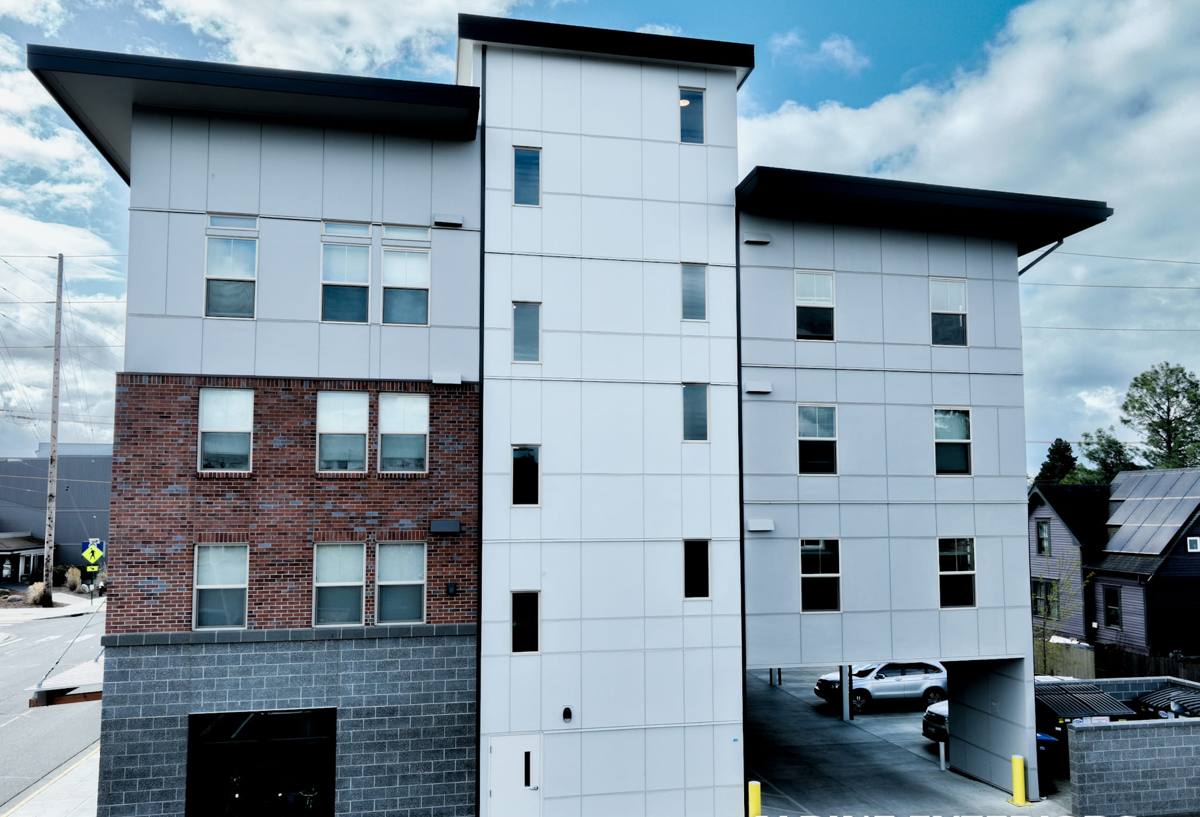
What Makes Sudden Valley a Tough Place for Siding
Sudden Valley sits against the shoreline of Lake Whatcom, tucked into tree cover that keeps a lot of the property in shade for long stretches of the year. That combination — lake-effect moisture, driving rain off the water, and shaded siding that doesn't dry out quickly — is exactly the environment where lesser siding products show their weaknesses first. Add in the salt-tinged marine air that reaches inland through Whatcom County from the Puget Sound side, and you've got a climate that punishes anything with a moisture-sensitive core or a coating that can't hold up to a long, damp moss season.
We're not describing a worst-case scenario. This is a normal year in this part of Whatcom County. Any siding product we put on a home here has to handle it as routine weather, not an edge case.
What James Hardie Fiber Cement Actually Is
James Hardie siding is made from a mix of Portland cement, sand, and cellulose fiber, cured under pressure and heat. It's not plastic, and it's not wood. That distinction matters for three reasons:
- It doesn't burn. Fiber cement is non-combustible, which matters more each year as wildfire smoke and ember exposure become a bigger part of Pacific Northwest summers.
- It doesn't feed moisture damage the way wood does. It won't rot, and it doesn't swell and split from repeated wetting and drying the way primed wood trim does.
- It doesn't warp or sag in heat the way vinyl can. Vinyl siding is a petroleum-based product that softens and distorts under direct summer sun and can go brittle in a hard freeze — fiber cement holds its shape across that whole range.
None of that makes it magic. Fiber cement is heavier, it has to be cut and fastened correctly, and it depends on the installer respecting clearances and flashing details. But the base material itself is engineered for exactly the kind of exposure Sudden Valley gets.
HZ5: Siding Engineered for This Specific Climate
James Hardie doesn't sell one universal product — it engineers different formulations for different climate zones, sold under its HZ (HardieZone) system. HZ5 is the cold-and-wet formulation, built for regions that see freeze-thaw cycles, extended damp seasons, and higher humidity — which describes Whatcom County's climate almost exactly. HZ5 boards are formulated to resist moisture absorption and to hold dimensional stability through repeated wet-cold-dry-warm cycles, rather than using a generic warm-climate mix that wasn't built for our winters.
This is one of the clearest reasons we don't cross-shop other fiber cement brands. Not every fiber cement manufacturer offers a true climate-specific formulation — some sell one national product regardless of region. Ordering the wrong zone product, or a product that doesn't differentiate by zone at all, is a quiet mistake that only shows up years later as premature cracking or moisture uptake at the edges.
The ColorPlus Finish: Why We Don't Field-Paint Siding
Most of what we install carries Hardie's ColorPlus Technology — a color coat baked onto the board in a factory, cured under controlled heat, rather than sprayed or brushed on-site after installation. Field-applied paint on siding is only ever as good as the weather conditions on the day it's applied and the number of coats the crew has time for. Factory-applied ColorPlus finish goes on in a controlled environment, with a consistent multi-coat process every time.
Practically, this means:
- Color goes on before the board ever gets wet, uneven sun exposure, or dust from a job site.
- Touch-up products are formulated to match the exact factory color, so nail heads and cut edges blend in properly.
- The finish carries its own separate warranty coverage against fading and peeling, on top of the product warranty.
We do still special-order primed Hardie boards for a handful of custom color jobs, but ColorPlus is what we recommend for the vast majority of homes, specifically because Sudden Valley's shaded, moisture-heavy microclimate is hard on a field-applied finish.
The Product Lines We Work With
James Hardie makes several board profiles, and the right one depends on the home's architecture, not personal preference alone.
| Product Line | Look | Best Fit |
|---|---|---|
| HardiePlank Lap Siding | Traditional horizontal lap, smooth or woodgrain texture | Most single-family homes; the standard choice |
| HardiePanel Vertical Siding | Vertical panels with battens | Craftsman and modern-farmhouse styles, gable accents |
| HardieShingle | Staggered or straight-edge shingle profile | Cottage-style homes, accent gables |
| HardieTrim | Smooth trim boards for corners, fascia, window casing | Paired with any of the above for a finished look |
We walk homeowners through which combination fits their home's style and roofline before we ever talk color or budget — the wrong profile on the wrong architecture is a cosmetic mistake that outlasts the warranty.
The Warranty, Explained Honestly
James Hardie backs its fiber cement products with a 30-year non-prorated limited warranty on the substrate, and ColorPlus finishes carry their own separate finish warranty (typically 15 years, with specifics depending on the product line). A few things homeowners should understand about how it actually works:
- The warranty is transferable to a new owner if the home sells, which is a real value-add if you're thinking about resale.
- Warranty coverage requires the product to be installed according to Hardie's published installation instructions — clearances, fastening patterns, and flashing details all matter to keeping coverage intact.
- It's a manufacturer warranty on the material, not a substitute for a contractor's own workmanship warranty, which is a separate thing we provide on our labor.
We register every job we install so the manufacturer warranty is properly on file with the homeowner's name, not just handed over as a pamphlet.
Why Installation Quality Is Half the Product
Fiber cement siding fails less often because the material breaks down and more often because it was installed wrong. The two most common mistakes we see when we're called out to inspect someone else's installation:
- Insufficient clearance — siding installed too close to grade, roofing, or a deck surface, so it wicks moisture instead of shedding it.
- Wrong fasteners or fastening pattern — using the wrong nail type, spacing, or depth, which either lets boards work loose over time or cracks the board at the fastener point.
Correct installation isn't complicated, but it's precise, and it's exactly where corners get cut when a crew is trying to move fast on volume rather than a single system they know cold.
What We Check on Every Installation
- Minimum clearance maintained from grade, roofing, and hardscape per Hardie spec
- Correct fastener type, length, and spacing for the specific product line
- Proper flashing and weather barrier behind every seam, window, and penetration
- Factory-cut edges used wherever possible; field cuts sealed and painted to match
- Expansion gaps left at butt joints and trim per manufacturer spec
- Caulking limited to where Hardie specifies it — not used to mask a clearance or flashing shortcut
What This Costs, Realistically
Fiber cement is a mid-to-upper tier siding investment — more than vinyl, generally in line with or somewhat above other fiber cement brands, and less than full masonry or true wood siding maintained properly over its life. What actually moves the number on a given home:
| Factor | Why It Matters |
|---|---|
| Home size and wall complexity | More corners, gables, and dormers mean more cuts and labor time |
| Product line and texture | Shingle and vertical panel profiles run more labor-intensive than standard lap |
| Existing siding removal | Tear-off and disposal of old siding versus a bare wall |
| Underlying sheathing condition | Rot or water damage found once old siding is off adds repair scope |
| Trim and accent detail | Custom trim packages and multi-color schemes add labor |
We give a firm number after we've actually looked at the home — not a phone estimate — because the sheathing condition underneath old siding is the single biggest unknown on any re-side, especially on a home that's been through a few decades of Whatcom County winters.
The Bottom Line
We don't install James Hardie because it's the only siding on the market. We install it because, product formulation, factory finish, and installation standards together, it's the system best matched to what a home in Sudden Valley actually has to survive year after year — the driving rain off the lake, the shaded moss season, and the salt air working in from the Sound. If you're planning a re-side or a new build and want a straight answer about what fits your home, we're glad to walk the property with you and put together a free, no-pressure estimate.