 Sudden Valley Exterior
 Vinyl Siding Isn't a Bad Product — It's the Wrong Product for This Climate
We get asked about vinyl siding almost every week, and we understand why. It's inexpensive, it goes up fast, and most homeowners have seen it on half the houses in their neighborhood. If you're comparing bids and one contractor is quoting vinyl at a fraction of the cost of fiber cement, it's a reasonable question to ask why we don't offer it at all.
The honest answer is that vinyl siding is a fine product in the right setting — dry inland climates with moderate temperature swings and low humidity. Sudden Valley isn't that setting. Between the marine air drifting in off Bellingham Bay, the moisture that sits in the trees and on north-facing walls around Lake Whatcom, and the long grey stretch of fall-through-spring rain that defines a Whatcom County winter, this is one of the tougher climates in the country for a thin plastic cladding product to perform in over the long haul. We'd rather tell you that up front than sell you something and let you find out the hard way.
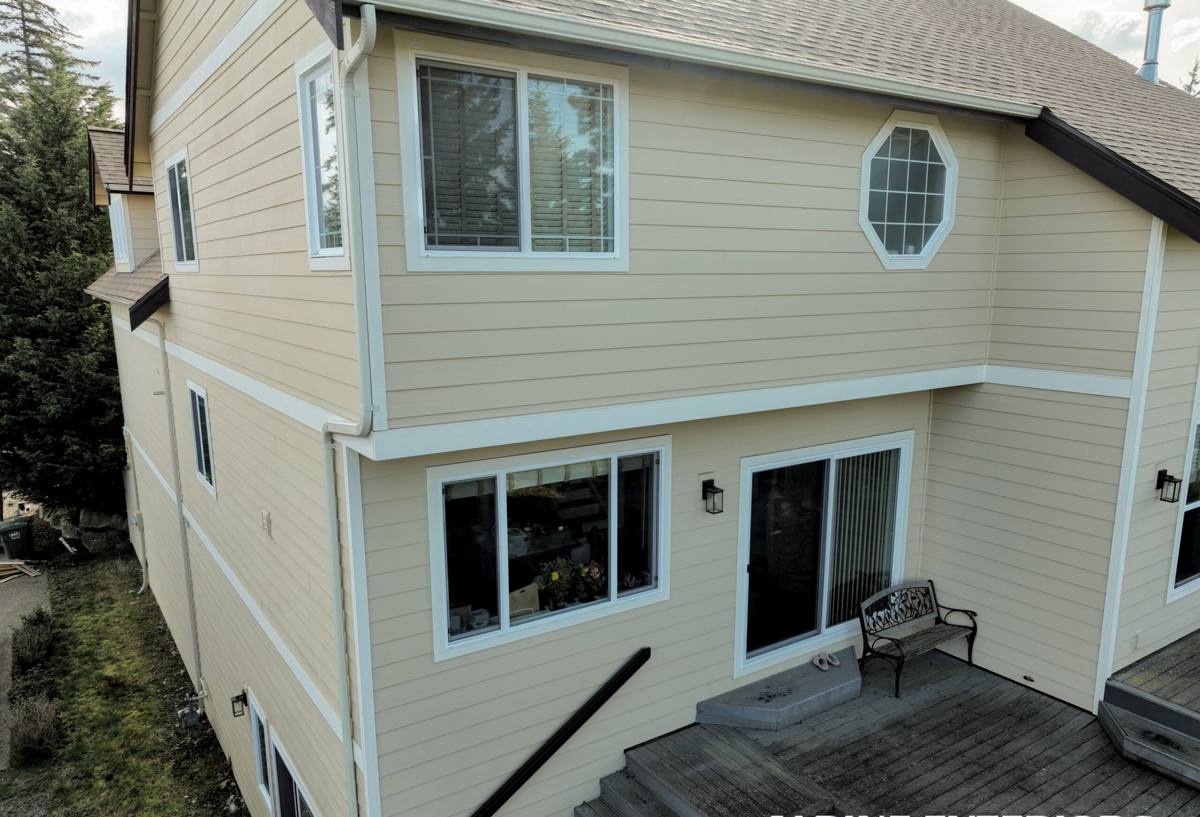
What Vinyl Siding Actually Is
Vinyl siding is extruded PVC (polyvinyl chloride) formed into panels that interlock and hang from a nailing strip along the top edge. It's not fastened rigidly to the wall the way fiber cement or wood is — it's designed to hang loose and slide slightly with temperature changes. That's not a manufacturing flaw; it's how the product is engineered to work. But it also explains most of the long-term issues we see on older vinyl-clad homes in this area.
What It Gets Right
To be fair to the product: modern vinyl siding doesn't rot, it doesn't need painting, and premium lines have gotten noticeably better at resisting fading and impact damage than the vinyl from twenty years ago. For a budget-conscious rental property or a quick flip in a mild climate, it can make sense. We're not here to tell you vinyl siding is garbage — we're here to tell you why we, specifically, don't put it on homes in this specific climate.
Where Vinyl Struggles in a Whatcom County Climate
Moisture Behind the Panels
Vinyl siding is installed as a "rain screen" of sorts — it's not meant to be fully sealed, because it needs to breathe and drain. That works fine in a dry climate where whatever moisture gets behind the panel has plenty of time to dry out between storms. In Sudden Valley, where driving rain off the lake can hit a wall for days at a stretch during the wet season, that drying window shrinks. Moisture that gets behind loose or gapped vinyl panels can sit against the house wrap and sheathing far longer than it would in Eastern Washington or the Southwest, which raises the risk of hidden moisture damage that you won't see until you pull the siding off.
Cold-Weather Cracking and Impact Damage
PVC becomes more brittle as temperatures drop. Whatcom County doesn't get brutally cold most winters, but we do get enough freezing nights, wind-driven debris, and the occasional hailstorm that older or thinner vinyl panels can crack, especially near corners and trim. Once a panel cracks, it's a water entry point, and matching discontinued colors for a repair is often harder than homeowners expect.
Moss, Algae, and the Long Wet Season
This region grows moss on everything — roofs, decks, fences, and yes, siding. Vinyl's textured surface and the shaded, damp conditions common on tree-lined Sudden Valley lots give algae and moss a place to take hold, particularly on north- and west-facing walls that don't get much sun to dry out between rains. It's a cosmetic issue more than a structural one, but it means more pressure-washing and upkeep than most homeowners are told to expect when they're sold on "zero maintenance" vinyl.
Fading and Heat Distortion
Darker vinyl colors absorb more heat and can warp or "oil-can" (a rippled, wavy appearance) in direct summer sun, which limits how dark a color you can safely choose. Over years of UV exposure — even under our cloudier Pacific Northwest sun — color fades unevenly, and because the color is baked through a plastic panel rather than a factory finish designed for UV stability, faded vinyl generally can't be touched up or repainted without extra prep work most homeowners don't plan for.
Installation Sensitivity Most Homeowners Never Hear About
Vinyl siding looks simple to install, and that's part of the problem. Because panels are designed to float and expand, correct installation depends on nailing them loosely enough to allow movement, keeping consistent gaps at butt joints, and flashing penetrations properly. Crews under pressure to move fast — which is common with a low-cost product — often nail panels too tight, skip expansion gaps, or rush flashing details around windows and doors. The result is buckling, waviness, and water intrusion that shows up years later, long after the installer is gone. We see this pattern often enough on remodel and repair calls that it's a major reason we chose not to offer the product at all rather than gamble on installation quality every time.
Vinyl vs. James Hardie Fiber Cement: A Side-by-Side Look
| Factor | Vinyl Siding | James Hardie Fiber Cement |
|---|---|---|
| Core material | PVC plastic | Cement, sand, and cellulose fiber |
| Combustibility | Melts/burns under heat | Non-combustible |
| Cold/impact resistance | Can crack in freezing temps or hail | Rigid, resists cracking and denting |
| Moisture handling | Designed to drain, sensitive to prolonged exposure | Engineered HZ5 formulation for Pacific Northwest moisture |
| Color/finish | Molded-in color, can fade unevenly | Factory-baked ColorPlus finish, more UV-stable |
| Repaintable | Difficult without heavy prep | Yes, straightforward |
| Typical warranty | Varies widely by manufacturer/thickness | Strong transferable warranty backing the product |
| Upfront cost | Lower | Higher |
Why We Install James Hardie Fiber Cement Instead
We standardized on James Hardie because it addresses the exact weak points we see vinyl struggle with in this climate. It's non-combustible, which matters more each year as wildfire smoke and dry-season fire risk become a bigger part of Pacific Northwest summers even in a generally wet region like ours. It's rigid enough to resist the impact and cold-cracking issues that show up on vinyl-clad homes near the lake. And Hardie's HZ5 product line is specifically formulated for climates with higher moisture exposure — which describes Sudden Valley about as well as anywhere in the state.
The Factory Finish Difference
Hardie's ColorPlus finish is baked on at the factory under controlled conditions, rather than mixed into a plastic extrusion or field-painted after installation. That gives more consistent color, better fade resistance over time, and — unlike vinyl — the option to repaint down the road if you ever want to change the look of the house without replacing the siding.
Built for the Long Haul
Fiber cement is heavier and denser, which means it holds paint and caulk better at trim and joint lines, resists moss and algae staining better than textured vinyl, and doesn't warp or oil-can in summer sun. It costs more upfront than vinyl, and we won't pretend otherwise — but for a home that's going to sit through decades of Whatcom County winters, we think that cost difference is the honest trade-off, not a hidden one.
What This Actually Costs Over Time
We won't quote you exact numbers here because every home, elevation, and trim package is different — but it's worth understanding the cost factors that matter more than the sticker price on day one.
- Installation labor: Vinyl installs faster, which is part of why it's cheaper; fiber cement requires more precise cutting, fastening, and caulking.
- Repair and matching: Discontinued vinyl colors can be difficult to match years later; Hardie's factory-finish colors are more consistently available.
- Maintenance labor: Moss and algae washing, and periodic caulk/trim upkeep, apply to both products but tend to show up more visibly on shaded vinyl walls.
- Resale and appraisal: Fiber cement is often viewed favorably by appraisers and buyers familiar with the product's durability reputation in wet climates.
- Warranty structure: Compare what's actually covered — some vinyl warranties prorate or exclude fading and impact damage after a set number of years.
A Practical Checklist Before You Choose a Siding Contractor
Whether you go with us or another contractor, and whichever product you choose, these are the questions worth asking before you sign anything:
- Ask exactly which siding brand and product line they install — and whether it's their only option or one of several.
- Ask how they handle expansion gaps, flashing, and nailing for the specific product being installed.
- Ask to see the manufacturer's written installation instructions and whether the crew follows them to the letter (this affects warranty validity).
- Ask what the warranty actually covers — labor, materials, fading, cracking — and for how long.
- Ask how the product has performed on other homes in Whatcom County specifically, not just in general marketing materials.
- Get the scope, product, and price in writing before work begins.
Our Bottom Line
We're not going to tell you vinyl siding is a scam or that every vinyl-clad home in Sudden Valley is falling apart — that wouldn't be true, and it's not how we talk about this business. What we will tell you is that after years of working on homes around Lake Whatcom and throughout the county, we've made a deliberate choice to install only James Hardie fiber cement because it holds up better against the specific combination of salt air, driving rain, and moss season that defines this climate. That's a professional standard we're comfortable standing behind, not a sales pitch.
If you're weighing vinyl against fiber cement for your own home, we're happy to walk through your specific situation — sun exposure, tree cover, wall orientation, and budget — and give you a straight answer, not a script. Reach out for a free, no-pressure estimate and we'll tell you exactly what we'd do if it were our own house.