 Sudden Valley Exterior
 Why Deck Repair Looks Different in South Hill
A deck in South Hill doesn't fail the way a deck in a dry climate fails. It isn't sun-baked lumber cracking apart from UV exposure — it's moisture that never fully leaves the wood between one rain event and the next. Salt air off the water, driving rain that gets pushed sideways into ledger boards and rail posts, and a moss season that can run half the year all work on a deck the same way they work on siding and roofing: slowly, from the inside of joints and connections outward, until a problem that started as a small soft spot becomes a structural one.
That's the frame we bring to every repair call. A deck that looks fine from the yard can still have a rotted ledger connection, a rusted joist hanger, or a post base sitting in standing water underneath the decking. Repair work here isn't just about replacing a few boards — it's about understanding which parts of a Pacific Northwest deck take the abuse first and checking those parts specifically, not just the parts a homeowner can see from a lawn chair.
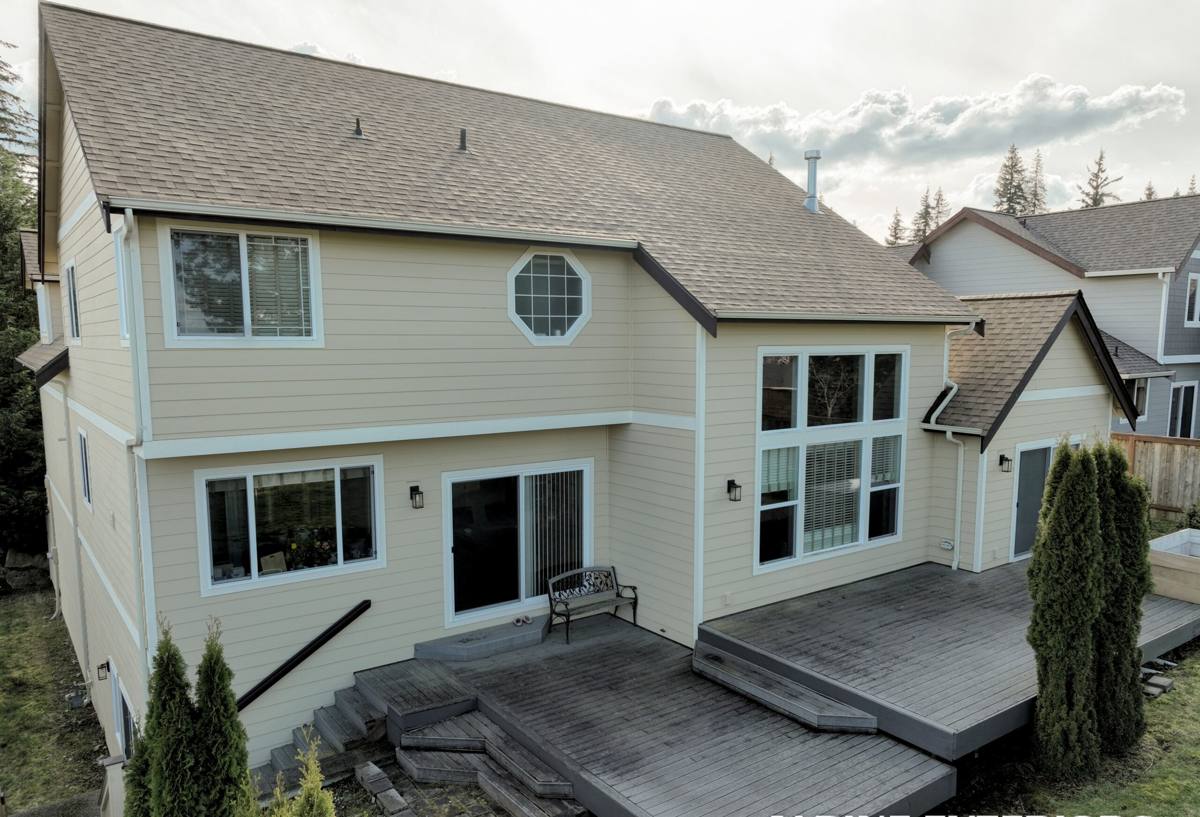
The Repair Problems We See Most in This Climate
Ledger Board and Framing Rot
The ledger board — where the deck attaches to the house — is the single most common failure point we find, and it's almost never visible until you pull decking or trim back. Driving rain gets behind flashing that was installed too thin, missing, or improperly lapped, and the wood behind it stays wet long after a storm passes. Once that happens, the connection holding the deck to the house is compromised, which is a safety issue, not a cosmetic one.
Fastener and Hardware Corrosion
Metal connectors — joist hangers, post bases, structural screws — take a beating from damp air and, closer to the water, salt exposure. Cheaper or mismatched hardware corrodes years before the wood around it fails, and once a hanger or bracket rusts through, it stops doing its job even though the framing next to it might still look sound. We check hardware condition as its own item, separate from the wood.
Moss, Algae, and Surface Decay
Horizontal deck boards, especially in shaded spots or under overhangs, hold moisture longer than vertical siding ever will. That's what makes moss and algae take hold so readily on decking through the wetter months — and it's not just a slip hazard. A board carrying a mat of moss stays saturated underneath it, which accelerates rot in that specific board long before its neighbors show the same wear.
Repair or Replace? How We Make That Call
Not every deck problem calls for a full rebuild, and not every "repair" is actually worth doing instead of a partial replacement. We look at the framing separately from the decking surface, because they age differently and fail for different reasons.
| Sign | Usually a Repair | Usually a Replacement |
|---|---|---|
| A handful of soft or cupped boards | Yes — spot-replace affected boards | No, unless most of the deck matches |
| Soft or spongy wood at the ledger board | Sometimes, if isolated and framing tests sound | Often — this is a structural connection |
| Rusted or bent joist hangers | Yes — hardware swap is a contained job | No, unless framing wood is also compromised |
| Railing posts loose or rotted at the base | Sometimes, if the post pocket itself is sound | Often, if water has been sitting at the base for years |
| Widespread board cupping and graying across the whole deck | No — patching won't match or last | Yes — the whole surface is at the same age and exposure |
| Deck flexes or bounces underfoot | Rarely | Yes — this points to a framing problem, not a surface one |
The honest answer, most of the time, is that framing and connections get repaired or reinforced, while decking boards that are past their service life get replaced as a group so the surface ages evenly going forward. Mixing a few new boards into an old, weathered deck almost never looks or performs the way homeowners hope.
A Practical Self-Check Before You Call Anyone
- Press a screwdriver into the wood at the ledger board and any post bases — if it sinks in easily, that wood is compromised
- Look underneath the deck (or ask whoever inspects it to) for rust streaks below joist hangers
- Check whether the deck bounces noticeably when a few people stand and shift weight together
- Note where moss or standing water collects after a rain — those spots age faster than the rest
- Look for daylight gaps or separation where the ledger meets the house
- Check railing posts for any side-to-side movement at the base, not just at hand height
What a Correct Repair Actually Involves
A repair that's done right starts with pulling enough decking or trim to actually see the framing — not just patching what's visible from above. That means:
- Framing inspection — checking the ledger connection, joists, beams, and post bases for rot, not just the boards on top
- Flashing correction — if the ledger board is wet, the flashing behind it is almost always the reason, and replacing rotted wood without fixing the flashing just restarts the same failure
- Hardware assessment — every hanger, bracket, and structural fastener gets checked, since corroded hardware is a common hidden cause of a "soft" deck
- Targeted wood replacement — cutting out and sistering or replacing only the framing members that actually failed, not the whole structure by default
- Surface work — replacing decking boards, addressing moss and staining, and resetting or replacing railing components as needed
Skipping the framing step and only replacing surface boards is the single most common shortcut we see on decks that come back with the same complaint a couple of years later. The boards looked new, but the wet flashing or rusted hanger underneath them never got addressed.
Materials That Actually Hold Up Here
What we use for a repair depends on what's already there and what the framing needs, but the trade-offs are worth understanding before you agree to a scope of work.
| Material | Where It Fits a Repair | What to Know |
|---|---|---|
| Pressure-treated framing lumber | Joists, beams, ledger, post replacement | Standard for structural repair; rated for ground or moisture contact where relevant |
| Stainless or hot-dip galvanized hardware | All connectors and structural fasteners | Costs more than mismatched or coated hardware but is what actually resists corrosion in a wet climate long-term |
| Wood decking (cedar or treated) | Matching an existing wood deck | Needs regular cleaning and refinishing to keep moss and graying in check |
| Composite decking | Full or partial surface replacement | Lower surface maintenance, but still needs correct ventilation underneath — moisture problems move to the framing if that's ignored |
| Self-adhered flashing membrane | Ledger board connection | The detail most often missing or done poorly on decks that develop ledger rot in the first place |
We're not going to tell a homeowner composite is automatically "better" than wood, or the reverse — that's a maintenance-versus-upfront-cost decision that depends on the deck and the budget. What we won't do is replace decking without also correcting the flashing and hardware underneath it, because that's the part that actually determines whether the repair lasts.
Our Process, Start to Finish
We keep this straightforward:
- On-site inspection — we look at the framing, not just the walking surface, before we quote anything
- Written scope — what's being repaired, what's being replaced, and why, in plain terms
- The repair itself — framing and flashing work first, then hardware, then surface
- Walkthrough — we show you what we found and what we did before we call it finished
We don't upsell a full rebuild when a targeted repair will genuinely hold. We also won't hand back a deck with fresh boards over a framing problem we found and didn't fix — if we see something that needs attention beyond the original scope, we tell you before we proceed, not after the invoice.
Keeping a Repaired Deck Healthy
A good repair buys you years, but a little seasonal attention buys you more. This isn't a sales pitch for a maintenance plan — it's the short list that actually matters in this climate:
- Sweep leaves and debris off the deck surface before the wet season sets in — trapped debris is where moss and rot start
- Rinse or lightly scrub moss and algae off boards and railings once or twice a year, before it builds up a mat
- Check the ledger board area visually each fall for any staining or soft spots
- Keep gutters and downspouts near the deck clear so runoff isn't dumping extra water onto or under it
- Reseal or refinish wood decking on the manufacturer's recommended cycle, not just when it looks bad
- Confirm railing posts are still solid at the base once a year, especially after a hard winter
Why Local Experience Matters for South Hill Homes
A deck repair crew that only works occasionally in Whatcom County will treat every deck the same way they'd treat one in a drier region — fix what's visibly broken and move on. A crew that works this area regularly knows to expect ledger rot behind flashing that looks fine from the yard, knows which hardware actually resists the salt air and driving rain here versus what's rated for a milder climate on the label, and knows how fast moss reclaims a surface that wasn't cleaned before the wet months. That local pattern recognition is the difference between a repair that gets the visible problem and one that gets the actual cause.
It also means we're not guessing at how a South Hill deck ages between now and next winter — we've already seen what this climate does to decks like yours, and we scope the repair around that, not around a generic checklist.
If you've got a deck in South Hill that's showing soft spots, rust stains, moss buildup, or just doesn't feel as solid as it used to, we're happy to take a look. The estimate is free, there's no pressure attached to it, and you'll get a straight answer about what actually needs to happen — use the form below to get started.