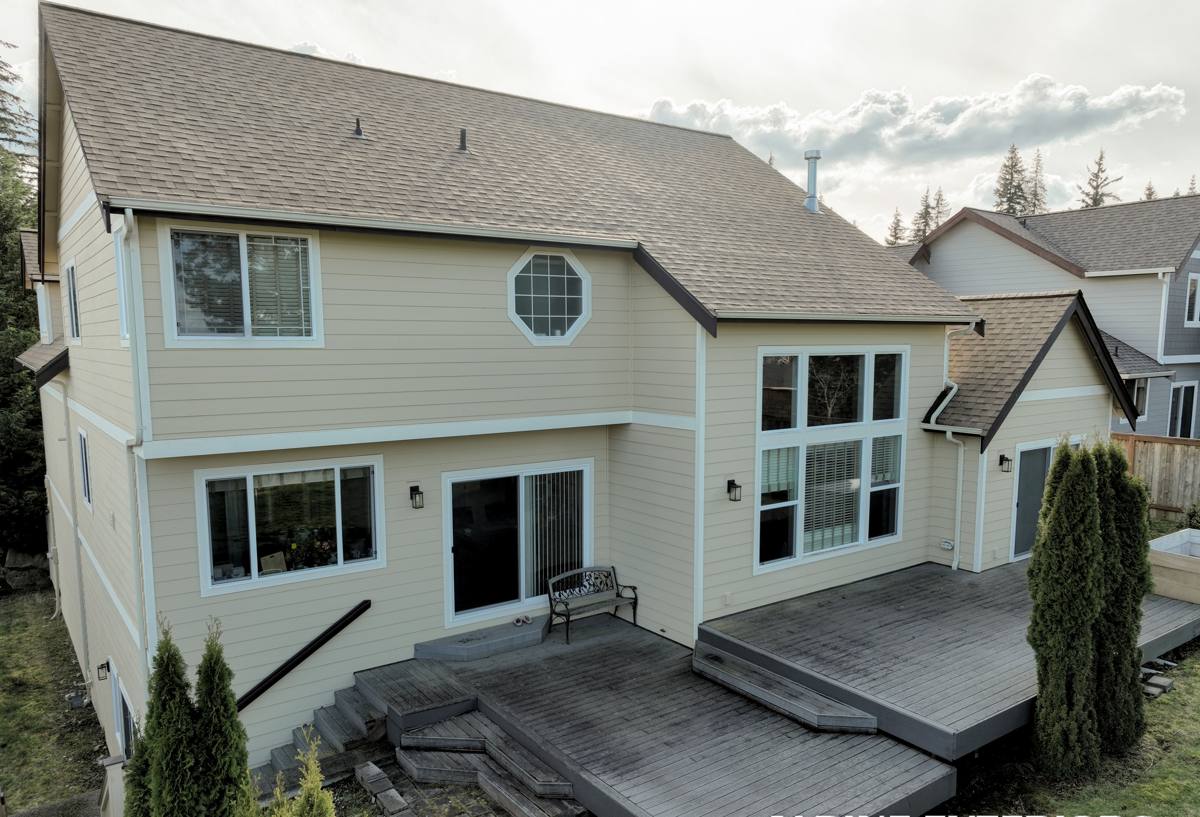
 Sudden Valley Exterior
 Why Silver Beach Decks Take More Punishment Than the Catalog Photos Suggest
Composite decking is marketed as a low-maintenance, install-it-and-forget-it product, and in the right conditions that's mostly true. Silver Beach isn't quite the "right conditions" test case the manufacturers use in their brochures. Homes here sit close to water, catch a steady flow of moist marine air, and go through long stretches of the year where surfaces barely get a chance to dry between rain events. That combination changes what "correct installation" actually means, and it changes what a deck needs from its owner after the crew leaves.
Three things drive almost every deck problem we see in this part of Whatcom County: salt-laden air accelerating corrosion on fasteners and hardware, driving rain that gets pushed sideways into gaps and seams that would stay dry in a calmer climate, and a moss and algae season that can run eight months or more on any surface that doesn't get direct sun and airflow. None of these are exotic problems. They're just persistent, and persistence is what wears decks out early.
What a Correct Composite Decking Job Actually Involves
The composite boards themselves get most of the attention, but boards are the last thing installed and the least likely part of a deck to fail on their own. Almost every early deck failure we get called out to inspect traces back to something underneath or behind the boards, not the boards themselves.
The Substructure
Pressure-treated joists and beams need to be rated for ground contact where applicable, spaced to the composite manufacturer's specification (composite typically needs tighter joist spacing than wood, especially on angled or diagonal patterns), and fully protected with joist tape over the top edge. Skipping joist tape is one of the most common shortcuts we see on older decks, and it's the single biggest reason joists rot from the inside out while the decking on top still looks fine.
Ledger Attachment and Flashing
Where a deck attaches to the house, the ledger board and its flashing are doing the real waterproofing work. In a climate with this much sustained rainfall, a poorly flashed ledger is a slow leak into the rim joist and, eventually, the framing behind the siding. This is the detail we spend the most time getting right, because it's the one that causes structural damage to the house itself, not just the deck.
Fasteners and Hardware
Salt air corrodes standard-grade fasteners faster than most homeowners expect. We use stainless steel or coated hardware rated for coastal exposure on structural connections, not just the visible screws. Corroded hidden hardware is invisible until it fails, which is exactly why it matters more than the fasteners you can see.
Drainage and Airflow Underneath
Moss and mildew grow where moisture sits and air doesn't move. A deck built tight to grade, with no slope and no ventilation underneath, stays damp for days after a storm. Proper elevation, a slight drainage slope, and skirting that still allows airflow keep the underside of the deck drying out instead of incubating growth.
Choosing the Right Composite Board for This Environment
Not all composite decking behaves the same way in wet, low-sun conditions. Capped composite (a wood-plastic core with a protective polymer shell) is what we recommend for most Silver Beach installs because the cap resists moisture absorption and staining far better than uncapped composite or traditional wood. Within capped composite, board texture matters more here than in drier climates — a deep wood-grain embossed surface holds algae and moisture in its texture longer than a lower-profile, tighter-grain finish.
| Decking Option | Moisture Behavior | Moss/Algae Resistance | Maintenance Burden |
|---|---|---|---|
| Capped Composite | Very low absorption, dimensionally stable | Good, especially smoother-textured boards | Periodic washing, no staining or sealing |
| Uncapped Composite | Absorbs moisture over time, can swell at cut edges | Moderate, more prone to surface staining | Occasional cleaning, more sensitive to cut-edge sealing |
| Pressure-Treated Wood | Absorbs and releases moisture constantly | Poor without regular treatment | Annual staining/sealing to perform well |
| PVC/Cellular PVC | Essentially zero absorption | Good, but surface can stay slick when wet | Low, but higher material cost |
We don't push one brand over another as a blanket rule — board selection should match the deck's sun exposure, slope, and how the homeowner actually plans to maintain it. What we won't do is install uncapped composite or untreated wood in a heavily shaded, low-airflow spot and call it a low-maintenance solution, because in that specific setup it isn't one.
How Our Process Works
1. On-Site Assessment
We look at sun exposure, prevailing wind and rain direction, existing drainage, and how close the deck sits to grade or water. This tells us which board type and substructure details actually matter for that specific spot, not just what's popular.
2. Structural Check
If we're replacing an existing deck, we check ledger attachment, footings, and framing condition before quoting anything. Rebuilding on top of a compromised substructure just moves the same failure a few years down the road.
3. Installation
Joist tape, coastal-rated fasteners, proper hidden-fastener spacing for the board profile, and flashing details get done in that order, before a single visible board goes down. This is the part of the job that doesn't show up in photos but determines whether the deck is still solid in ten years.
4. Walkthrough and Care Guidance
We go over cleaning schedule, what to watch for near shaded or low-airflow sections, and how to handle the first year of settling and weathering before we consider the job done.
Living With a Composite Deck in a Moss-Prone, Salt-Air Climate
Composite decking is genuinely lower-maintenance than wood, but "lower maintenance" isn't "no maintenance" here. A little seasonal attention prevents almost every problem we get called back for.
- Sweep debris off the deck regularly, especially fir needles and leaf litter that trap moisture against the board surface
- Wash the deck with a soft-bristle brush and mild soap and water at least twice a year, more often in shaded areas
- Avoid pressure washing at close range or high PSI, which can etch composite surfaces and force water into seams
- Check and clear gaps between boards and along the perimeter so water and debris don't build up
- Keep planters, mats, and furniture feet from sitting in one spot too long without moving them, since trapped moisture underneath is a common cause of localized staining
- Inspect railing posts and stair stringers annually, since these connection points see more stress and more water exposure than the field of the deck
Problems We Commonly Fix on Existing Silver Beach Decks
Most of our repair calls fall into a handful of repeat issues: rotted ledger connections from missing or failed flashing, corroded fasteners that let railings or stair treads work loose, joists that failed from the inside because they were never taped, and boards installed too tight to the house or too close to grade with nowhere for water to go. None of these are complicated to prevent during a new install. They're just easy to skip, and they're expensive to fix once they've been ignored for a few seasons.
Why Hire a Crew That Already Works This Area
A contractor who mainly builds decks in drier inland conditions will often use standard fastener grades, standard joist spacing, and standard drainage details, because that's what works where they usually build. None of those defaults are wrong in general — they're just not matched to a lakeside, marine-influenced Whatcom County property that deals with driving rain and a long wet season most of the year. Crews who work Silver Beach regularly build in the corrosion-resistant hardware, the drainage slope, and the airflow underneath as standard practice, not as an upgrade. That's the difference between a deck that needs real attention again in five years and one that just needs an occasional wash.
What Drives the Cost of a Composite Deck Here
| Cost Factor | Why It Matters in This Climate |
|---|---|
| Board grade (capped vs. uncapped, PVC) | Higher-grade capped boards resist moisture and staining longer, reducing long-term maintenance cost |
| Substructure condition | Rot or corrosion in existing framing adds repair cost before new decking can go down |
| Fastener and hardware grade | Coastal-rated stainless hardware costs more up front but avoids early corrosion failures |
| Site accessibility and elevation | Sloped lakeside lots and elevated decks require more structural work and site prep |
| Railing and stair complexity | Custom railing runs and multiple stair sections add labor and material beyond a simple rectangular deck |
We give honest, project-specific numbers after seeing the site — broad national average ranges for composite decking exist, but they don't account for substructure repairs, elevation, or hardware grade, all of which move the real number for a Silver Beach property.
Let's Look at Your Deck
If you're planning a new composite deck or trying to figure out why an existing one is showing early wear, we're happy to take a look and give you a straight assessment — what's actually going on, what it would take to fix or build it right for this climate, and a clear estimate with no pressure to sign anything on the spot. Use the form below to request a free estimate.