 Sudden Valley Exterior
 Ferndale's Roof Climate: Salt Air, Driving Rain, and a Long Moss Season
Ferndale sits close enough to the water and to Whatcom County's marine weather patterns that roofs here take a different kind of beating than roofs fifty miles inland. It isn't one big storm that does the damage — it's the steady combination of salt-laden air off the Strait, wind-driven rain that finds its way sideways under poorly lapped shingles, and a wet season that runs long enough for moss and algae to get a real foothold on north-facing slopes and shaded valleys.
None of that means asphalt shingles are the wrong choice for Ferndale. They're still the most practical, cost-effective roofing material for most homes here. It means the installation has to account for these conditions from the first course of underlayment to the last ridge cap, not just rely on the shingle itself to do all the work.
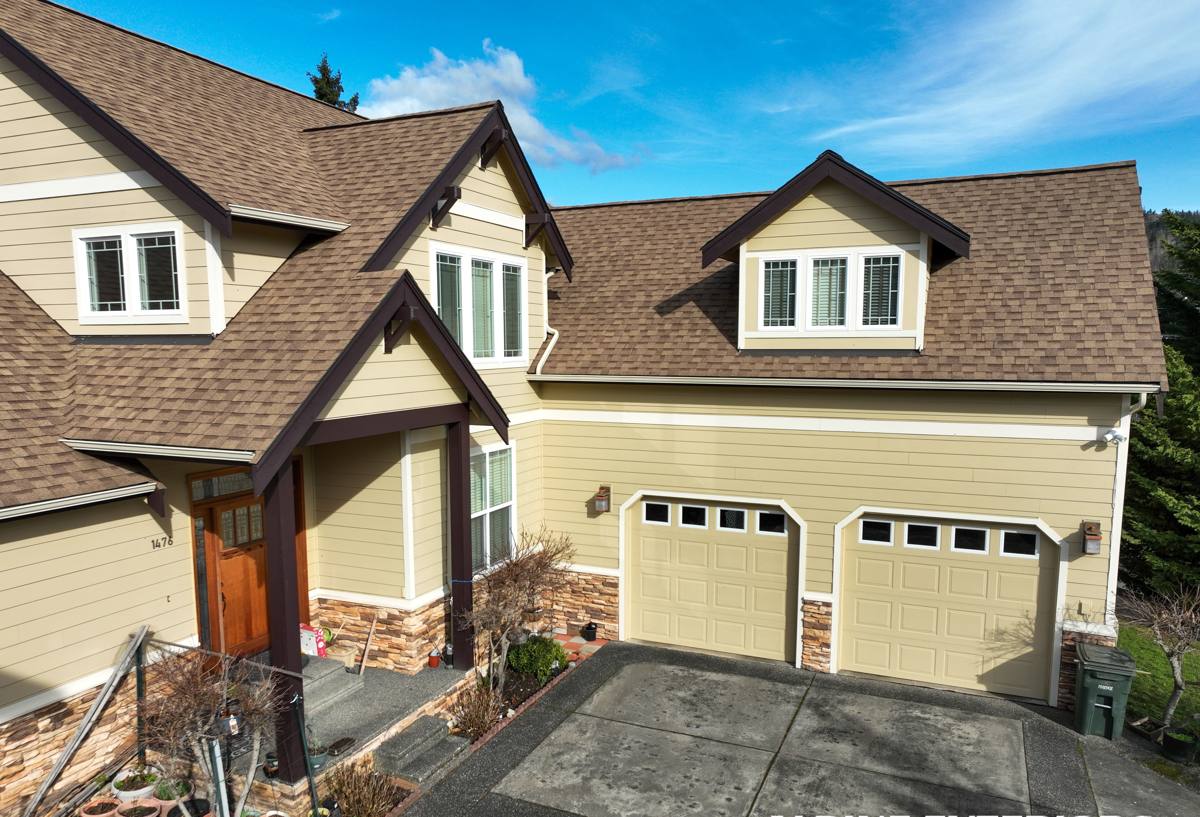
What Ferndale Homes Actually Need From an Asphalt Shingle Roof
We look at four things on every Ferndale roof before we ever talk shingle color or brand:
- Wind-driven rain resistance — proper shingle overlap, sealant strip activation, and fastening that holds up when rain is coming in at an angle, not just straight down.
- Algae and moss resistance — especially on north-facing roof planes and anything shaded by trees, which describes a lot of lots in this part of the county.
- Salt air tolerance — corrosion-resistant flashing, fasteners, and vents so metal components don't fail years before the shingles do.
- Ventilation that actually balances — intake and exhaust that moves moist attic air out before it condenses under the deck and feeds moss and rot from underneath.
A roof that's missing any one of these can look fine for a year or two and still be failing underneath. That gap between "looks fine" and "is fine" is where most of the expensive surprises come from.
What a Correct Installation Involves
Underlayment and Moisture Barrier
In a climate this wet, synthetic underlayment or a felt-and-ice-and-water-shield combination isn't optional upgrade talk — it's the baseline. Ice-and-water shield belongs at eaves, in valleys, and around every penetration, because those are the spots where wind-driven rain and ponding find a way in first. Skipping this step to save money is one of the most common shortcuts we see when we tear off an older Ferndale roof, and it's usually the reason for the water stains that sent the homeowner looking for a new roof in the first place.
Flashing Details
Chimneys, skylights, sidewall transitions, and roof-to-wall junctions are where roofs actually leak — the open field of shingles rarely fails on its own. We use corrosion-resistant step flashing and counterflashing, sized and lapped correctly, rather than relying on caulk or roof cement to bridge a gap that should have been flashed properly in the first place. Caulk is a maintenance item, not a flashing system.
Ventilation
A shingle roof needs to breathe. Balanced intake at the eaves and exhaust at the ridge keeps the attic close to outside temperature and humidity, which does two things: it protects the shingles from baking and curling prematurely, and it keeps moisture from condensing on the underside of the deck — moisture that otherwise feeds rot and gives moss a head start from below as well as above.
Fastening
Every shingle gets the manufacturer-specified nail count and placement, hand-checked, not just run through by whoever's fastest with the gun. Under-nailed shingles are one of the most common causes of wind damage claims, and it's an invisible defect until the wind actually tests it.
Shingle Options for Ferndale Conditions
Most homeowners are choosing between a few tiers of asphalt shingle. Here's how they actually compare for a coastal Whatcom County property, not just on a spec sheet:
| Shingle Type | Wind Rating | Algae Resistance | Best Fit |
|---|---|---|---|
| 3-tab asphalt | Lower | Standard, fades over time | Budget-conscious rentals or short-hold properties |
| Architectural (laminated) | Higher | Copper- or ceramic-granule algae resistance available | Most primary residences in this area |
| Impact-rated architectural | Higher, plus impact class | Same algae-resistant options | Homes wanting longer service life and hail/debris resilience |
We steer most Ferndale customers toward an architectural shingle with algae-resistant granules built in. The upcharge over 3-tab is modest, and given how long moss season runs here, it pays for itself in fewer years before you're dealing with staining and treatment.
Cost Factors on a Ferndale Roof
| Factor | Why It Moves the Price |
|---|---|
| Roof pitch and access | Steeper roofs and limited staging area take longer and need more safety setup |
| Layers to remove | Tear-off of an existing layer (or two) adds labor and disposal cost |
| Deck condition | Soft or rotted sheathing found at tear-off needs replacement before shingles go down |
| Valleys, penetrations, and flashing | More chimneys, skylights, and valleys mean more flashing work and material |
| Shingle tier chosen | 3-tab, architectural, and impact-rated products carry different material costs |
We won't quote a number over the phone with no eyes on the roof — pitch, layers, and deck condition change the job too much. What we will do is give you a written estimate that breaks these factors out so you can see exactly what you're paying for.
How We Work
Inspection and Estimate
We walk the roof, check the attic side for ventilation and moisture signs, and look closely at valleys, flashing, and any north-facing or shaded slopes where moss tends to establish first. You get a written estimate, not a verbal ballpark.
Tear-Off and Deck Check
We remove the old roofing down to the deck (rather than layering over it), which is the only way to actually see the sheathing condition and catch soft spots before they become a warranty argument later. Any damaged decking gets replaced and priced separately, with photos, before we cover it up.
Installation
Ice-and-water shield at eaves and valleys, synthetic underlayment across the field, corrosion-resistant flashing at every penetration and wall transition, then shingles fastened to spec. Ridge and intake ventilation gets balanced as part of the install, not treated as an afterthought.
Cleanup and Walkthrough
Magnetic sweep for nails, tarp-and-haul debris removal, and a walkthrough where we point out what we did and answer questions before we consider the job finished.
Living With a Shingle Roof in a Moss and Salt Air Climate
Even a correctly installed roof needs a little seasonal attention here. This isn't about creating work — it's about catching small things before they become tear-off-sized problems.
- Have moss growth removed gently (not pressure-washed) before it lifts shingle edges or holds moisture against the deck.
- Keep gutters clear so water isn't backing up under the shingle edge during heavy rain.
- Trim back tree branches that shade north-facing slopes and keep them damp longer than the rest of the roof.
- Have flashing and sealant points checked every few years, especially around chimneys and skylights — these are the first places small leaks start.
- After any significant windstorm, do a visual check (or have us do one) for lifted or missing shingles before the next rain finds the gap.
Why a Crew That Already Works Ferndale Matters
Roofing crews that work all over Western Washington aren't wrong, but a crew that's regularly on roofs in Ferndale and the surrounding Sudden Valley and greater Whatcom County area has already seen how the local weather actually behaves on real houses — which slopes moss up first, which older neighborhoods tend to have deck issues under the shingles, and how local permitting and inspection expectations run. That local pattern recognition shows up in fewer surprises during tear-off and a faster, better-informed estimate up front.
It also matters after the job is done. A local crew is the one who answers the phone in year three if something needs a look, not a company that was in the area for one season and moved on.
Signs Your Ferndale Roof Needs a Closer Look
- Granules collecting in gutters or at downspout outlets
- Shingles that look cupped, curled, or are visibly missing after a windstorm
- Dark streaking or thick moss growth on north-facing slopes
- Daylight or water stains visible in the attic near valleys or penetrations
- A roof approaching or past 20 years old with no major work done
Any one of these on its own isn't necessarily an emergency, but it's worth having a professional take a look rather than waiting for a leak to tell you.
If you're in Ferndale and want a straight answer about what your roof actually needs — repair, partial replacement, or a full tear-off — we're happy to take a look. Request a free, no-pressure estimate using the form below.