 Sudden Valley Exterior
 Why Lake Whatcom's Climate Is Hard on Exterior Siding
Homes around Lake Whatcom sit in a pocket of Whatcom County weather that's tougher on exteriors than most homeowners realize. The lake itself keeps humidity elevated for much of the year, prevailing weather off the Pacific brings long stretches of driving rain, and the tree cover that makes this area beautiful also means shade, damp air, and a moss season that can run from fall through spring. Add in the salt-laden air that reaches inland from the Sound on a windy day, and you've got an exterior envelope that's under near-constant moisture pressure with limited drying time between storms.
Siding in this environment isn't failing because homeowners did anything wrong — it's failing because the product or the installation wasn't built for these conditions in the first place. Wood-based siding swells and checks as it cycles wet and dry. Vinyl can't stop moss and algae from taking hold in shaded, damp corners. Caulked seams that work fine in a drier climate open up here, and once water gets behind the cladding, it has nowhere to go and no time to dry before the next rain arrives.
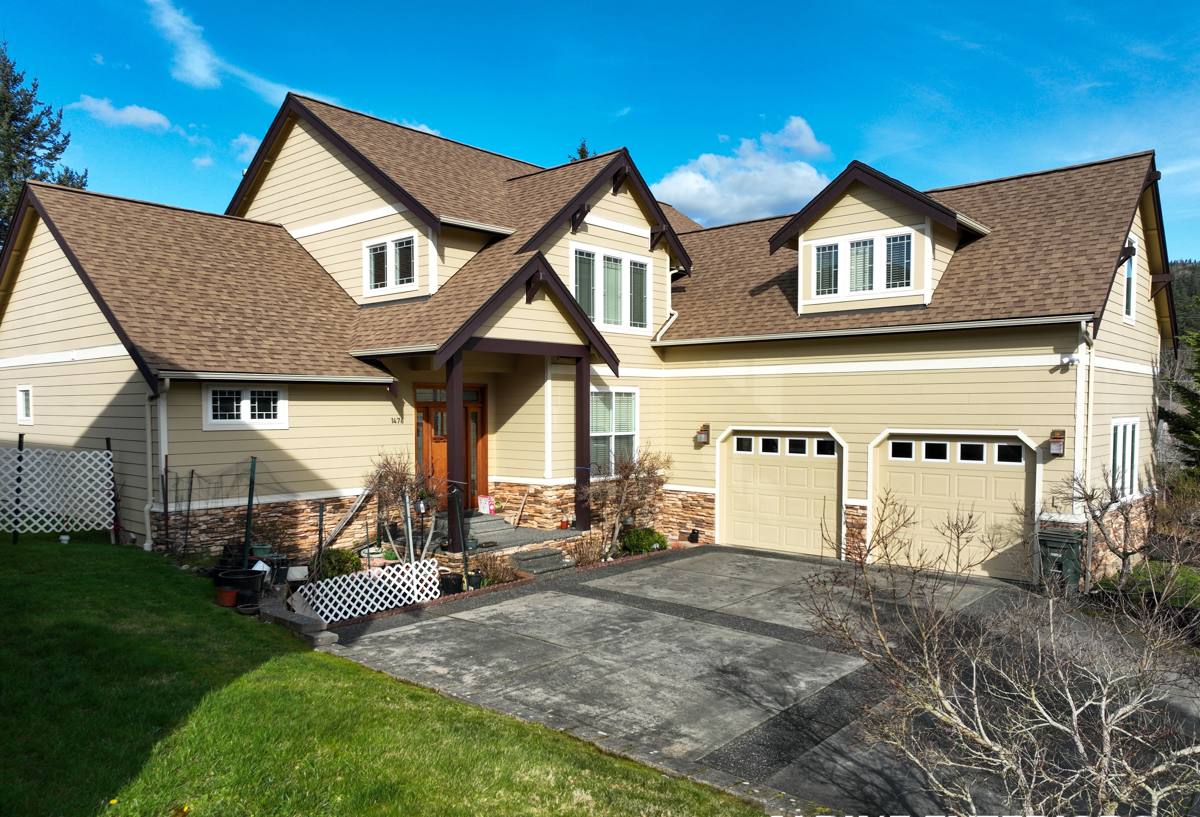
Why We Standardized on James Hardie for This Area
We install James Hardie fiber cement siding exclusively. We don't install LP SmartSide, vinyl, Cemplank, Allura, primed spruce, or cedar. That's not a marketing position — it's a decision we made after years of servicing homes in exactly this climate. Fiber cement is non-combustible, dimensionally stable, and doesn't absorb water the way wood-based products do, which matters enormously in a place where the siding rarely gets a long dry stretch to recover.
James Hardie's HZ5 product line is engineered specifically for climates like ours — freeze-thaw cycling, high moisture exposure, and coastal-influenced air. The factory-applied ColorPlus finish is baked on under controlled conditions rather than field-painted, which means better adhesion and a finish that resists the fading and peeling that field-applied paint struggles with once it's exposed to years of rain and UV. It also comes with a meaningful, transferable warranty — something that matters if you ever sell the home.
We're not going to tell you every other product is worthless. LP SmartSide and cedar both have real strengths in the right application. But for what Lake Whatcom homes go through every year, we'd rather put one product on right than offer five options and hope the wrong one holds up.
What "Climate-Engineered" Actually Means
James Hardie makes region-specific formulations (HZ5 for northern climates, HZ10 for hot-humid regions) that adjust the cement formulation for the freeze-thaw and moisture patterns of the area they're sold into. For Lake Whatcom, that means a board built to hold its shape and resist moisture intrusion through repeated wet winters rather than a one-size-fits-all product.
What a Correct James Hardie Installation Involves
Fiber cement siding is only as good as the installation behind it. A huge share of the siding problems we get called out to inspect trace back to installation shortcuts, not the product itself. On a lake-adjacent, high-moisture property, the details matter more than usual:
- Weather-resistive barrier: a continuous, properly lapped moisture barrier behind the siding, with all penetrations sealed — this is the layer that catches whatever gets past the cladding.
- Rainscreen or drainage gap: a gap between the siding and the wall assembly so any moisture that does get behind the boards can drain and the assembly can dry, rather than staying trapped against the sheathing.
- Correct fastener spacing and type: James Hardie specifies fastener type, spacing, and placement precisely — get this wrong and you get cracking, popped fasteners, or panels that don't perform to warranty.
- Proper flashing at every penetration: windows, doors, deck ledgers, hose bibs, and vents all need flashing detailed to shed water down and out, not into the wall.
- Minimum ground clearance: siding installed too close to grade, decks, or roof lines wicks moisture and stays wet — clearance requirements exist for a reason.
- Caulked joints kept to a minimum: a well-detailed installation relies on flashing and lap geometry to shed water, not on caulk as the primary defense, because caulk is the first thing to fail in a climate like this.
Any one of these done wrong won't necessarily show up in year one. It shows up in year five or six, as staining, soft spots, or paint failure at specific points on the house — usually right where a detail was skipped.
How Our Process Works
1. On-Site Assessment
We walk the exterior with you, looking at drainage patterns, tree cover and shade exposure, moss and algae growth, and the condition of the existing siding, trim, and flashing. On lake-facing and shaded elevations we pay particular attention to how much sun and airflow each wall actually gets, since that drives how much moisture load that side of the house carries.
2. Scope and Product Selection
We spec the right James Hardie profile (lap siding, panel, shingle-style) and HZ5 formulation for the home, factoring in exposure on each elevation. Not every wall needs the same detailing — a shaded north wall near the lake and a sun-exposed south wall don't carry the same moisture risk.
3. Tear-Off and Substrate Check
Old siding comes off and we inspect the sheathing and framing underneath before anything new goes up. This is where hidden moisture damage from years of a failing exterior often surfaces — and it needs to be addressed before new siding goes over it, not after.
4. Barrier, Flashing, and Drainage Detailing
Weather-resistive barrier, flashing at every penetration, and drainage plane installed to spec — the part of the job that isn't visible once the siding goes up but determines how the wall performs for the next 30 years.
5. Installation to Manufacturer Spec
Siding installed with correct fastener pattern, clearances, and joint treatment, following James Hardie's installation requirements exactly — which is also what keeps the manufacturer warranty intact.
6. Final Walkthrough
We walk the finished job with you, elevation by elevation, before we consider it done.
Signs Your Current Siding Is Losing the Fight
| What You See | What It Usually Means |
|---|---|
| Dark streaking or green film, especially on shaded walls | Moss/algae growth from prolonged dampness and limited sun exposure |
| Soft or spongy spots when pressed | Moisture has penetrated the substrate — common with wood-based siding after repeated wet cycles |
| Cracked or peeling paint concentrated near trim and joints | Caulk or paint film has failed at a seam, letting water in behind the finish |
| Visible gaps or warping at board seams | Wood-based product expanding and contracting with moisture cycles |
| Rust streaks below fasteners | Incorrect fastener type or exposed fastener heads corroding in the damp air |
None of these mean the whole house needs replacing immediately, but they're worth having looked at before winter, when moisture exposure is at its worst.
Cost Factors: What Actually Drives the Price
| Factor | Why It Matters |
|---|---|
| Home size and number of elevations | More wall area and more corners/penetrations means more material and more detailing time |
| Condition of existing sheathing | Rot or moisture damage found during tear-off adds repair scope before new siding can go on |
| Siding profile chosen | Lap, panel, and shingle-style profiles carry different material and labor costs |
| Trim and accessory work | Window and door trim, corner boards, and fascia detailing add scope beyond the field siding |
| Access and site conditions | Steep grades, tree-heavy lots, and tight lake-adjacent lots can affect staging and labor time |
We won't quote a job without walking the property first — anyone giving you a firm number over the phone for a full re-side isn't accounting for what's actually on your walls.
Why a Crew That Already Works Lake Whatcom Matters
Siding installation isn't uniform across Whatcom County. A crew used to drier inland conditions can install a technically "correct" James Hardie job and still miss the detailing that this specific environment demands — extra attention to drainage on shaded, tree-covered elevations, ground clearance on sloped lake-adjacent lots, and flashing sized for the volume of rain this area actually sees. A crew that already works this neighborhood has already seen where the moisture problems show up first on local homes, and builds around that from day one rather than learning it on your house.
There's also a practical side: familiarity with local permitting, typical lot conditions around the lake, and the realities of scheduling around this area's wet season all make the job smoother and reduce surprises mid-project.
Questions Worth Asking Any Siding Contractor
- Are you a James Hardie certified or preferred installer, and can you explain why?
- What drainage plane and weather barrier will you use behind the siding?
- How do you handle flashing at windows, doors, and deck penetrations?
- What happens if you find rot or moisture damage in the sheathing during tear-off?
- Is the manufacturer warranty transferable if I sell the home?
- Can you show me the specific James Hardie profile and HZ formulation you're recommending, and why?
A contractor who can answer these clearly, without vague reassurances, is worth trusting with a job that's supposed to last decades.
Get a Straight Answer About Your Siding
If your Lake Whatcom home's siding is showing streaking, soft spots, or paint failure, or you're just planning ahead before the wet season sets in, we're happy to take a look and give you an honest read on what's going on and what it would take to fix it right. Request a free, no-pressure estimate using the form below.