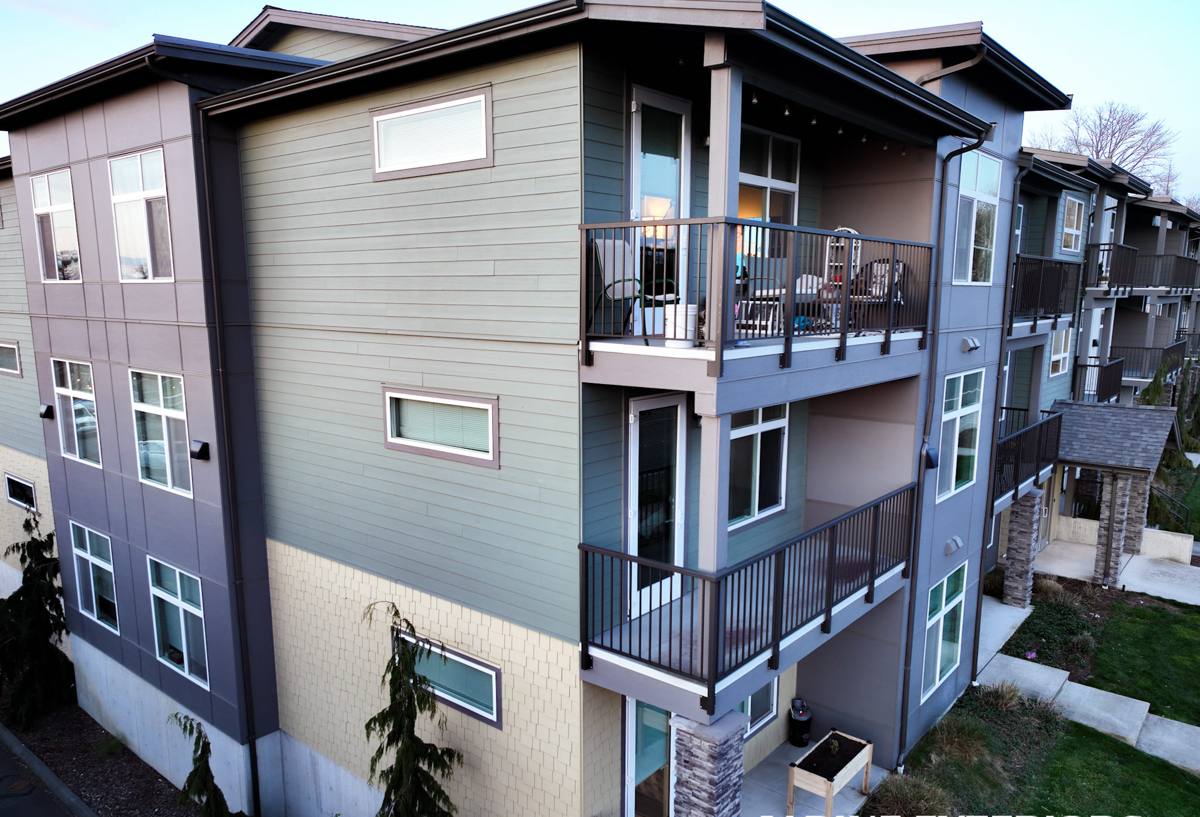
 Sudden Valley Exterior
 Why Sunnyland Homes Need Windows Built for This Climate
Sunnyland sits close enough to Bellingham Bay and Lake Whatcom that homes here deal with a specific combination of weather stress most window salespeople never mention: salt-tinged air moving in off the water, wind-driven rain that hits windows sideways instead of straight down, and a moss season that runs long enough to feel like it never really ends. None of these are dramatic on their own, but together they wear on window hardware, seals, and frames faster than in a drier inland climate.
Salt air is corrosive to exposed metal — hinges, locks, balance mechanisms — and it accelerates the breakdown of cheap weatherstripping. Driving rain finds any gap in flashing or caulking and pushes water sideways and even slightly upward into a wall cavity, which is why leaks so often show up nowhere near where the actual failure point is. And moss and algae, once established on a north-facing wall or a shaded frame, hold moisture against wood and vinyl surfaces for weeks at a time, which shortens the life of sealants and finishes. A window that's rated fine for a dry climate can still underperform here if it wasn't installed with these specific conditions in mind.
What "Energy-Efficient" Actually Means for This Area
Energy efficiency isn't one number — it's a combination of glass performance, frame construction, and how well the unit is sealed into the wall. For Whatcom County's marine climate, we're balancing two things: keeping heat inside during the long wet, overcast months, and controlling condensation, which is a bigger problem here than in drier regions because of the sustained humidity.
The ratings that actually matter
- U-Factor — measures how well the window resists heat loss. Lower is better. This is the number that matters most for our winters.
- SHGC (Solar Heat Gain Coefficient) — measures how much solar heat passes through. Less critical here than in sunnier climates, but still worth factoring in for south- and west-facing rooms.
- Air Leakage (AL) — measures how much air passes through the assembly. Lower matters a lot given how much wind-driven rain and air pressure this area sees.
We look at all three together rather than chasing a single "best" number, because a window optimized for solar gain in a desert climate isn't necessarily the right pick for a shaded Sunnyland lot with high humidity and limited direct sun.
Glass and gas fill
Dual-pane, low-E glass with an argon gas fill is the practical standard for this climate — it's a meaningful step up from older single-pane or basic dual-pane units without pushing into triple-pane territory, which adds weight and cost that most homes here don't need to justify. Low-E coatings also help cut interior condensation, which matters more in a marine climate than most homeowners realize until they're dealing with fogged glass or mildew on sills every winter.
Frame Material: What Holds Up Against Salt Air and Rain
The frame matters as much as the glass, especially in this climate. Here's how the common options actually perform under sustained coastal exposure:
| Frame Material | Salt Air / Moisture Resistance | Maintenance | Typical Trade-Off |
|---|---|---|---|
| Vinyl | Good — won't corrode or rot | Low | Limited color/finish options; can expand/contract with temperature swings |
| Fiberglass | Excellent — very stable, resists moisture and salt exposure | Low | Higher upfront cost than vinyl |
| Wood (unclad) | Poor without diligent upkeep — prone to rot in sustained damp conditions | High | Best appearance for period homes, but demands regular refinishing here |
| Wood-clad (vinyl or aluminum exterior) | Good on the exterior face, but cladding seams are a moisture entry point if not detailed correctly | Medium | Good look with better protection, but installation quality matters more than with solid vinyl or fiberglass |
| Aluminum | Fair — conducts heat/cold poorly, prone to condensation without a thermal break | Low | Not our first recommendation for energy efficiency in this climate |
For most Sunnyland homes we recommend vinyl or fiberglass as the practical choice — both hold up well against salt exposure and driving rain without the upkeep that wood demands in a climate this wet. If a home has a wood-frame look worth preserving, we'll talk through what real maintenance that requires rather than just install and move on.
The Parts of the Job That Actually Prevent Leaks
Most window failures we get called out to fix aren't glass or frame problems — they're installation problems. The window itself is usually fine; water got in around it because flashing or sealant work was rushed or done out of order.
Sill pans and flashing, in the right sequence
A correctly installed window starts with a sloped sill pan that directs any water that gets past the exterior seal back outside rather than into the wall framing. Flashing tape goes on in a specific shingle-style order — sill, then sides, then head flashing lapped over the sides — so water is always directed downward and outward, never trapped behind a layer above it. Skip or reverse this order and you get a leak that might not show up for a year or two, by which time there's hidden rot.
Sealant that's rated for this climate
Not all exterior sealants hold up to sustained damp conditions and UV exposure the way this area demands. We use products rated for continuous outdoor exposure in wet climates, not a generic caulk that will crack and shrink within a couple of seasons.
Insulation around the frame, not just at it
The gap between a new window and the rough opening needs to be filled with a low-expansion foam or backer rod and sealant — not stuffed with fiberglass batting, which does little to stop air infiltration and nothing to stop bulk water.
Our Installation Process, Step by Step
We keep this straightforward because the steps that matter are the ones that prevent callbacks, not the ones that sound impressive in a sales pitch.
- On-site assessment — we check existing frame condition, look for signs of past water intrusion, and measure each opening individually since older homes rarely have perfectly uniform openings.
- Product selection — we walk through frame material and glass package options based on the home's exposure (how much direct rain and wind a given wall actually takes), not a one-size answer for the whole house.
- Careful removal — old units come out without damaging the surrounding wall assembly, and we check the sheathing underneath for hidden moisture damage before anything new goes in.
- Sill pan and flashing installation — done in the correct sequence every time, regardless of how the old window was flashed.
- Window setting and shimming — the unit is leveled, plumbed, and squared before it's fastened, so it operates smoothly for years rather than binding or sagging.
- Insulation and sealing — gap filled correctly, exterior sealed with climate-rated product, interior trim reinstalled or replaced as needed.
- Final check and cleanup — every window is opened, closed, and locked to confirm smooth operation before we consider the job done.
Signs Your Current Windows Are Working Against You
Homeowners often live with a window problem for years before connecting it to their energy bills or comfort. Watch for these:
- Condensation building up between the panes (a sign the seal has failed, not something you can fix from the inside)
- Visible fogging or a milky look to the glass even when it's clean
- Drafts you can feel near the frame on a windy day, even with the window fully latched
- Difficulty opening, closing, or locking — often a sign the frame has shifted or hardware has corroded
- Soft or discolored trim or sill wood near the window, which usually points to water getting in somewhere it shouldn't
- Visible moss or dark staining building up on or directly around the frame
- A noticeably colder room near the window compared to the rest of the house in winter
Any one of these on its own isn't necessarily urgent, but a few of them together usually means it's worth having someone take a real look rather than waiting.
Permits and Working Within Local Rules
Standard window replacement in an existing opening typically doesn't require a building permit in Whatcom County, but that can change if the job involves altering the rough opening size, structural header work, or work on a designated historic structure. We'll flag upfront if a particular job crosses into permit territory rather than letting that surprise come up mid-project. If a property is part of an HOA with exterior appearance guidelines, we're glad to work from whatever standards apply — better to confirm that before ordering material than after.
Why a Crew That Already Works Sunnyland Matters
There's a real difference between a crew that installs windows generically and one that's used to the specific conditions this stretch of Whatcom County throws at a house. We know what driving rain off the water does to a poorly flashed window over a few winters. We know which frame materials actually hold up against sustained salt air exposure rather than just looking fine on the showroom floor. And because we're local, if something ever needs a second look after installation, we're not driving in from out of the area to get to it — we're already working nearby.
That local familiarity also means fewer surprises during the estimate itself. We're not guessing at how a home in this area will perform over time; we've seen it play out on houses with the same exposure, the same moss patterns, and the same weather coming off the lake and the bay.
If your windows are drafty, fogged, hard to operate, or just overdue for a look, we're happy to come out, take honest measurements, and walk you through real options with no pressure to decide on the spot. Use the form below to request a free estimate for your Sunnyland home.