 Sudden Valley Exterior
 Deming's Roofs Work Harder Than Most People Realize
Deming sits up the Nooksack River valley, tucked in under heavy tree cover on the way toward Mount Baker, and that setting shapes what a roof out here has to survive. Whatcom County as a whole deals with driving rain off the Sound, long stretches of marine-influenced weather, and a moss season that can run most of the year in shaded, tree-heavy lots. Add in wind funneling down the valley during winter storms and falling limbs from the surrounding timber, and you get a combination of stresses that a roof in a drier, more open part of the county rarely faces.
None of that means Deming roofs fail faster because the materials are bad. It means storm damage here tends to show up in specific, predictable ways — and repairing it right means understanding those patterns instead of treating every job like a generic patch-and-go.
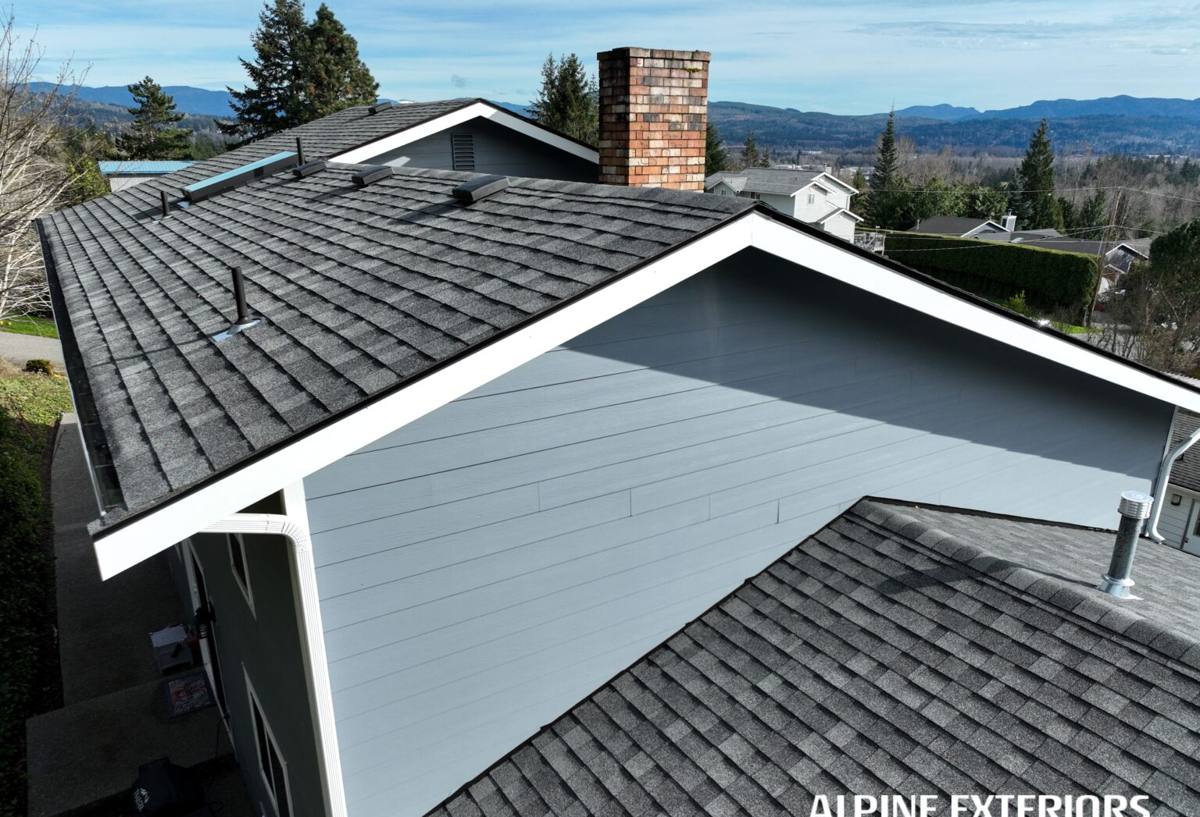
What Actually Counts as Storm Damage
Homeowners often picture storm damage as a hole punched through the roof, but most of what we get called out for in this area is quieter than that.
Wind and Debris
Gusts moving through the river valley can lift shingle tabs, crack ridge caps, or drive small branches and cones into the roof plane hard enough to bruise or puncture shingles without an obvious visible break. Windthrow from nearby trees is also a real factor — a limb doesn't have to fall through the roof to do damage; a glancing hit can crease shingles or knock flashing loose in a way that only leaks weeks later.
Water Intrusion
Driving rain finds every weak point. Wind-driven rain pushes water sideways under shingle edges, around chimney and pipe flashing, and into any spot where sealant has aged out. In a heavy moss climate, moss mats trap water against the roof surface and slow drainage, so a storm can push already-saturated shingles past their limit even if the wind itself wasn't extreme.
Hidden Damage
The damage that costs homeowners the most is usually the kind they don't see: a lifted shingle that lets water track sideways into the decking, a cracked pipe boot that drips slowly into insulation, or granule loss that's stripped a shingle's UV and weather protection without opening a visible gap. This is why a proper storm inspection covers more than "is there a hole."
Our Storm Damage Inspection and Repair Process
We approach every storm call the same structured way, whether it's a single lifted shingle or a section that took a direct hit from a falling limb.
- Emergency stabilization. If there's active leaking or an exposed area, our first priority is a tarp and any temporary sealing needed to stop water getting into the structure — this happens before we talk about the full repair plan.
- Full roof inspection, not just the damaged spot. Storm forces rarely stay in one place. We check the whole roof plane, flashing points, valleys, and moss-prone shaded sections for related or unrelated issues while we're already up there.
- Photo documentation. Every damaged area gets documented clearly, both for our own repair plan and for any insurance claim you may file.
- A written scope and estimate. You get a plain-English explanation of what's damaged, what needs to happen, and why — before any repair work starts.
- The repair itself. Matching materials where possible, correcting the underlying cause (not just the surface symptom), and re-checking surrounding shingles and flashing for hidden secondary damage.
- Final walkthrough. We show you what was done and what to watch for, especially if moss or drainage was part of the original problem.
Repair or Replace? How We Decide
Not every storm-damaged roof needs a full replacement, and not every roof that "looks fine" from the ground is actually sound. The right call depends on the roof's age, how widespread the damage is, and what's underneath the surface.
| Factor | Repair Usually Makes Sense | Replacement Worth Considering |
|---|---|---|
| Roof age | Under 12-15 years, otherwise healthy | Near or past the material's expected service life |
| Extent of damage | Isolated to one section or a handful of shingles | Damage spread across multiple roof planes |
| Decking condition | Solid, dry decking under the damaged area | Soft spots or rot found once shingles are pulled back |
| Moss/moisture history | Occasional moss, otherwise good drainage | Long-term moss buildup with granule loss across large areas |
| Shingle match availability | Close match available for patching | Discontinued product, patch would be visibly mismatched |
We'll always tell you honestly which column your roof falls into. A repair that's likely to fail again in a year isn't a good use of your money, and a full replacement on a roof that just needs a section fixed isn't either.
Materials We Use for This Climate
Whatcom County's mix of heavy rain, shade, and moss pressure means material choice matters more here than in drier regions.
Shingles
For repairs, we match the existing shingle line as closely as possible so the patch blends and performs consistently with the rest of the roof. When an exact match isn't available — common on older roofs — we explain the trade-offs of a close match versus a full replacement of the affected slope, so the decision is yours with full information.
Underlayment and Flashing
In areas prone to wind-driven rain, we prioritize synthetic underlayment and properly lapped, corrosion-resistant flashing over anything that depends heavily on sealant alone. Sealant-only fixes are quick, but they're a maintenance item, not a permanent solution — we use them where appropriate, not as a substitute for correct flashing work.
Moss and Drainage Treatment
Where moss contributed to the failure, part of the repair includes clearing growth from the repaired area and, where it makes sense, discussing longer-term moss control so the same spot doesn't fail again next season.
Insurance and Storm Claims
Many storm repairs in this area are at least partially covered by homeowners insurance, but coverage depends heavily on your specific policy and the cause of damage. A few things worth knowing going in:
- Document damage with photos as soon as it's safe to do so, before any temporary repairs disturb the area.
- Get a written, itemized estimate — adjusters work faster with clear scope and photos than with a verbal description.
- Ask your insurer about their timeline and any deadline for filing after a storm event.
- We can provide documentation to support a claim, but we don't represent your insurer or guarantee a specific claim outcome — that decision is between you and your policy.
Why a Crew That Already Works Deming Matters
A roofer who regularly works this stretch of the county already knows what a Deming roof is up against before they climb the ladder — the tree cover that keeps certain slopes shaded and mossy year-round, the way wind moves differently in a river valley than it does closer to open water, and how quickly a small leak can turn into rot damage in a climate this wet. That familiarity shortens the inspection, sharpens the diagnosis, and means fewer surprises once a repair is underway.
It also matters for response time. Storm damage doesn't wait for a convenient appointment slot, and a crew already working in and around this area can typically get a tarp up faster than one dispatching from farther away — which is often the difference between a contained repair and a much larger interior damage bill.
Keeping Your Roof Ready for the Next Storm
Once repairs are done, a little seasonal attention goes a long way in this climate. Use this as a general homeowner checklist between storm seasons:
- Clear gutters and downspouts before the fall rains start, so water has somewhere to go.
- Trim back branches that overhang the roofline — they're the most common source of impact and abrasion damage here.
- Check for moss buildup on shaded, north-facing slopes each spring and fall.
- Look at flashing around chimneys, vents, and skylights after any significant wind event.
- Have any repaired area re-checked after its first full winter, especially if it was a partial patch rather than a full slope replacement.
Most of these take a few minutes and prevent the slow, hidden damage that turns into an expensive repair later.
Get a Straight Answer on Your Roof
If a recent storm left you with a lifted shingle, a new drip stain on the ceiling, or just uncertainty about whether your roof came through okay, it's worth having it looked at before the next system rolls through. We'll give you a clear, honest assessment of what's actually going on and what it would take to fix it — no pressure, no upsell. Fill out the form below for a free estimate.