 Sudden Valley Exterior
 Why Cordata's Climate Is Harder on Siding Than It Looks
Cordata sits close enough to Bellingham Bay and the Salish Sea that homes here deal with a mix most siding products were never designed for: salt-laden air moving in off the water, long stretches of wind-driven rain, and shaded, damp walls that stay wet for days at a time under the region's tree canopy. None of these on their own is unusual for Western Washington. Together, year after year, they're what actually determine whether a siding job looks good for five years or holds up for thirty.
Salt air accelerates corrosion on fasteners, flashing, and trim hardware faster than inland homes ever see. Driving rain finds every gap in a water-resistive barrier or flashing detail that wasn't done right the first time. And Whatcom County's moss season isn't a few weeks — it's a good chunk of the year, especially on north- and west-facing walls that don't get direct sun to dry out between storms. Siding for a Cordata home has to handle all three at once, not just one of them.
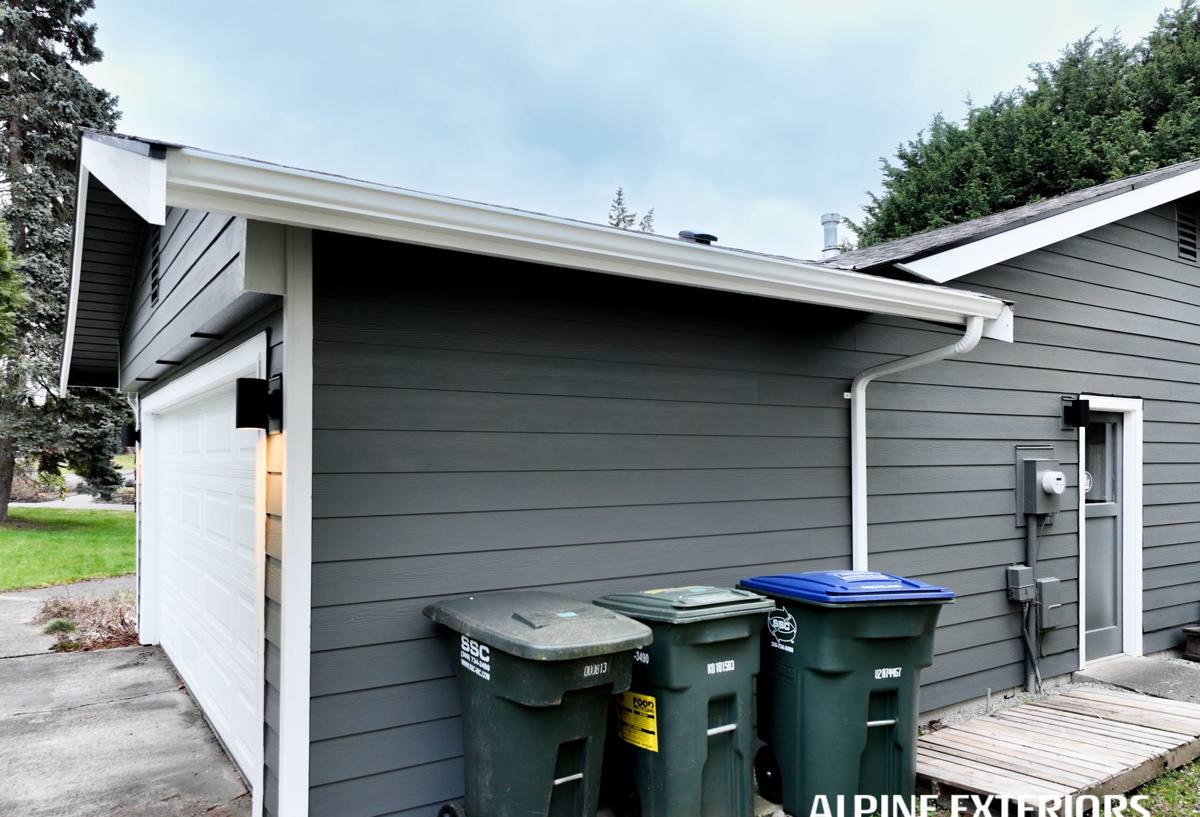
What Correct James Hardie Installation Actually Involves
James Hardie fiber cement is engineered for Pacific Northwest conditions, but the product only performs as well as the installation behind it. A correct job is mostly about water management — the siding itself is the last line of defense, not the only one.
Water Management Comes First
Before a single plank goes up, the wall needs a continuous weather-resistive barrier, correctly lapped and taped, with flashing integrated at every window, door, deck ledger, and roofline. Kick-out flashing where a roof edge meets a wall is one of the most commonly skipped details in this region, and it's exactly the spot where driving rain causes hidden rot behind otherwise fine-looking siding. A drainage gap behind the cladding lets any moisture that does get past the surface find its way back out instead of sitting against the sheathing.
Fasteners and Clearances
Because of the salt-air exposure in this area, fastener choice matters more than most homeowners realize. Corrosion-resistant fasteners — stainless steel or hot-dip galvanized, depending on the application — are non-negotiable here; standard fasteners can start staining and weakening years before the siding itself shows any wear. James Hardie's HZ5 product line, engineered for climates like this one, also specifies exact nailing patterns and minimum clearances: siding held at least 6 inches above grade, clear gaps at roof lines, decks, and other siding-to-trim junctions so water never gets trapped against the material.
Joints, Caulking, and Cut Edges
Every field-cut edge needs to be sealed before installation, not after, and joints need the right balance of caulked versus purposely open depending on their location. Over-caulking traps moisture just as badly as under-caulking lets it in — this is a judgment call that comes from experience, not a checklist followed blindly.
Hardie Compared to Other Siding Choices in This Climate
We install James Hardie exclusively, and it's worth being straightforward about why, especially for a climate like Cordata's. Every siding material has trade-offs; here's how the common alternatives actually behave under salt air, sustained rain, and heavy moss exposure.
| Material | How It Handles This Climate | Ongoing Maintenance | Long-Term Behavior |
|---|---|---|---|
| James Hardie fiber cement | Non-combustible, dimensionally stable, holds up to sustained moisture exposure when installed to spec | Occasional wash; factory finish resists fading and moss staining better than field-applied paint | Decades of service life when installation details are correct |
| Vinyl | Can warp or become brittle with temperature swings; seams and fasteners are more exposed to moisture intrusion | Low, but fasteners and trim corrode faster near salt air | Shorter replacement cycle, especially on sun- and wind-exposed walls |
| Engineered wood (LP SmartSide and similar) | Wood-based core is more sensitive to sustained dampness than fiber cement | Requires more diligent caulk and paint upkeep to prevent moisture entry at cut edges and joints | Performance depends heavily on how well moisture is kept out of the substrate |
| Cedar | Natural material, attractive, but absorbs moisture readily in a climate this wet | Regular refinishing, staining, and moss/mildew treatment | Highest ongoing maintenance burden of the group |
This isn't a knock on any of these products in the right application. It's why, after years of doing exterior work in exactly this kind of climate, we standardized on one material we trust to perform without asking homeowners to fight the weather every season.
Our Process for a Cordata James Hardie Project
- Assessment: We walk the exterior, check for existing moisture damage or rot behind current siding, and evaluate wall orientation — west- and south-facing walls exposed to prevailing storms usually need extra attention at flashing points.
- Product and color selection: We help you choose the right HardiePlank profile and ColorPlus finish for the home's style and the amount of moss and shade the walls actually get.
- Tear-off and sheathing check: Old siding comes off, sheathing is inspected and repaired as needed, and a new weather-resistive barrier goes on correctly lapped and flashed.
- Installation to HZ5 spec: Corrosion-resistant fasteners, correct clearances, and proper flashing at every penetration and roofline.
- Final walkthrough: A punch-list review with you, plus warranty registration so the coverage is actually in place, not just implied.
Choosing the Right Profile and Finish for a Cordata Home
James Hardie offers several lap siding textures — smooth, cedar-mill grain, and others — and the right choice usually comes down to the home's existing style rather than a single "best" answer. What matters more in this climate is the ColorPlus factory finish. A baked-on factory finish resists fading and holds up to sustained damp exposure better than field-applied paint, and it carries its own finish warranty separate from the substrate warranty. In an area with this much shade and moisture, that finish durability is doing real work, not just a cosmetic upgrade.
Cost Factors for a Cordata Siding Project
Every home is different, but the biggest cost drivers on a Cordata project tend to be the same handful of variables.
| Factor | Why It Affects Cost |
|---|---|
| Tear-off vs. new construction | Removing existing siding and addressing any hidden moisture damage adds labor and sometimes sheathing repair |
| Home size and number of stories | More wall area and taller walls affect material, labor, and equipment needs |
| Trim and architectural detail | Homes with more corners, dormers, or trim work require more precise flashing and cutting |
| Siding profile and finish chosen | Different HardiePlank profiles and ColorPlus colors carry different material costs |
| Access and site conditions | Slopes, mature landscaping, or tight lot lines can affect staging and labor time |
Living With Hardie Siding Through Moss Season
Fiber cement siding holds up far better than wood-based alternatives in damp, shaded conditions, but no exterior material is entirely moss-proof. A little routine attention keeps a Hardie exterior looking like new for years.
- Rinse the siding once or twice a year, especially on shaded north- and west-facing walls, to keep moss and algae from getting a foothold
- Keep gutters clear so overflow doesn't run down the siding face and create streaking or staining
- Trim back tree branches and shrubs that keep walls in constant shade and slow down drying time after rain
- Check caulked joints annually, particularly around windows and trim, since sealant is the first thing to show wear
- Address roof and walkway moss promptly — it spreads spores that make wall moss worse over time
Why a Crew That Already Works in Cordata Matters
Whatcom County's building department, the region's wind-driven rain patterns, and the HZ5 climate requirements aren't things you learn from a manual — they're things a crew learns by doing the work here repeatedly. Knowing which walls on a typical Cordata lot take the worst weather, what inspectors look for locally, and how long moss season really lasts changes how a job gets planned and detailed. A crew installing Hardie for the first time in this climate is more likely to miss a flashing detail that only shows up as a problem two winters later.
The Warranty Behind the Work
James Hardie backs its siding with a long-term, transferable limited warranty on the substrate, and a separate finish warranty on ColorPlus color. Transferability matters at resale, and the coverage is only as good as the installation underneath it — most warranty claims that get denied trace back to installation details, not the product itself. That's the real reason installation quality gets so much attention on this page: it's what keeps the warranty meaningful.
If you're weighing a siding project for a Cordata home, we're happy to walk the exterior with you, point out anything specific to your home's exposure, and put together a straightforward, no-pressure estimate.