 Sudden Valley Exterior
 Why Bellingham Roofs Wear Differently Than Roofs Inland
A roof in Bellingham does not fail the same way a roof fails in Spokane or Yakima. Out here, the enemy isn't one big storm — it's a slow, steady grind of moisture, salt-tinged air off the Sound, and shade from the evergreens that never really dries out between rain events. Add in a moss season that can run eight or nine months of the year in shaded, north-facing sections of a roof, and you've got a climate that punishes shortcuts a lot faster than drier parts of the state.
When we install a new roof for a Bellingham home, we're not just matching shingles to a color chart. We're building a roof system that has to shed driving, wind-blown rain without backing up under the shingles, resist moss colonization on shaded slopes, and hold up to the low-grade salt exposure that comes with living near Bellingham Bay and the greater Whatcom County coastline. Get any one of those wrong and the roof will show it within a few winters — not with a dramatic failure, but with soft decking, streaked shingles, and moss creeping under the shingle tabs where you can't see it until it's already done damage.
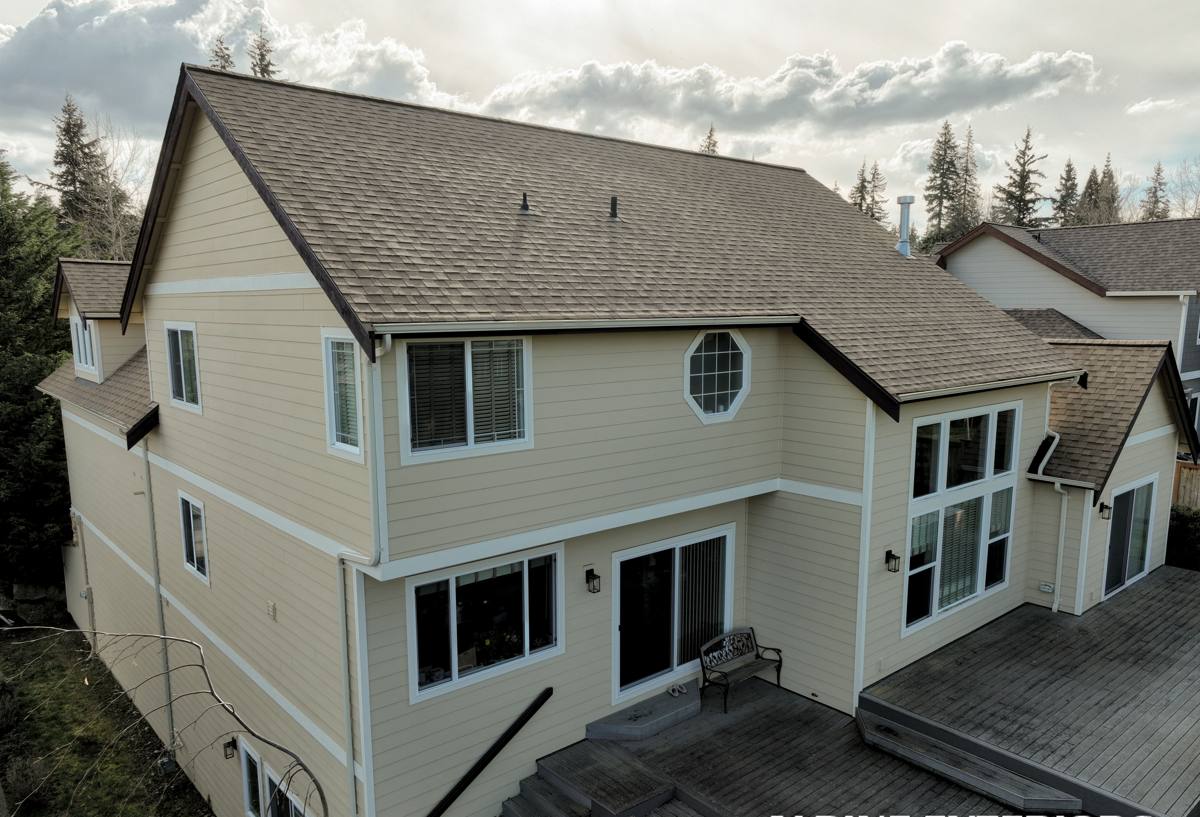
What "Correct" Actually Means for a New Roof Here
Every roofing crew will tell you they do it right. The difference shows up in the parts of the job that aren't visible from the street. A correct new roof installation in this climate includes, at minimum:
- Ice-and-water shield membrane at eaves, valleys, and roof penetrations — not just at the eave line, given how long moisture sits on shaded slopes here
- Synthetic underlayment rated for extended UV and moisture exposure, since Bellingham roofs often stay wet or damp for days between dry spells
- Balanced intake and exhaust ventilation sized to the actual attic, not a generic ridge vent slapped on without matching soffit intake
- Step flashing and counter-flashing at every wall intersection and chimney, not caulk-and-hope flashing
- Corrosion-resistant fasteners and flashing metals appropriate for coastal-influenced air
- A moss-management strategy built into the install, not left as an afterthought for the homeowner to deal with later
None of these items are optional extras. They're the difference between a roof that quietly does its job for its full warranty life and one that starts generating callbacks — leaks at the chimney, moss ridges along the north slope, soft spots near valleys — inside five to seven years.
The Decking Underneath Matters as Much as the Shingles on Top
We don't quote a roof sight-unseen and we don't skip the tear-off inspection. Once the old roofing is off, we check the decking for soft spots, delamination, and any moisture staining that points to a slow leak that's been running longer than the homeowner realized. In a climate this wet, it's common to find isolated soft plywood near a valley or a plumbing vent even on a roof that looked fine from the ground. Replacing bad decking during the install — instead of covering it up — is a non-negotiable part of how we work.
Choosing the Right Roofing Material for This Climate
There's no single "best" roofing material for Bellingham — there's a best fit for the specific roof, its exposure, and the homeowner's budget and maintenance expectations. Here's how the common options actually compare once you factor in salt-influenced air, sustained rain, and heavy moss pressure:
| Material | Moss Resistance | Coastal/Salt-Air Durability | Typical Lifespan Here | Relative Cost |
|---|---|---|---|---|
| Architectural asphalt shingle (algae-resistant) | Good with proper ventilation and zinc/copper strips | Good — corrosion isn't a factor for the shingle itself | 20–30 years | $ |
| Standard 3-tab asphalt shingle | Fair — thinner profile traps moisture longer | Fair | 15–20 years | $ |
| Standing seam metal | Very good — sheds moss naturally on most slopes | Excellent with correct coating and fastener spec | 40–50+ years | $$$ |
| Cedar shake | Poor without diligent, ongoing maintenance | Fair — needs regular treatment near salt air | 20–30 years with upkeep | $$$ |
We're candid with homeowners about cedar shake in this climate: it can look great, but it demands a maintenance schedule most people don't keep up with once the roof is a few years old, and moss pressure on a shaded Bellingham lot works against it constantly. That's a maintenance-burden and moisture-behavior conversation, not a knock on the product — it's simply a poor match for a low-maintenance goal in a wet, shaded setting. For most homes we work on, a quality algae-resistant architectural shingle or standing seam metal gives the best balance of performance and cost.
How Our New Roof Installation Process Works
Homeowners want to know what's actually going to happen once they sign off, so here's the sequence we follow on a typical Bellingham re-roof:
- On-site inspection and measurement. We walk the roof, check the attic for existing ventilation and moisture signs, and measure for an accurate material takeoff — not a rough estimate from a satellite photo.
- Written proposal. Material options, ventilation plan, flashing scope, and a firm price — no vague allowances that turn into change orders mid-job.
- Permitting. We pull the required permit through the local jurisdiction before work starts. This isn't a formality — it means the finished roof gets inspected against code, which protects the homeowner.
- Material staging and protection. Landscaping, gutters, and siding get protected before tear-off begins.
- Tear-off and decking inspection. Old roofing comes off down to the deck, and any compromised sheathing is identified and replaced.
- Underlayment and flashing installation. Ice-and-water membrane, synthetic underlayment, and new flashing go in per the plan — this is the layer that determines whether the roof leaks in driving rain, regardless of what shingle sits on top.
- Ventilation correction. Intake and exhaust vents are installed or corrected to balance airflow through the attic.
- Roofing material installation. Shingles, panels, or shakes go on to manufacturer spec, including proper nailing pattern and exposure.
- Cleanup and final walkthrough. Magnetic sweep for stray fasteners, debris haul-off, and a walkthrough with the homeowner before we call it done.
Ventilation and Moisture Control: The Part Nobody Sees From the Ground
A new roof that isn't ventilated correctly will fail early no matter how good the shingles are. In a climate where the attic air is already carrying more moisture than it would inland, a mismatch between intake vents at the soffit and exhaust vents at the ridge traps humid air against the underside of the decking. Over a few winters that shows up as premature shingle aging from the underside, condensation staining on the decking, and in some cases mold growth in the attic — none of which is covered under a manufacturer's shingle warranty, because the warranty assumes correct ventilation was installed.
Part of our process is measuring net free ventilation area against the attic square footage and correcting any imbalance before the new roofing goes down. It's one of the least glamorous parts of a roof job and one of the most important for long-term performance in this climate.
Flashing and Valleys: Where Driving Rain Actually Gets In
Roofs rarely leak through the field of the shingles. They leak at the transitions — chimneys, skylights, sidewalls, and valleys — where wind-driven rain gets pushed uphill against gravity during a real Pacific storm. A correctly flashed roof uses step flashing woven with the shingle courses at every wall intersection, proper counter-flashing let into the wall material (not surface-mounted and caulked), and either a woven or metal open valley sized for the volume of water Bellingham roofs actually see in a heavy winter rain event. We treat flashing as its own scope of work, not an afterthought to shingle installation, because it's almost always the source of a leak on an otherwise sound roof.
Building Moss Resistance Into the Installation
Moss on a Bellingham roof isn't just cosmetic — left alone, it holds moisture against the shingle surface, lifts shingle tabs, and accelerates granule loss. Rather than treating moss as a maintenance problem to deal with after the fact, we address it at install time:
- Zinc or copper strips installed near the ridge on shaded or north-facing slopes, which release trace metal ions with rainfall that inhibit moss and algae growth over time
- Algae-resistant shingle products on slopes with heavy tree cover or limited sun exposure
- Ventilation correction, since a cooler, drier attic reduces the condensation that feeds moss growth from underneath
- Trim recommendations for overhanging branches where they're contributing to a shaded, damp microclimate on the roof
None of these steps eliminate the need for periodic roof cleaning, but they meaningfully slow how fast moss re-establishes on the slopes that struggle with it most.
What Drives the Cost of a New Roof
Homeowners comparing quotes are often comparing very different scopes of work without realizing it. These are the factors that actually move the price:
| Cost Factor | Why It Matters |
|---|---|
| Roof pitch and complexity | Steeper pitches and multiple valleys/dormers take longer and require more safety equipment |
| Number of existing layers | Tear-off of two layers costs more in labor and disposal than a single-layer tear-off |
| Decking condition | Hidden rot found at tear-off adds material and labor not visible in the original quote |
| Material choice | Standard asphalt, algae-resistant asphalt, and metal carry very different material costs |
| Ventilation and flashing scope | Correcting undersized ventilation or reflashing every wall intersection adds real labor |
| Access and site conditions | Steep lots, limited staging area, or difficult material hoisting affect labor time |
A quote that's noticeably lower than others is almost always lower because one or more of these items got left out — most commonly ventilation correction and full flashing replacement.
Timeline and Permitting
Most single-family re-roofs in this area take one to three days of active work once material is on-site, weather permitting — and weather is the operative word. We watch the forecast closely and won't tear off a roof into an open sky when a wet system is moving through; a roof left exposed overnight in a driving rain is a problem nobody wants. Permitting timelines vary by jurisdiction, but we handle the application and inspection scheduling as part of the job so the homeowner isn't chasing paperwork.
Why a Crew That Already Works This Area Matters
A roofing crew that works Bellingham and the surrounding Whatcom County communities regularly knows things a traveling or out-of-area crew has to learn on the fly: which slopes in a given neighborhood tend to hold moss hardest, how local permitting offices want inspections scheduled, and how tight a weather window realistically is during the wetter months. That local pattern recognition doesn't replace good workmanship, but it does mean fewer surprises during the job and a roof plan that's built around how this specific climate actually behaves — not a generic install applied to a coastal Pacific Northwest home.
A Quick Checklist Before You Sign With Any Roofing Contractor
- Do they inspect the attic and existing ventilation before quoting, not just the roof surface?
- Is ice-and-water shield specified at eaves and valleys, not just a bare minimum strip?
- Does the proposal name the flashing scope explicitly — new step flashing, new counter-flashing, valley type?
- Is a moss-management step (zinc/copper strip, algae-resistant material) included or offered?
- Will they pull the permit and schedule the required inspection themselves?
- Is the warranty structure explained clearly — what's covered by the manufacturer versus the installer's workmanship warranty?
If you're planning a new roof for a Bellingham home, we're glad to walk the roof with you, explain what we find, and put together a straightforward estimate — no pressure, no hard sell. Use the form below to request your free estimate.