 Sudden Valley Exterior
 Why Roofs in Alger Wear Out Faster Than the Manufacturer's Warranty Suggests
Every asphalt shingle sold in this country comes with a warranty number that assumes a fairly mild, dry climate. Alger doesn't get that climate. Sitting close to the water with the kind of marine air that moves through this part of Whatcom County, homes here deal with a combination most roofing products were never really tested against: salt-laden air, long stretches of driving rain, and a moss season that can run eight or nine months out of the year. None of those three things alone is a big deal. Together, over ten or fifteen years, they add up to premature granule loss, soft decking, and shingles that fail from the underside before they ever look obviously "old" from the street.
Salt air accelerates corrosion on every metal component of a roof system — nails, flashing, vent boots, drip edge. Driving rain, especially when it comes in sideways off a storm, finds every marginal seal and works it loose over time. And moss doesn't just look bad; it holds moisture against the shingle surface long after the rain has stopped, which is exactly the condition that breaks down asphalt and rots the plywood underneath it. A new roof installation done right in this area has to account for all three from the first nail, not just meet the minimum code requirement.
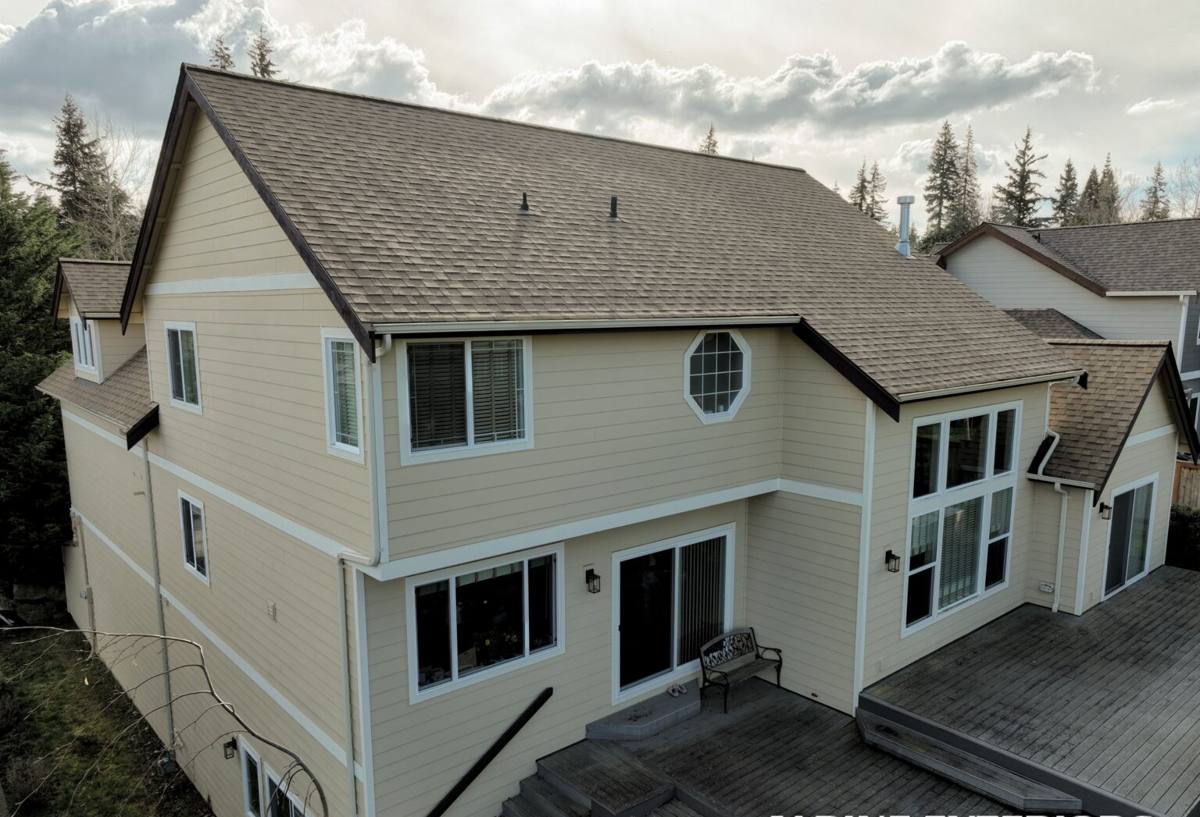
Signs an Alger Home Needs a New Roof, Not Another Repair
We get calls every year from homeowners who've had three or four repairs done over as many years and are starting to wonder if they're just delaying the inevitable. Usually they are. Here's how to tell the difference between a legitimate repair situation and a roof that's telling you it's done.
Signs pointing to full replacement
- Granules collecting in gutters or at downspout outlets in noticeable amounts, not just a light dusting
- Shingles that are curling, cupping, or cracking across multiple areas of the roof, not one isolated spot
- Soft or spongy decking felt when walking the roof, especially near valleys or eaves
- Daylight visible through the roof deck from inside the attic
- Moss growth that returns within months of cleaning, especially on north-facing slopes
- A roof that's already had two or more leak repairs in unrelated locations within the last few years
If you're only seeing one of these, in one spot, a repair may still make sense. If you're seeing several at once, spending more money chasing individual leaks usually costs more over time than doing the job once, correctly.
What a Correct New Roof Installation Actually Involves
A new roof is more than shingles nailed to plywood. The parts you can't see from the ground are what determine whether the roof lasts 12 years or 30 in a climate like this one.
Tear-off and deck inspection
We remove the old roofing down to the deck rather than layering over it. This lets us inspect every sheet of plywood or OSB for soft spots, delamination, or rot — problems that are common on older Whatcom County homes where a roof has been quietly absorbing moisture for years. Any compromised decking gets replaced before anything new goes down; installing new shingles over a weak deck just hides the problem for another buyer or another storm to find.
Underlayment built for wind-driven rain
In an area that gets sideways rain, we use synthetic underlayment with self-adhering ice-and-water membrane at the eaves, valleys, and any roof-to-wall transition — the spots where wind-driven water is most likely to get pushed under the shingle line. This is one of the few parts of a roof that's genuinely cheap insurance against the exact weather pattern Alger sees regularly.
Flashing and metal components rated for salt air
Every piece of exposed metal — step flashing, valley metal, vent boots, drip edge — gets chosen with corrosion resistance in mind, not just cost. Standard galvanized fasteners can start showing rust within a few years this close to the water; we spec corrosion-resistant fasteners and flashing as a standard practice here, not an upsell.
Ventilation that actually balances
Intake at the eaves has to match exhaust at the ridge, or the whole system underperforms regardless of how good the shingles are. We size this to the specific roof rather than installing a standard vent count out of habit.
Choosing a Roofing Material for This Climate
There isn't one "best" material — there's a best fit for your roof pitch, your budget, and how long you plan to own the home. Here's how the common options actually compare for a coastal Whatcom County property.
| Material | Typical Lifespan Here | How It Handles Moss & Moisture | Trade-offs |
|---|---|---|---|
| Architectural asphalt shingle | 20–25 years | Good with proper ventilation and periodic moss treatment; most common choice | Best upfront cost; needs occasional moss/debris maintenance |
| Standing seam metal | 40–50 years | Excellent — moss struggles to hold on smooth metal, sheds water fast | Higher upfront cost; requires an experienced installer for watertight seams |
| Synthetic (composite) shake | 30–40 years | Good moisture resistance; doesn't absorb water like wood | Mid-to-upper cost; fewer installers are trained on it correctly |
| Cedar shake | 20–30 years with upkeep | Requires the most ongoing maintenance to resist moss and rot in wet climates | Traditional look, but highest maintenance burden here |
We install a range of these, but we're honest with clients about maintenance burden up front. A wood shake roof can look great in Alger, but only if the owner is committed to the cleaning and treatment schedule that a marine climate demands — we'd rather tell you that before the contract than after the first moss bloom.
Our Installation Process, Start to Finish
- On-site inspection and honest assessment — we walk the roof and attic before quoting anything, so the estimate reflects your actual roof, not a guess from ground level.
- Written estimate with material options — clear pricing, no vague allowances buried in fine print.
- Scheduling around the weather window — in this climate, timing matters; we plan tear-off days around forecasts we can actually trust, not just a calendar slot.
- Tear-off and deck repair — old roofing removed, deck inspected and repaired as needed.
- Underlayment, flashing, and shingle or panel installation — done to manufacturer spec plus our own additions for wind-driven rain and salt exposure.
- Ventilation check and balance — intake and exhaust confirmed to work together.
- Full cleanup and magnetic sweep — job site and yard cleared of debris and stray fasteners.
- Final walkthrough — we go over the finished roof with you before calling the job done.
Ventilation and Moisture Control: The Half of the Job Nobody Sees
Most roof failures we investigate in this region trace back to moisture trapped inside the attic, not water getting through the shingles. A roof that's too tightly sealed, or that has mismatched intake and exhaust venting, traps humid air against the underside of the deck. Over a few winters of Whatcom County dampness, that moisture condenses, soaks into the plywood, and starts the rot process from the inside — often long before the shingles themselves show any wear. Part of doing this job correctly is treating ventilation as equal in importance to the shingle brand on top of it.
Cost Factors for a New Roof in Alger
Every roof is different, and we don't publish blanket price lists because they mislead more than they help. What we can tell you honestly is what tends to move the number up or down.
| Factor | Effect on Cost |
|---|---|
| Roof size and number of stories | Larger and taller roofs mean more material and more labor time/access equipment |
| Roof pitch and complexity (valleys, dormers, chimneys) | More cuts, flashing, and labor hours per square than a simple gable roof |
| Deck condition found at tear-off | Rotted plywood sections add material and labor not visible before tear-off begins |
| Material chosen | Asphalt is the most economical; metal and composite shake cost more upfront but longer between replacements |
| Access and site conditions | Tight lots, steep driveways, or limited staging area can add setup time |
We put all of this in writing before work starts, and we'll walk you through exactly why the number is what it is — no allowances that turn into surprise change orders halfway through the job.
Why Hiring a Crew That Already Works in Alger Matters
A roofing crew that mainly works inland doesn't think about salt exposure on fasteners the same way a crew that works this stretch of Whatcom County coastline does. It's not about skill — it's about what problems you've actually seen repeatedly and learned to build around. We've replaced enough roofs in this specific climate to know which flashing details fail first, which north-facing slopes hold moss longest, and which underlayment choices actually hold up to the driving rain this area gets rather than the mild-weather scenario most manufacturer literature assumes. That kind of local pattern recognition is hard to get from a crew that's only passing through.
After Installation: Keeping a New Roof Performing in This Climate
A correctly installed roof still benefits from basic upkeep, especially here. This isn't a maintenance contract pitch — it's just what actually extends the life of the investment you just made.
- Clear gutters and downspouts at least twice a year so water isn't backing up under the roof edge
- Have moss growth treated or removed before it spreads across a full slope, not after
- Trim back overhanging branches that keep shaded areas of the roof damp longer than the rest
- Do a visual check after any major windstorm for lifted shingles or displaced flashing
- Keep an eye on the attic for musty smells or visible moisture, which can signal a ventilation issue early
If you're weighing a repair against a full replacement, or you already know your roof is due, we're happy to take a look and give you a straight answer either way. Fill out the form below for a free, no-pressure estimate on your Alger home.