 Sudden Valley Exterior
 Deck Building for South Hill, Built for Whatcom County Weather
South Hill sits above the lake with some of the best outdoor living potential in Sudden Valley — but that same exposure means decks here take a beating that decks in drier climates never see. Between the driving rain off Lake Whatcom, the salt-tinged air that drifts in from the Sound, and a moss season that can run from October through May, a deck built without those factors in mind will show problems within a few years: soft spots, slick surfaces, corroding hardware, and stain that fails long before it should. We build and rebuild decks for South Hill homeowners with all of that baked into the plan, not treated as an afterthought.
This page covers what a deck built for this specific neighborhood actually needs, what a correct build or replacement involves, and how we run the job from first look to final walkthrough.
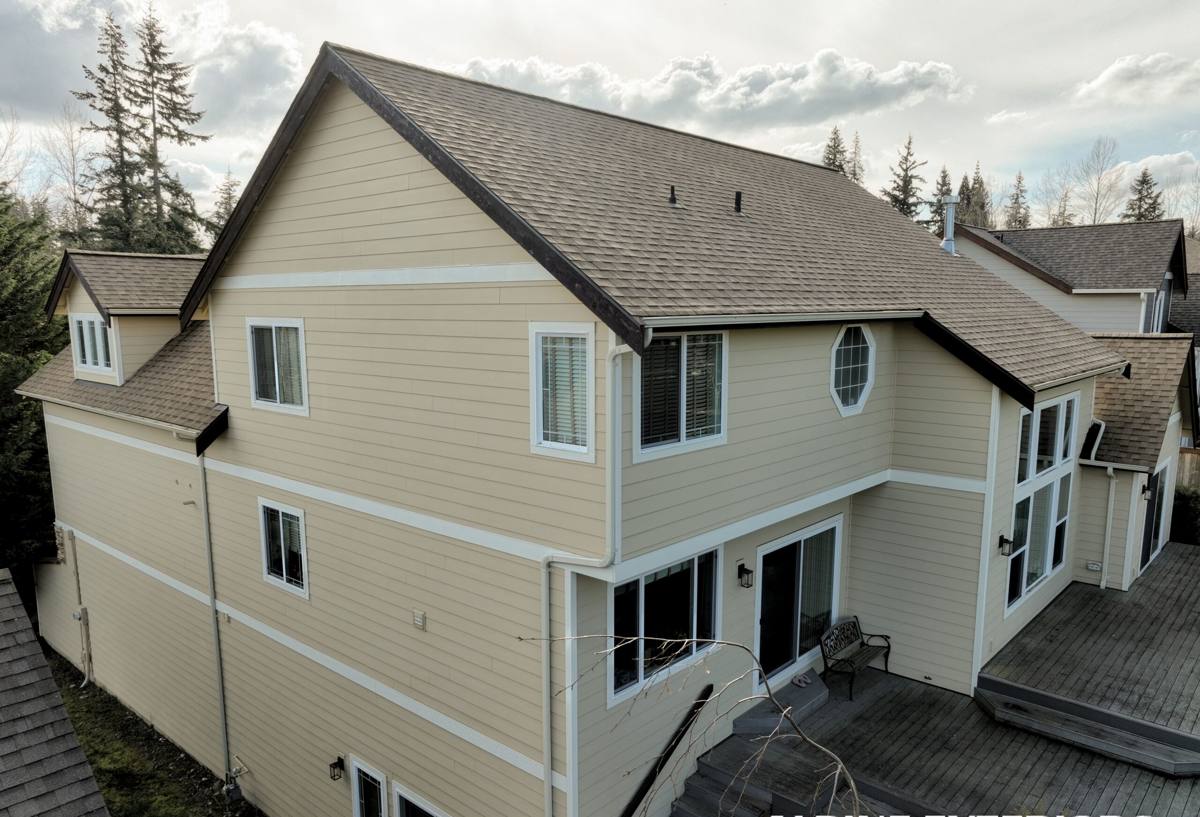
What South Hill's Climate Does to a Deck
Every deck problem we get called out for in this area traces back to one of three things: moisture that has nowhere to go, materials that weren't rated for constant damp exposure, or fasteners that were never meant to sit in salt-influenced air.
Moss and Standing Moisture
Whatcom County's long wet season means any deck surface that doesn't shed water fast becomes a moss farm. Moss isn't just cosmetic — it holds moisture against the decking, which accelerates rot in wood and can stain or degrade composite surfaces over time. Board spacing, slope, and airflow underneath the deck all affect how quickly a surface dries out after rain, and on a lot with any shade from trees around South Hill, that drying time matters even more.
Driving Rain and Water Intrusion
Rain here doesn't fall straight down — wind off the lake pushes it sideways into ledger boards, stair stringers, and any spot where the deck meets the house. If flashing and ledger attachment aren't done correctly, water works its way behind the siding and into the rim joist, and that damage is invisible until it's serious.
Salt Air and Hardware Corrosion
Structures within reach of marine-influenced air need corrosion-resistant fasteners and connectors as standard, not as an upgrade. Standard galvanized hardware can start showing rust streaks and weakening well ahead of schedule in this environment; we treat stainless or heavy hot-dip galvanized rated for coastal exposure as the baseline for ledger bolts, joist hangers, and structural screws.
What a Correct Deck Build Involves
A deck is a structure first and a surface second. Homeowners usually focus on the decking material, but the parts you don't see are what determine whether the deck is still solid in fifteen years.
- Footings sized for the soil: South Hill's terrain varies from lot to lot, and footing depth and diameter need to match what's actually underfoot, not a generic minimum.
- Proper ledger attachment and flashing: the ledger board is the single most common failure point on older decks; it needs mechanical fasteners rated for the load and flashing that actually sheds water away from the house.
- Joist spacing matched to the decking material: composite, PVC, and wood all have different span ratings — using wood-rated spacing under composite decking leads to bounce and premature sagging.
- Corrosion-resistant structural hardware throughout, not just at points that are easy to inspect later.
- Positive drainage away from the house and adequate under-deck airflow so the structure has a chance to dry between rain events.
- Code-compliant guardrails and stair geometry, especially important on the sloped lots common around the lake.
Decking Material Options: Honest Trade-Offs
There's no single "best" decking material — there's a best material for how you'll use the deck, how much maintenance you want to do, and your budget. Here's how the common options compare for this climate specifically.
| Material | Moss/Moisture Behavior | Maintenance | Typical Lifespan |
|---|---|---|---|
| Pressure-treated wood | Absorbs moisture; needs sealing to resist moss and rot | Annual cleaning and re-sealing recommended | 10–15 years with upkeep |
| Cedar | Naturally rot-resistant but still needs care in constant damp | Periodic staining/sealing | 15–20 years with upkeep |
| Composite decking | Doesn't rot, but moss can still grow on the surface film if it stays wet and shaded | Occasional washing; no staining or sealing | 25-plus years, backed by manufacturer warranty |
| PVC decking | Fully moisture-resistant, best resistance to surface moss growth | Lowest maintenance of the group | 25-plus years, backed by manufacturer warranty |
We install all of the above. Where a homeowner wants real wood grain and is willing to keep up with sealing, wood or cedar is a fine choice. Where low maintenance matters more than upfront cost, composite or PVC pays for itself in avoided upkeep, especially given how much moss pressure this area puts on a deck surface.
A Note on Underlayment and Joist Protection
Regardless of decking material, we recommend a joist tape or butyl-based joist protection on top of the framing. It's inexpensive relative to the whole project and it's the single best insurance against the framing rotting out from underneath decking that itself is otherwise holding up fine — a common and expensive failure mode we see on older decks in wetter neighborhoods.
New Build vs. Deck Replacement vs. Repair
Not every deck problem means a full teardown. Part of an honest estimate is telling you which category your project actually falls into.
- Repair: isolated soft boards, a failing stair stringer, or hardware that's rusted out but the framing underneath is sound.
- Resurface: the structure and footings are solid, but the decking itself has reached the end of its life — a good option when the bones are still good.
- Full replacement: ledger attachment is compromised, footings are undersized or heaving, or rot has spread into the joists and beams.
We tell you which situation you're in during the estimate, with the reasoning behind it, before any work is quoted.
Cost Factors for South Hill Deck Projects
Deck pricing varies with size, material, height off grade, and site access — there's no honest flat number to quote sight unseen. The factors below are what actually move the price up or down.
| Factor | Why It Matters Here |
|---|---|
| Deck height / grade change | Sloped South Hill lots often need taller footings and additional railing or stairs |
| Footing count and depth | Soil conditions on individual lots can require deeper or more numerous footings |
| Decking material | Composite and PVC cost more upfront than wood but reduce long-term maintenance spend |
| Ledger and ledger flashing complexity | Older homes may need additional siding work to properly flash the ledger |
| Hardware grade | Coastal-rated fasteners cost more than standard galvanized but last significantly longer here |
| Access for equipment | Tight lots or steep driveways can add labor time for material staging |
Our Process
- On-site assessment: we look at the existing structure (if there is one), the grade, drainage, and how the deck will be used, and take measurements.
- Honest scope and estimate: we tell you whether you're looking at repair, resurface, or full rebuild, and walk through material options and their trade-offs for your specific site.
- Permitting: most deck work in Whatcom County requires a permit; we handle that process as part of the job.
- Build: footings, framing, ledger and flashing work, decking, and railings, in that order, with corrosion-resistant hardware throughout.
- Final walkthrough: we go over the finished deck with you, including basic care guidance for whichever material you chose.
Maintenance Checklist for South Hill Decks
Whatever material you choose, a few habits go a long way toward fighting the moss and moisture this area throws at every outdoor structure.
- Sweep leaves and debris off the deck surface regularly through fall, before they trap moisture underneath
- Rinse or wash the surface periodically during moss season, even on composite and PVC decking
- Check the gap between deck boards and clear out any buildup that's blocking drainage
- Inspect the ledger board area annually for staining or soft siding, an early sign of water intrusion
- Reseal or restain wood and cedar decking on the schedule the product calls for — don't wait for visible graying
- Confirm gutters and downspouts near the deck are directing water away, not onto the structure
Why Hire a Crew That Already Works South Hill
Deck-building fundamentals don't change from town to town, but the details that determine whether a deck lasts do. Knowing how much rain-driven wind a given lot orientation around the lake actually takes, how long moss season really runs in a given year, and which fastener grades hold up under Whatcom County's mix of rain and salt air comes from doing this work locally, over and over. That's the difference between a deck that looks right on installation day and one that's still solid in fifteen years.
If you're planning a new deck, a resurface, or need an honest read on whether your current deck is a repair or a replacement, we're happy to take a look. Reach out for a free, no-pressure estimate using the form below.