 Sudden Valley Exterior
 Why Bellingham Roofs Wear Differently Than Roofs Inland
A roof in Bellingham does not fail the same way, or on the same timeline, as a roof fifty miles inland. Whatcom County sits right up against the water, which means homes here deal with a steady mix of salt-laden air off Bellingham Bay, long stretches of driving rain pushed in by marine weather, and shaded, moisture-holding tree cover that keeps moss and moss growth active for most of the year. None of those factors are dramatic on their own. Together, over ten or fifteen years, they add up to premature granule loss, soft decking, and flashing that corrodes faster than the shingles above it.
When we're asked to replace a roof in Bellingham, we're not just swapping old shingles for new ones. We're building a roof system that's supposed to hold up against this specific combination of salt exposure, rainfall volume, and moss pressure — not a generic roof that happens to be installed here.
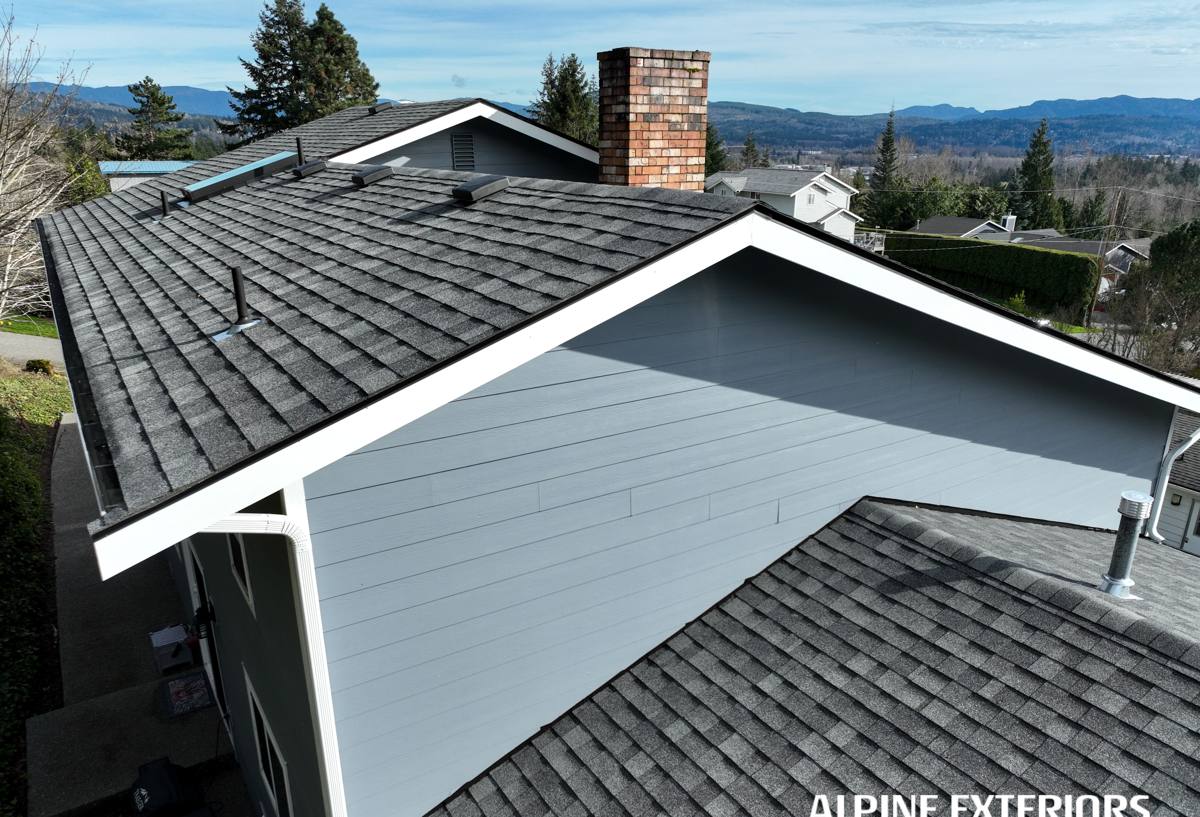
What Bellingham's Climate Actually Does to a Roof
Driving Rain and Wind-Driven Moisture
Bellingham gets a lot of rain, but the bigger issue for roofs is the angle it arrives at. Storms coming off the Strait of Georgia and Puget Sound often push rain sideways during the worst weather, which forces water up under shingle tabs, around vent boots, and into any gap in flashing that a calmer rain would never reach. A roof that's fine in a light drizzle can still leak during a windy November storm if the underlayment and flashing details weren't built for wind-driven water in the first place.
Salt Air Corrosion
Proximity to the bay means airborne salt settles on exposed metal — flashing, fasteners, vent caps, and gutter hardware — and speeds up corrosion compared to roofs further from the water. Standard electro-galvanized fasteners and thin-gauge flashing hold up fine in a lot of the country, but along the Whatcom County coastline they can start showing rust streaks and pinholing well before the shingles themselves are due for replacement. This is one of the most overlooked reasons a roof "fails early" here — it's rarely the shingle field, it's the metal.
Moss Season
Bellingham's tree cover and damp, mild climate give moss a long growing season — realistically most of the year, with the heaviest growth from fall through spring. Moss holds moisture against the shingle surface, works its way under tabs as it grows, and physically lifts shingle edges over time. A roof that isn't detailed or maintained with moss in mind will show it first at the north-facing slopes and any area with shade, well before the rest of the roof shows its age.
Signs a Bellingham Roof Needs Replacement, Not Another Repair
- Granules collecting in gutters or at downspout outlets, especially after a hard rain
- Moss established in the shingle mat itself, not just sitting on the surface
- Soft or spongy decking felt when walking the roof, usually near valleys or eaves
- Rust staining running down from flashing, vent boots, or metal chimney caps
- Daylight visible through the attic roof deck, or damp insulation below it
- Repeated leaks in the same area after past patch repairs
- Shingles curling, cupping, or cracking, particularly on sun-exposed south and west slopes
- A roof approaching or past the manufacturer's expected service life for this climate
One or two of these can often be handled with a repair. Several at once, especially combined with an older roof, usually means repair costs start competing with replacement costs without actually solving the underlying problem.
What a Correct Roof Replacement Includes Here
Tear-Off and Deck Inspection
We remove the existing roofing down to the deck rather than layering over it. That's the only way to actually see what the salt air and moisture have done to the sheathing — soft spots, delamination, or fastener corrosion don't show up until the old material is off. Any damaged decking gets replaced before anything new goes down; new shingles over a compromised deck just hide the problem for another few years.
Underlayment Built for Wind-Driven Rain
Given how often rain gets pushed sideways here, we use synthetic underlayment across the full roof and self-adhered ice-and-water membrane at the vulnerable points — eaves, valleys, and around every penetration. This is the layer that actually keeps water out if wind gets under a shingle tab during a storm, and it matters more in Bellingham than in drier, calmer climates.
Corrosion-Resistant Flashing and Fasteners
Because of salt air exposure, we don't treat flashing and fastener choice as an afterthought. We use flashing and hardware rated for coastal exposure rather than the minimum-grade materials that are fine inland but corrode early here. This is a small percentage of total material cost and one of the biggest factors in whether a roof still looks and performs well in year twelve versus year six.
Moss-Conscious Details
Where the roof plan allows it, we can install zinc or copper strips near the ridge on shaded slopes, which release trace metal ions with each rain and slow moss regrowth on the areas below. It's not a substitute for occasional cleaning, but it meaningfully extends the time between moss treatments on the parts of the roof that get the least sun.
Ventilation That Matches the Home
Proper intake and exhaust ventilation keeps the attic dry and temperature-balanced, which matters in a climate where trapped moisture is already working against the roof from outside. We check existing ventilation as part of every replacement and correct it when it's undersized or unbalanced, rather than just reusing whatever was there.
Material Options for Bellingham Homes
| Material | How It Handles This Climate | What to Know |
|---|---|---|
| Architectural asphalt shingles | Good moisture and wind performance when properly detailed; wide range of algae-resistant options | Most common choice; look for a moss/algae-resistant rated product given the local growing season |
| Standing seam metal | Sheds rain and moss buildup very well; long service life | Higher upfront cost; needs coastal-rated fasteners and coatings near the bay |
| Synthetic/composite shingles | Resists moisture absorption and moss better than untreated wood options | Higher material cost than asphalt; good fit for homes wanting a wood-shake look without the maintenance burden |
| Cedar shake | Traditional look, but holds moisture and supports moss growth more readily in this climate | We'll install it if a homeowner wants that look, but we're upfront that it demands more upkeep here than asphalt or metal |
We don't push one material on every home. The right choice depends on the roof's slope, shade exposure, budget, and how much maintenance a homeowner actually wants to keep up with — a heavily shaded north slope pushes harder toward moss-resistant materials than a sunny, open roof does.
Our Replacement Process
- On-site inspection and estimate — we walk the roof, check the attic, and identify deck condition and ventilation issues before quoting anything
- Written proposal — materials, scope, and price laid out clearly, with options if more than one approach makes sense
- Scheduling around weather — we plan tear-off days with Bellingham's rain patterns in mind so decking isn't left exposed longer than necessary
- Tear-off and deck repair — old roofing removed, deck inspected and repaired as needed
- Underlayment and flashing installation — the waterproofing layer that does the real work in wind-driven rain
- Roofing material installation — installed to manufacturer specification, not shortcuts
- Final walkthrough — we review the finished roof with the homeowner and confirm everything meets what was quoted
Why Local Experience in Bellingham Matters
A roofing crew that mostly works dry, inland climates will often use the same detailing everywhere, because it's worked for them elsewhere. That approach doesn't hold up as well against Bellingham's specific combination of salt air, wind-driven rain, and a long moss season. Crews who work Whatcom County regularly know which slopes on a typical local roof stay shaded and mossy longest, which flashing grades actually hold up near the bay, and how local weather affects scheduling a tear-off without leaving a home exposed.
That kind of local knowledge doesn't show up in a brochure, but it shows up in how the roof performs five or ten years after installation.
What Affects the Cost of a Roof Replacement in Bellingham
- Roof size and pitch — steeper, more complex roofs take longer and require more safety setup
- Layers of existing roofing that need to be removed
- Deck condition and how much sheathing needs replacing
- Material selection, from standard asphalt shingles up to metal or composite systems
- Ventilation corrections needed to bring the attic system up to standard
- Flashing and fastener upgrades for salt-air durability
- Access and site conditions, including tree cover and roof height
We give straightforward, itemized estimates rather than a single vague number, so a homeowner can see exactly what's driving the price and where there's room to adjust scope if needed.
Get a Free, No-Pressure Estimate
If your roof is showing moss buildup, granule loss, or age, or you just want an honest read on how much longer it has, we're happy to take a look. Use the form below to request a free estimate for your Bellingham home — no pressure, no obligation, just a straight assessment from a crew that works this climate every day.