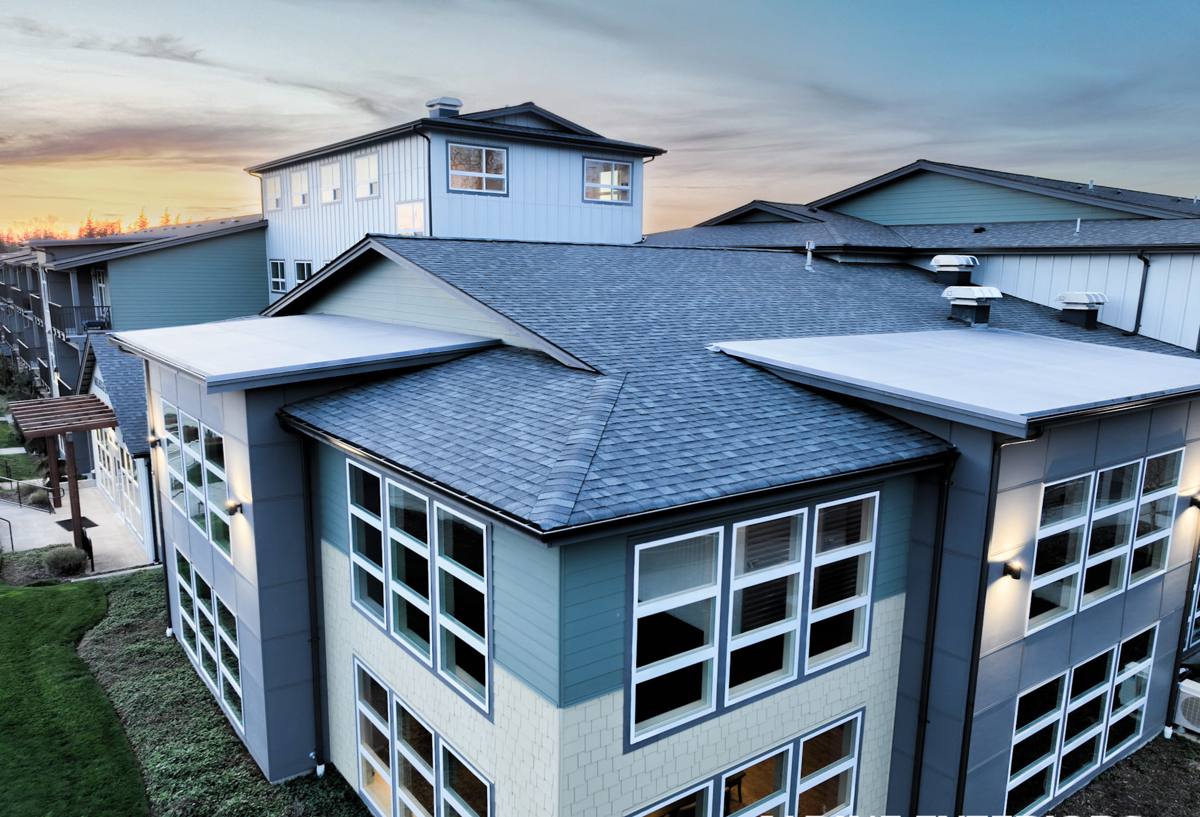
 Sudden Valley Exterior
 Ferndale Roofs Face a Different Set of Problems
A new roof in Ferndale has to deal with conditions that inland Washington homes rarely see. The proximity to Bellingham Bay and the Strait of Georgia means salt-laden air moves through the area regularly, which accelerates corrosion on fasteners, flashing, and any metal component that isn't rated for it. Add in Whatcom County's long wet season — months of driving, wind-blown rain rather than gentle straight-down showers — and you get water intrusion points that a roof built for a drier climate simply wasn't designed to handle.
Then there's moss. Ferndale's mix of shade, moisture, and mild temperatures gives moss a long growing season, and moss doesn't just sit on top of shingles looking bad — it holds water against the roofing material, lifts shingle edges, and works its way under laps over time. A roof installed without moss-conscious detailing will show problems years before it should.
None of this means a Ferndale roof needs to be exotic or overbuilt. It means the installation details that get skipped on an easy job elsewhere — proper flashing laps, correct fastener material, real ventilation — cannot get skipped here.
What a Correct New Roof Installation Actually Involves
"New roof" covers a lot of ground, and the difference between a roof that lasts its full rated life and one that fails early almost always comes down to what happens before the new shingles or panels ever go down.
Tear-off and deck inspection
We remove the old roofing down to the deck rather than layering over it. That's the only way to actually see the plywood or plank sheathing underneath — soft spots, old water staining, and rot hide under existing roofing and only show up once it's gone. Any damaged sheathing gets replaced before anything new goes on top of it.
Underlayment suited to the climate
Given how much of the year Ferndale sees rain, we treat underlayment as a real second line of defense, not a formality. Synthetic underlayment with proper lapping, plus self-adhered ice-and-water membrane at eaves, valleys, and any low-slope transitions, gives the roof a backup layer if wind-driven rain ever gets under the primary roofing surface.
Flashing at every transition
Chimneys, skylights, sidewalls, and valleys are where the overwhelming majority of roof leaks originate — not in the open field of shingles. Correct step flashing, counter-flashing, and valley metal, properly lapped with the underlayment and roofing material, is non-negotiable on every installation we do.
Ventilation, intake and exhaust
A roof deck that can't breathe traps moisture from inside the house, which condenses, saturates insulation, and can rot sheathing from below — independent of anything happening on the outside surface. Balanced intake (soffit) and exhaust (ridge or box vents) ventilation is part of a correct install, not an upsell.
Choosing a Roofing Material for a Ferndale Home
There's no single "best" roofing material — there's the right material for a given home, budget, and roofline. Here's how the common options actually perform under Whatcom County's salt air, rain, and moss exposure:
| Material | Moss/moisture behavior | Salt air durability | Maintenance |
|---|---|---|---|
| Asphalt composition shingle | Good with proper ventilation; zinc/copper strips reduce moss regrowth | Good; fasteners should be corrosion-resistant | Low — periodic moss treatment recommended |
| Standing seam metal | Excellent; sheds water and moss struggles to hold on smooth panels | Very good when finish and fasteners are coastal-rated | Low |
| Cedar shake | Requires diligent ventilation and gapping; moss and moisture are the primary long-term concern | Fair; needs regular care in salt air | Higher — periodic cleaning and treatment |
| Synthetic composite shingle/shake | Good; doesn't absorb moisture like wood | Good | Low |
We install all of the above and will walk through the honest trade-offs for your specific roof rather than steering everyone toward one product. Cedar shake, for example, can look great on the right home, but it asks for more ongoing homeowner attention in a climate like this one — that's a maintenance conversation, not a knock on the material.
Ventilation and Moisture: The Part Homeowners Don't See
Most new-roof problems that show up as "the roof failed" are actually ventilation or moisture-management problems that just happen to appear on the roof. Signs we look for on Ferndale homes during a new-roof estimate include:
- Insufficient or blocked soffit vents, which starves the attic of intake air
- Bathroom or kitchen exhaust fans that dump moist air into the attic instead of outside
- Undersized or mismatched ridge venting relative to the home's square footage
- Poly or vapor barriers installed incorrectly relative to the local climate
- Existing moss growth concentrated on the north-facing or shaded slopes, a sign of slow-drying areas
We correct what we can as part of the reroof and flag anything structural (like inadequate attic insulation) that's outside the roofing scope but worth addressing.
Our Installation Process
- On-site inspection and estimate — we walk the roof and attic, note deck condition, ventilation, flashing points, and moss/moisture patterns specific to your property.
- Material selection — we go over the honest trade-offs for your roofline, budget, and how long you plan to stay in the home.
- Scheduling around Whatcom County weather — we plan tear-off in sections so your home is never left open to a passing storm overnight.
- Tear-off and deck repair — full removal of old roofing, sheathing inspection, and replacement of any compromised decking.
- Underlayment and flashing — ice-and-water membrane at vulnerable points, synthetic underlayment across the field, new flashing at every penetration and transition.
- Roofing installation — installed to manufacturer specification and local code, with corrosion-resistant fasteners throughout.
- Ventilation check and correction — intake and exhaust balanced for the home's attic volume.
- Final walkthrough and cleanup — magnetic sweep for nails, debris haul-away, and a walk-through so you know what was done and why.
Common Mistakes We See on Ferndale Reroofs
A lot of the repair and reroof calls we get in this area trace back to a handful of recurring shortcuts from a prior installation:
Nailing over-driven or under-driven
Fasteners that are set too deep cut into the shingle mat and lose holding power; ones left proud can back out over years of freeze-thaw and wind cycling. Both show up as loose or lifted shingles well before the material's rated life.
Flashing reused instead of replaced
Old step flashing or valley metal left in place under new shingles is a common corner-cutting move — it saves labor time but leaves corroded or improperly lapped metal doing a new roof's most important job.
Ventilation left as-is
Reroofing over the same ventilation setup without evaluating whether it was adequate in the first place carries forward the exact moisture problems the old roof had.
Ignoring moss until it's a leak
Moss treatment and zinc/copper control strips are inexpensive compared to the cost of moss-related shingle damage a few years down the road.
Cost Factors for a New Roof in Ferndale
We don't quote pricing without seeing the roof, but the factors that move a bid up or down are consistent. This is meant to help you understand what's driving the number, not to replace a real estimate:
| Factor | Why it affects cost |
|---|---|
| Roof size and number of planes | More material and more labor hours; complex rooflines take longer per square than a simple gable |
| Pitch and access | Steep or hard-to-access roofs require more safety setup and slow down installation |
| Deck condition | Rotted or soft sheathing found during tear-off adds material and labor to replace it properly |
| Material choice | Asphalt, metal, cedar, and composite shakes carry different material and install-labor costs |
| Flashing and penetrations | Chimneys, skylights, and multiple valleys each add flashing work |
| Ventilation corrections | Adding or upgrading intake/exhaust venting is inexpensive during a reroof, costlier after |
Why It Matters That We Already Work in Ferndale
A roofing crew that regularly works Whatcom County jobs already knows how much ice-and-water membrane a given eave needs, which fastener spec holds up against the salt air off the bay, and how much moss control matters on a shaded north slope versus a sun-exposed one. That's not something you get from a general spec sheet — it's what you learn from doing the work in this specific climate, roof after roof.
It also means we're a known, reachable local business if a question comes up after the job is done — not a crew that worked through the area once and moved on.
After Installation: Keeping a New Roof Performing
A correctly installed roof still benefits from basic homeowner attention, especially in a climate that grows moss year-round:
- Keep gutters clear so water isn't backing up under the eaves
- Trim back overhanging branches to reduce shade and debris on the roof surface
- Have moss growth treated before it spreads, rather than after it's visible from the street
- Check attic ventilation isn't blocked by insulation or storage after move-in
- Schedule a periodic visual inspection, particularly after major windstorms
If you're weighing a new roof for a Ferndale home, we're glad to come out, look at the actual roof and attic, and give you a straight answer on condition, options, and what it will take to do it right. Use the form below to request a free, no-pressure estimate.