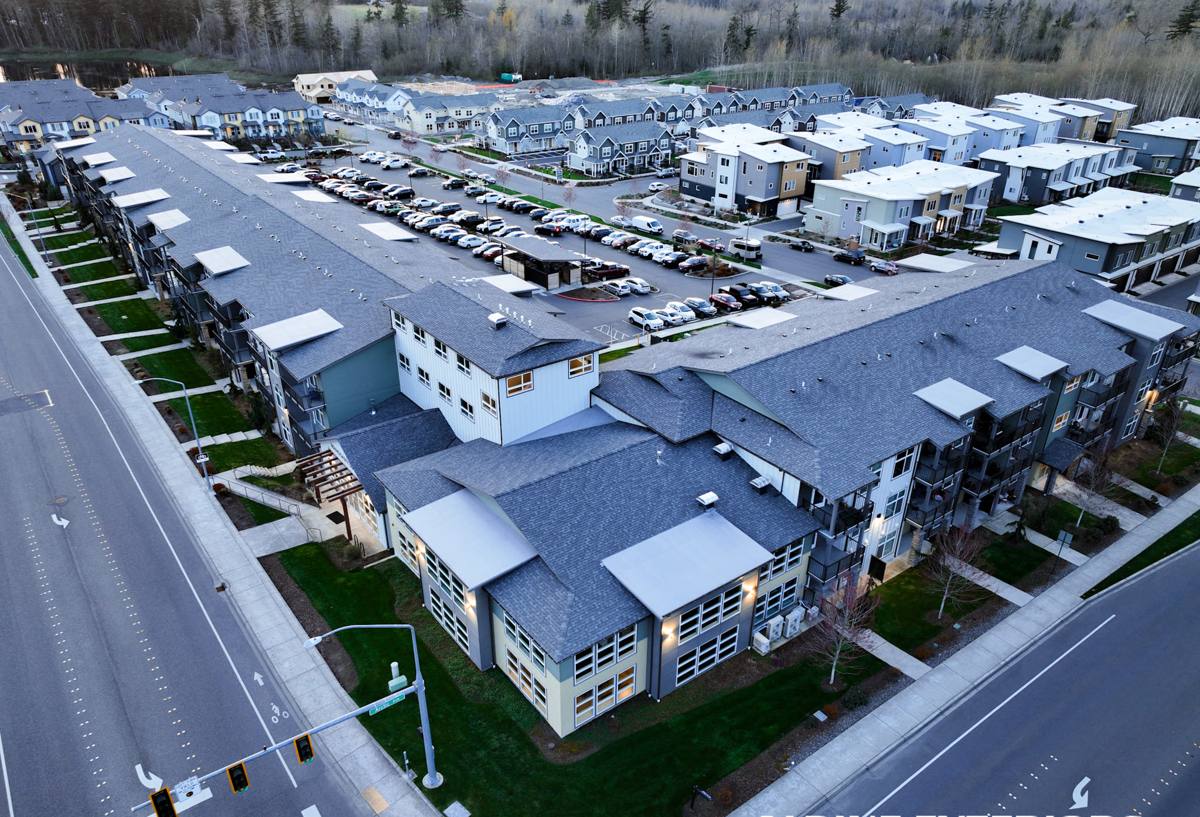
 Sudden Valley Exterior
 Building New in Happy Valley? Get the Windows Right the First Time
If you're framing a new home in the Happy Valley area near Sudden Valley, the window package you choose during construction sets the tone for the next 20-plus years of that house's life. New construction gives you one real advantage over a retrofit: the wall is open, the flashing planes are accessible, and the window can be integrated into the building envelope properly instead of patched in around existing siding and trim. That window of opportunity — no pun intended — closes the day the siding goes on. Get it wrong now, and you're paying for a repair job in five to ten years instead of a maintenance-free install.
We work new-construction jobs in this part of Whatcom County regularly, and the same regional stressors show up on every project: salt-laden air moving in off the water, long stretches of driving rain, and a moss season that can run half the year. None of that is exotic or unusual — but it does mean a generic window install, done the way it might be done in a drier inland climate, is the wrong approach here.
What Happy Valley's Climate Actually Does to a Window Installation
Salt Air and Metal Fatigue
Salt-laden air corrodes unprotected fasteners, cheap window hardware, and unclad metal trim faster than most homeowners expect. It's not dramatic — you won't see rust overnight — but over a decade, it's the difference between hardware that still operates smoothly and a window that's stiff, pitted, or seized. This is a materials-selection issue, not an installation trick: it means specifying corrosion-resistant fasteners and hardware rated for coastal-adjacent exposure at the framing stage, before the wall is closed up.
Driving Rain and Wind-Driven Water
Whatcom County storms don't just drop rain straight down — wind pushes it sideways, right into the wall plane. A window that's watertight in calm conditions can still leak under wind-driven rain if the flashing details aren't right. This is the single most common failure point we see in new construction: the window unit itself is fine, but the flashing sequence around it wasn't built to shed water in the direction it actually travels during a real Pacific Northwest storm.
Moss, Moisture, and Slow-Drying Assemblies
A long moss season means extended periods where exterior surfaces stay damp longer than they would in a drier climate. That matters for window installs because any wall assembly that traps moisture instead of letting it drain and dry will eventually show it — at the window opening first, since that's where the building envelope has the most seams. New construction lets us build a wall that manages moisture correctly from day one, rather than fighting a wet assembly after the fact.
What a Correct New-Construction Window Install Actually Involves
"New-construction windows" refers to a window style with a nailing flange, installed before the exterior finish goes on — as opposed to a "replacement" or "pocket" window fitted into an existing opening. The nailing flange is what gets integrated into the house wrap and flashing, and that integration is where the real work happens.
- Rough opening check — verify the opening is square, level, and sized correctly before the window ever gets set. A slightly out-of-square opening now means a lifetime of a window that doesn't latch cleanly.
- Sill pan flashing — a sloped, sealed pan at the bottom of the opening so any water that gets past the window has somewhere to go besides into the framing.
- Weather-resistive barrier integration — house wrap cut and lapped in the correct shingle-style sequence (bottom pieces overlapped by top pieces) so water is directed outward at every layer, not trapped behind the flange.
- Window set and fasten — set plumb, level, and square, then fastened per the manufacturer's schedule — not just "however many screws seem like enough."
- Flange flashing tape — head, jamb, and sill flanges taped in the correct order (sides first, then head, with the head flashing lapping over the top of the side tape) so wind-driven rain is shed outward, not funneled toward a seam.
- Head flashing — a separate metal or membrane flashing above the window that kicks water away from the top of the opening before it ever reaches the flange.
- Interior air sealing — low-expansion foam or sealant around the interior perimeter, which does double duty for energy performance and keeping interior moisture out of the wall cavity.
Every one of those steps is inspectable while the wall is still open. Once siding and trim go on, you're trusting that each step was done right — which is exactly why the crew doing this work matters as much as the window brand.
Choosing a Window Package for This Climate
We don't push a single brand — the right window depends on your budget, the home's design, and how much long-term maintenance you want to take on. But a few honest trade-offs matter more here than they would in a milder inland climate:
| Factor | What to look for in this climate | Why it matters here |
|---|---|---|
| Frame material | Vinyl or fiberglass with proven coastal-region performance; clad-wood if you want the wood look | Bare wood exteriors need more upkeep against driving rain and damp, moss-prone conditions |
| Hardware/fasteners | Corrosion-resistant, coastal-rated | Salt air accelerates corrosion on standard hardware over time |
| Glass package | Dual-pane, low-E, argon-filled as a baseline | Manages condensation and heat loss through the long wet, cool season |
| Water/air rating | Look for a documented performance rating, not just a marketing claim | Wind-driven rain resistance is a tested spec, not a guess |
| Warranty structure | Understand what's covered — glass seal, hardware, and finish are often separate warranties | Coastal exposure is exactly the condition where the fine print starts to matter |
We'll walk you through actual product options once we know your budget and design — this table is meant to help you ask the right questions, not to sell you on one line.
Our Process for Happy Valley New Builds
We work with your builder or general contractor, or directly with you if you're owner-building. Typical sequence:
- Review the window schedule and rough openings against the plans before framing is finalized
- Confirm flashing details and sequencing with the builder ahead of time, so there's no ambiguity about who's doing what
- Install windows once the wall is framed and wrapped, before siding
- Photograph flashing and pan details at each opening for your own records, since this work gets covered up
- Final walk-through on operation, hardware, and weatherstripping before the wall is closed in
Timing matters on new construction — we coordinate directly with your build schedule so windows aren't a bottleneck, but we also won't rush a flashing detail to hit a date. A wall that's closed in around a bad flashing job is a much more expensive fix later than a half-day delay now.
A Practical Checklist Before You Sign Off on Your Window Package
- Do the rough openings match the actual window sizes, with proper shim space?
- Is there a sloped sill pan at every opening, not just caulk?
- Is the house wrap lapped correctly at every flange — sides, then head?
- Is there separate head flashing above each window opening?
- Are fasteners and visible hardware rated for coastal-adjacent exposure?
- What's actually covered under warranty — glass, frame, hardware, labor — and for how long?
- Has someone photographed the flashing details before siding covers them?
Why Local Experience Matters More Than It Seems
A window flashing detail that works fine in a drier climate can fail here simply because the rain comes sideways more often and stays around longer. Crews that mostly work inland or in milder markets sometimes bring those habits with them — not out of carelessness, but because it's what they know. We build every opening assuming wind-driven rain and a long damp season are the normal condition, not the exception, because in Whatcom County near Sudden Valley, they are.
That's the real value of hiring a crew that already works this specific area: we're not guessing at how water moves across a wall here, and we're not learning on your house.
Let's Talk About Your Build
If you're framing a new home in Happy Valley or elsewhere around Sudden Valley and want the window package planned correctly from the rough opening forward, we're glad to walk through it with you. Reach out for a free, no-pressure estimate — the form below gets you started.