 Sudden Valley Exterior
 Siding Repair in Geneva: What Whatcom County Weather Does to a Home's Exterior
Geneva sits close enough to the water and the timber line that homes here take a specific kind of beating. Salt-laden air moves in off the water and settles into anything porous. Driving rain, pushed sideways by wind off Lake Whatcom and the surrounding hills, finds every gap in flashing and trim. And because this part of Whatcom County stays cool and damp for much of the year, moss and algae get a long season to work into seams, laps, and fastener holes. None of that shows up overnight. It shows up as a soft spot behind a downspout, a stain that won't wash off, or a board that's started to cup at the edges.
Siding repair in this climate isn't just patching what's visible. It's understanding why that spot failed in the first place, because if the underlying cause — a bad flashing detail, a caulk joint that gave out, a material that was never suited to this much moisture — isn't addressed, the same failure comes back in the same place a year or two later.
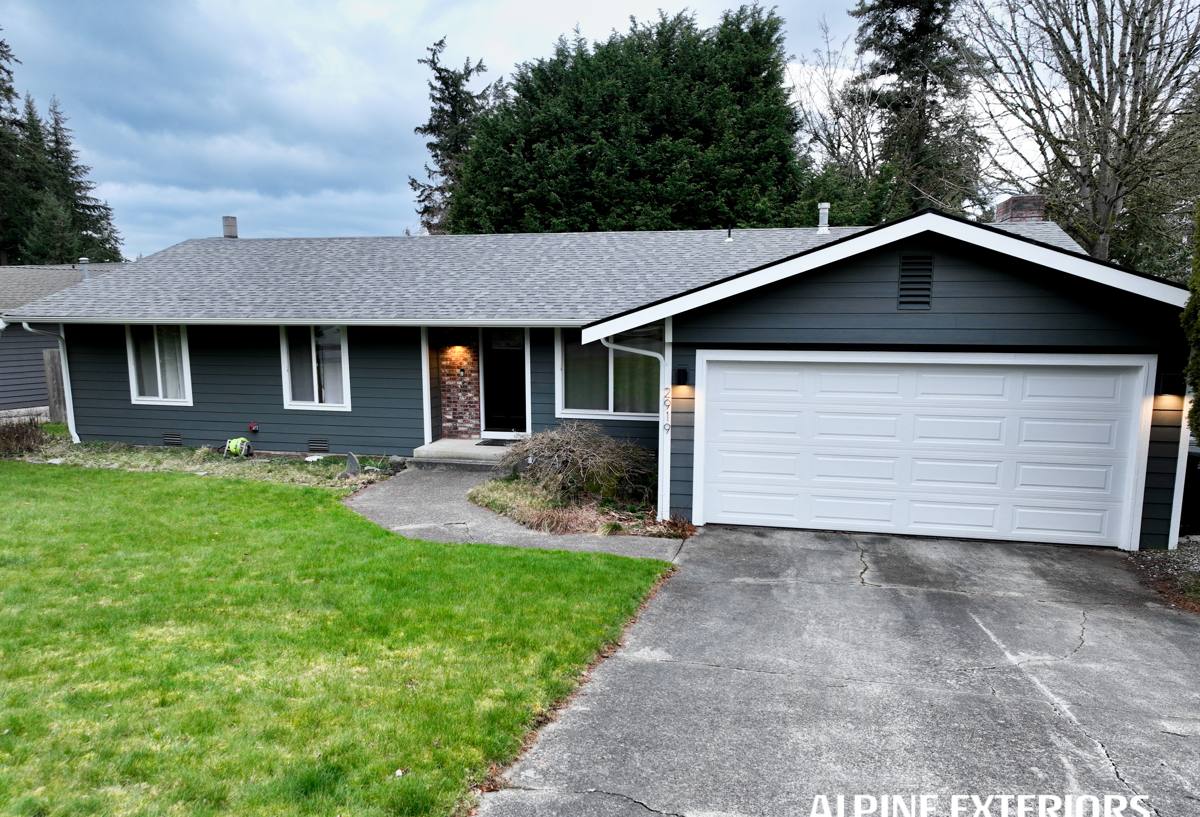
Signs Your Geneva Home Needs Siding Repair
Most siding damage in this area starts small and stays hidden behind trim, under eaves, or low on the wall where splashback collects. A short walk around the exterior once or twice a year catches most of it before it becomes a bigger job.
- Soft, spongy, or bubbling siding when pressed — usually a sign of trapped moisture underneath
- Visible cracking, splitting, or warping, especially on south- and west-facing walls that take the most weather
- Persistent black or green streaking that returns quickly after cleaning
- Peeling or bubbling paint, or chalky, faded color on one section that doesn't match the rest
- Gaps opening up at seams, corners, or around window and door trim
- Rust staining below nail heads or fasteners
- Any spot where you can see daylight, feel a draft, or notice a musty smell from inside near an exterior wall
Why These Signs Matter More Here
In a drier climate, a small crack or gap might sit for years without consequence. In Geneva's damp, moss-friendly conditions, that same gap is a wick — it pulls in moisture every time it rains, and with the amount of rain Whatcom County gets, that's often. Left alone, water intrusion behind siding leads to sheathing rot and framing damage that costs far more to fix than the siding itself.
What a Correct Siding Repair Actually Involves
A repair that only replaces the damaged board and stops there is a patch, not a fix. A correct repair traces the problem back to its source.
Diagnosing the Cause
Before any siding comes off, we look at what's feeding the damage: is water getting past a flashing detail above a window, running down behind a butt joint, or wicking up from grade-level splashback? Damaged siding is often a symptom. Fixing the symptom without fixing the cause just delays the next repair call.
Removing and Inspecting Behind the Siding
Once the damaged panels or boards are pulled, we check the water-resistive barrier and sheathing underneath. If moisture has gotten past the siding, there's a good chance it's affected what's behind it. Any soft or rotted sheathing gets replaced — patching over compromised sheathing is one of the most common corners cut in cheap siding repairs, and it guarantees a repeat failure.
Matching Materials and Finish
Mismatched replacement siding is one of the most common complaints homeowners have after a repair — a new board that's a slightly different shade or profile than the surrounding wall. Because we work with James Hardie's factory-finished ColorPlus lines, we can match existing color and texture far more reliably than with field-painted materials, whose finish weathers and fades unevenly over time.
Sealing, Flashing, and Fastening Correctly
The final step is the one that determines whether the repair lasts: correct flashing above openings, proper caulking at the joints that actually need it (and not the ones that don't — over-caulking traps moisture just as badly as gaps let it in), and fasteners set to the manufacturer's specification, not just driven in tight.
Repair vs. Replacement: How We Make the Call
Not every damaged section needs a full re-side, and not every repair is worth doing instead of replacing a larger section. We walk homeowners through this honestly rather than defaulting to whichever job is bigger.
| Situation | Usually Repair | Usually Replace (Section or Full) |
|---|---|---|
| Damage confined to one or two boards, isolated cause | Yes | No |
| Rot or moisture damage spread across a wall | No | Yes |
| Original siding is vinyl, LP SmartSide, or untreated wood nearing end of life | Case by case | Often, for long-term value |
| Existing siding is James Hardie, damage is localized | Yes | No |
| Repeated failures at the same spot over multiple years | No | Yes — points to a design or material flaw, not bad luck |
Why We Repair (and Rebuild) with James Hardie Fiber Cement
When a repair does call for replacing a full section or wall, we install James Hardie fiber cement — it's the only siding product we put on homes, full stop. We don't install vinyl, LP SmartSide, Cemplank, Allura, primed spruce, or cedar, and we're upfront about why: those products each carry trade-offs in this climate that Hardie's engineered lines are specifically built to avoid.
Built for Wet, Salt-Exposed Climates
Hardie's HZ10 product line is engineered for climates with significant moisture exposure and freeze-thaw cycling — a good match for a location dealing with salt air and driving rain for much of the year. Fiber cement doesn't swell, rot, or provide the same food source for moss and mildew that wood-based products can.
ColorPlus Finish for Repair Matching
Hardie's ColorPlus finish is baked on in a factory, not brushed on at the jobsite, which means it holds color and resists fading more consistently over time — a real advantage when a future repair needs to blend into existing siding years down the road.
Non-Combustible and Warrantied
Fiber cement is non-combustible, and Hardie backs its products with a strong, transferable warranty when installed to spec — something that matters both for the homeowner living there now and for resale value later.
Our Process for Geneva Siding Repair Calls
- Inspection and diagnosis — we assess the damage, identify the cause, and check for hidden moisture behind the siding
- Honest scope and estimate — we tell you plainly whether it's a repair or whether a larger section should be replaced, and why
- Removal and sheathing check — damaged material comes off, and anything compromised underneath gets addressed before new siding goes back on
- Correct reinstallation — proper flashing, fastening, and sealing to manufacturer spec, not just cosmetic patchwork
- Color and finish match — matched as closely as the product line allows so the repair doesn't stand out
- Final walkthrough — we show you what was found, what was fixed, and what to keep an eye on going forward
Why a Crew That Already Works Geneva Matters
Siding repair mistakes are almost always mistakes of assumption — assuming a flashing detail that works in a drier region will hold up here, or assuming a quick caulk-and-paint job is enough when the real issue is moisture already trapped behind the wall. A crew that works Sudden Valley and the surrounding Whatcom County area regularly has already seen how local conditions — the humidity, the moss growth pattern, the way wind-driven rain hits certain wall orientations — actually play out on homes like yours. That's the difference between a repair that holds and one that's back on the schedule next season.
Cost Factors in Siding Repair
Every repair is different, but a few factors consistently drive cost up or down. We give a firm, written estimate after inspection rather than a phone-quote guess, because the visible damage is rarely the whole story.
| Factor | Why It Matters |
|---|---|
| Extent of hidden moisture damage | Rotted sheathing or framing behind the siding adds real cost beyond the siding itself |
| Accessibility of the damaged area | Second-story or hard-to-reach sections take more labor and equipment |
| Color and profile matching | Matching older or discontinued siding can require more careful sourcing |
| Root cause repair (flashing, grading, drainage) | Fixing the actual cause, not just the symptom, prevents repeat costs |
| Scope — patch vs. full wall section | Larger sections can sometimes be more cost-effective per square foot than isolated patches |
Maintaining Your Siding After Repair
A correct repair should hold for years, but a little upkeep extends that considerably — especially in a climate that gives moss and moisture this much time to work.
- Rinse siding down at least once a year to clear moss, algae, and salt residue before it builds up
- Keep gutters clear so overflow doesn't run down the wall face
- Trim back landscaping that shades siding and keeps it damp longer than it should stay
- Check caulk joints at trim and openings annually, and re-seal if they've cracked or pulled away
- Walk the exterior each fall and spring looking for the early warning signs listed above
If you're seeing damage on your Geneva home, or you just want a second opinion on whether it's a repair or something bigger, we're happy to take a look. Reach out for a free, no-pressure estimate using the form below.