 Sudden Valley Exterior
 Why Geneva's Spot on Lake Whatcom Is Hard on Siding
Geneva sits tucked along the north shore of Lake Whatcom, right next to Sudden Valley, and that location creates its own weather pattern separate from what you'd get a few miles away in Bellingham proper. Homes here sit close to open water, under heavy tree cover, and on slopes that trap moisture instead of shedding it. That combination — lake-effect dampness, shade, and limited airflow — is a tougher environment for exterior siding than most of Whatcom County sees.
Moisture that doesn't leave
Driving rain off the lake gets pushed sideways into walls by wind funneling through the valley, and the surrounding tree canopy blocks the sun that would otherwise dry a wall face out between storms. On a lot with good southern exposure, siding gets a chance to dry between rain events. On a shaded, lake-facing wall in Geneva, that drying window can be short or nonexistent for weeks at a stretch during the wet season.
Moss, algae, and a long growing season
Wherever moisture sits and sunlight is scarce, moss and algae follow. North-facing walls, siding under eaves without gutters, and anything close to mature trees tend to green up first. That's a cosmetic problem at first, but moss holds water against the surface longer than bare siding would, which accelerates whatever underlying moisture damage is already happening. A siding material that resists water absorption at the core, not just at the paint layer, matters more here than in a drier part of the county.
What James Hardie Fiber Cement Actually Solves Here
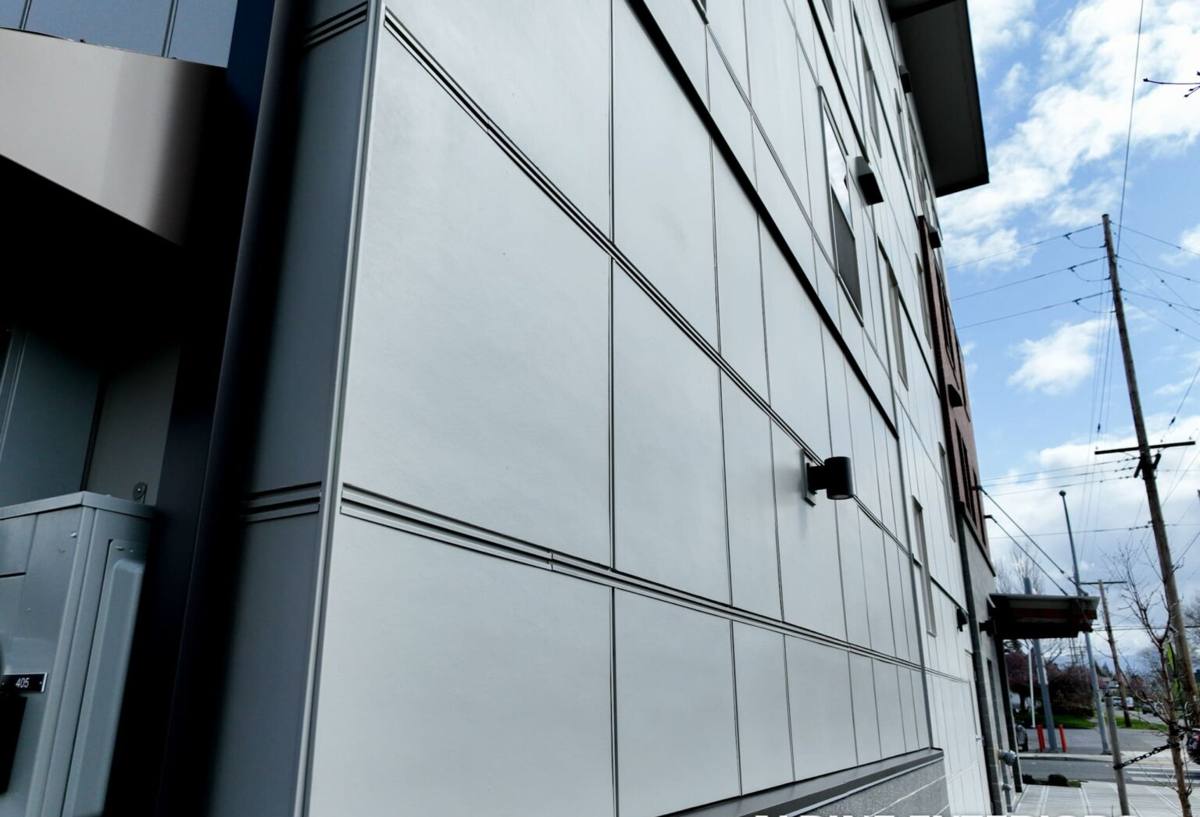
We install James Hardie exclusively, and on a lot like the ones around Geneva, the reasoning is straightforward. Fiber cement doesn't absorb water the way wood-based products do, it won't rot, and it holds its shape and paint line under repeated wet-dry cycling far better than materials with a wood or wood-fiber core.
A core that doesn't feed rot or insects
James Hardie's board is cement, sand, and cellulose fiber, cured into a rigid, non-organic material. It gives moss and mildew nothing to feed on the way a wood-based substrate can, and it isn't a food source for carpenter ants or moisture-loving insects that show up in damp, wooded settings like the Lake Whatcom shoreline.
ColorPlus finish versus field-applied paint
Most Hardie product on this kind of job goes on with a factory-applied ColorPlus finish rather than a job-site paint job. That finish is baked on under controlled conditions and backed by its own product warranty, and it holds color and resists fading better than a coat applied outdoors, especially on a wall that spends half the year under damp shade. Less repainting also means fewer disturbed caulk lines and fastener heads over time — every time you repaint, you introduce a chance to seal something wrong.
Non-combustible construction
Fiber cement doesn't support flame spread the way wood-based siding can. That's a wildfire-adjacent consideration more than a lake-moisture one, but it's part of why we standardized on Hardie across every job we do, Geneva included.
Picking the Right Hardie Product Line for This Site
James Hardie makes climate-specific formulations, and for a shaded, lake-adjacent property, the choice of HZ product line and profile is not a minor detail — it affects how the board handles the moisture cycle we described above.
| Product | Best use on a Geneva-area home | Why it fits |
|---|---|---|
| HardiePlank lap siding | Primary wall siding, most common choice | Traditional lap profile, wide color range, engineered for the Pacific Northwest's wet-dry cycling |
| HardiePanel vertical siding | Accent walls, gables, modern facades | Fewer horizontal seams to maintain on high-exposure gable ends |
| HardieTrim boards | Corners, window and door casing, fascia | Matches the fiber cement performance of the field siding instead of mixing in wood trim that will fail first |
| HZ5 vs. HZ10 engineering | Region-specific formulation Hardie assigns by climate zone | Western Washington falls in a wet, moderate-freeze zone; using the correct HZ spec avoids installing a formulation engineered for a different climate |
We confirm the correct HZ designation and profile mix for each Geneva job during the site visit rather than assuming — orientation, tree cover, and lake exposure vary block to block even within a small community like this one.
What a Correct Installation Involves
James Hardie siding performs to its warranty and its reputation only when it goes on correctly. In a high-moisture setting like this one, the installation details matter more than the brand name on the board.
A drainage plane behind the siding
Correct installation includes a weather-resistant barrier and, on most walls, a rain-screen gap that lets any moisture that does get behind the siding drain and dry out instead of sitting against the wall sheathing. This is the single biggest difference between a Hardie installation that lasts decades and one that develops hidden problems in five years, and it's the step that gets skipped most often by crews trying to save time.
Fastening, clearances, and flashing
Hardie specifies exact fastener spacing, minimum clearance from grade, decks, and roof lines, and specific flashing details at every window, door, and penetration. Get the ground clearance wrong on a lakeside lot with a lot of splash-back rain and moisture wicks straight into the bottom course. Get the flashing wrong at a window head and water tracks behind the siding for years before anyone notices a stain.
Caulking discipline
Hardie's own installation guidance is selective about where caulk belongs and where it doesn't — over-caulking can trap moisture rather than shed it. A crew that installs Hardie regularly follows the manufacturer's actual joint treatment rather than a generic "caulk everything" habit.
- Weather-resistant barrier installed continuously, lapped correctly at seams
- Rain-screen or drainage gap behind the siding on exposed walls
- Minimum clearance maintained from grade, roofing, and decking
- Correct fastener type and spacing per the Hardie install guide, not generic siding nails
- Flashing integrated at every window, door, and penetration before siding goes on
- Factory-cut and field-cut edges sealed per Hardie's specification, not skipped
- Caulk used only where Hardie's guidelines call for it
Mistakes We See on Older Siding Around Geneva and Sudden Valley
A lot of the siding failures we get called out to inspect in this area trace back to installation shortcuts rather than the material itself. Missing or skipped rain-screen gaps, siding installed tight to grade or to a deck surface, and butt joints without proper flashing all show up more often on shaded, lake-facing walls simply because there's less sun to mask the consequences. Moss growth that isn't addressed also tends to hide early staining and softness at board edges until it's further along than a homeowner realizes.
Our Process for a Geneva Hardie Project
Site assessment
We walk the property, note tree cover, lake exposure, drainage patterns around the foundation, and the condition of the existing siding and trim. On a wooded, lakeside lot, we pay particular attention to which walls stay damp longest and where moss has already established.
Product and color selection
We help you choose the right Hardie profile, HZ formulation, and ColorPlus color for the site and the home's exposure, factoring in how much sun each elevation actually gets.
Installation
Removal of the old siding, inspection and repair of any sheathing damage found underneath, correct weather barrier and drainage plane installation, then the Hardie siding, trim, and flashing detail work.
Final walkthrough and warranty registration
We walk the finished job with you, confirm seams, caulk lines, and clearances, and register the manufacturer warranty in your name so it's transferable if you sell the home.
Cost Factors for a Geneva Siding Project
| Factor | Why it moves the price |
|---|---|
| Existing siding removal and disposal | Tear-off adds labor, especially if old siding or trim has hidden moisture damage |
| Sheathing repair | Rot found under old siding on shaded, lake-facing walls has to be replaced before new siding goes on |
| Access and site layout | Sloped, wooded, or waterfront lots common around Lake Whatcom can add setup and staging time |
| Profile and trim complexity | Multiple siding profiles, extensive trim, or vertical accent panels add labor over a single flat lap-siding run |
| Color | Standard ColorPlus colors versus custom or premium selections |
We give a firm, itemized quote after the site visit rather than a phone estimate — on lots like these, what's underneath the old siding matters as much as the square footage.
Why a Crew That Already Works This Area Matters
Geneva and Sudden Valley aren't like a flat subdivision in town. Lake exposure, slope, tree cover, and access all vary house to house, and a crew that's already worked this shoreline knows which walls typically need extra attention to drainage and which don't. That local pattern recognition, paired with installing nothing but James Hardie and following its specification to the letter, is what keeps a siding job performing for decades instead of needing attention again in five or six years.
If you're planning a siding project in Geneva or elsewhere around Sudden Valley, we're happy to take a look and put together a free, no-pressure estimate — just fill out the form below.