 Sudden Valley Exterior
 Siding That Has to Work in Geneva's Weather, Not Just Look Good on Day One
Homes around Geneva face the same weather pattern that shapes every property near Sudden Valley and the rest of Whatcom County: wet winters, wind-driven rain that comes in sideways off the water, tree-shaded lots that stay damp long after a storm passes, and a moss season that can run half the year in the shadier spots. Siding that isn't built for that combination doesn't fail all at once — it fails slowly, in ways that are easy to miss until the repair bill is bigger than it needed to be: soft trim boards, streaked or peeling paint, swollen seams, and green film creeping up from the base of the wall.
This page is about one product, in one place: fiber cement lap and panel siding installed correctly on Geneva-area homes. We're not going to give you a generic rundown of siding options — we're going to explain what this specific climate does to siding, what a correct installation has to account for, and why we've standardized on a single product line for every home we side in this area.
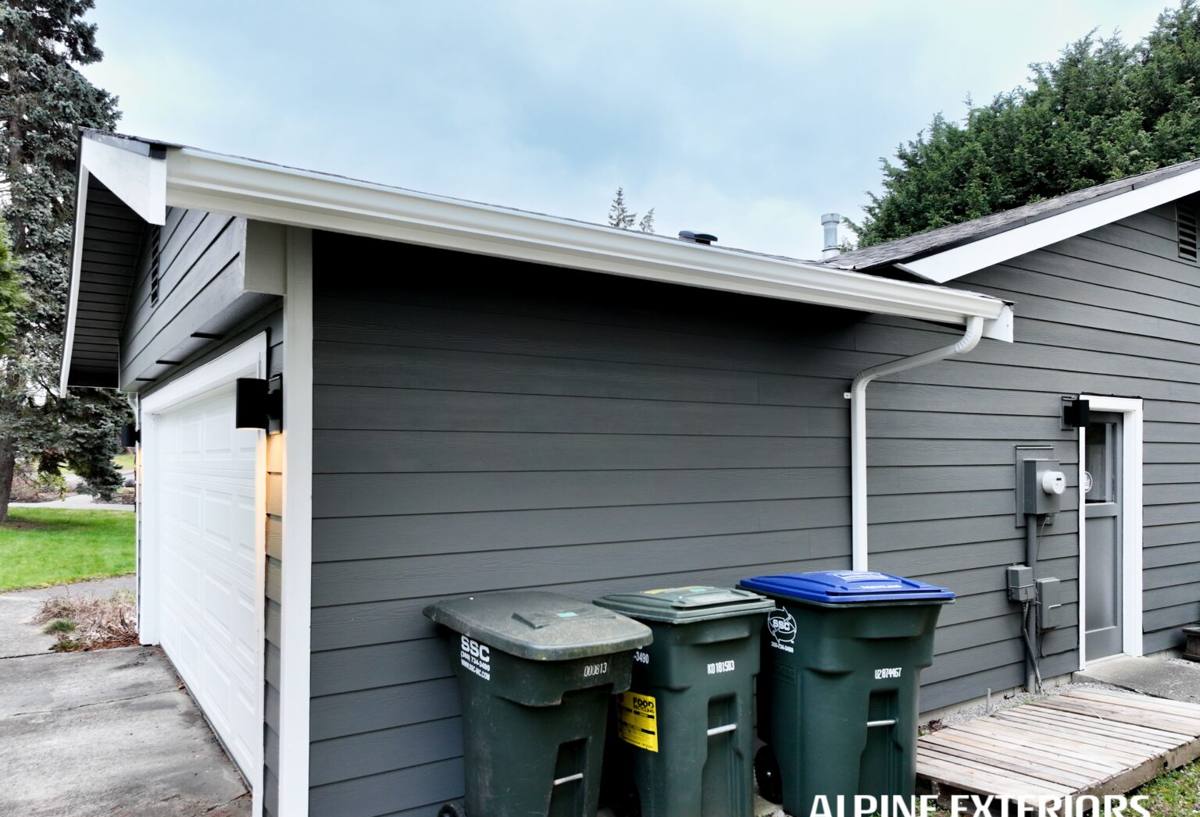
What This Climate Actually Does to Siding
Driving rain and wind-driven moisture
Storms coming off the water don't just fall straight down — wind pushes rain sideways and up under laps, trim, and butt joints. Any siding system that depends on caulk alone to keep that water out will eventually let some through. Once moisture gets behind the cladding, it needs somewhere to go, and on a lot of older installations, it doesn't have one.
Moss, algae, and shaded exposures
Lots near Lake Whatcom and Sudden Valley tend to have mature tree cover, which is great for privacy and terrible for dry time. North- and east-facing walls that stay in shade most of the day hold moisture longer, and that's exactly the condition moss and algae need to take hold. Organic-based siding materials give that growth something to feed on and root into; siding that's inert and non-organic doesn't.
Marine-influenced, salt-laden air
Whatcom County's proximity to Puget Sound and the Salish Sea means the air carries salt content that inland areas don't deal with. Over years, that accelerates corrosion on exposed fasteners and metal trim, and it works against finishes that aren't formulated to resist it. It's a slow effect, but it's a real one, and it factors into what fasteners, flashing, and finish we spec on every job.
Put those three things together — sideways rain, prolonged shade and moisture, and salt-influenced air — and you get a climate that is genuinely hard on wood-based composite siding, cedar, and vinyl. Wood-based products can swell and soften at cut edges and seams once moisture gets in repeatedly. Vinyl can warp, fade, and gap at the corners as it expands and contracts, leaving more opportunities for wind-driven water to find a way behind it. None of that means those products are worthless everywhere — it means we don't think they hold up well enough, for long enough, in this specific climate to be worth installing here.
Why We Install James Hardie Fiber Cement — and Nothing Else
We install James Hardie fiber cement siding exclusively. Not LP SmartSide, not vinyl, not Cemplank or Allura, not primed spruce or cedar. That's a deliberate standard, not a lack of options.
- Non-combustible material. Fiber cement is made from cement, sand, and cellulose fiber — it doesn't burn, swell from moisture the way wood-based products can, or degrade from insect activity.
- Climate-engineered product line. Hardie manufactures different formulations for different climate zones. The HZ5 line is built for the wetter, cooler regions that include the Pacific Northwest, which matters for a place that sees the rainfall and humidity Whatcom County does.
- Factory-applied ColorPlus finish. The color is baked on at the factory in a controlled process, which gives more consistent resistance to fading and moss/mildew staining than field-applied paint on a jobsite, and it comes with its own finish warranty.
- Dimensional stability. Fiber cement doesn't expand and contract with moisture and temperature the way wood-based composites and vinyl do, so joints and fastening stay tighter over time.
- A transferable warranty backed by a large, established manufacturer. That matters if you sell the home — a warranty that's actually going to be honored is worth more than a slightly cheaper install today.
We're not going to tell you every other product is junk — LP SmartSide and vinyl both have legitimate uses and plenty of homes wearing them without issue in drier climates. Our position is narrower: given what driving rain, prolonged shade, and salt-influenced air do over a 20-30 year timeline, we don't think those products are the right long-term bet for homes in this part of Whatcom County, and we'd rather turn down work than install something we don't believe in.
What a Correct Fiber Cement Installation Actually Involves
Fiber cement siding is only as good as the installation behind it. A lot of the moisture problems people blame on "bad siding" are actually the result of a rushed or incomplete install — this is where the real difference between a correct job and a fast one shows up.
Drainage plane and rain screen gap
Water that gets past the siding face needs a path to drain and dry out instead of sitting against the sheathing. That means a proper weather-resistive barrier underneath and, ideally, a small drainage gap between the back of the siding and the wall so any moisture that does get in can escape instead of soaking wood framing.
Flashing at every penetration and transition
Windows, doors, roof-to-wall transitions, deck ledgers, and anywhere pipes or vents pass through the wall are the places water actually gets in — not the flat field of siding. Correct step flashing, head flashing, and kick-out flashing at these points matters more to long-term dryness than almost anything else in the job.
Fastening and clearances
Hardie specifies fastener type, spacing, and how far siding needs to sit above grade, roofing, decks, and other hard surfaces. Skipping the minimum clearance is one of the most common shortcuts we see on re-sides, and it's one of the fastest ways to trap moisture at the bottom courses.
Caulking used correctly, not as a crutch
Sealant belongs at true butt joints and specific trim details, using a sealant rated for the application — it's not a substitute for flashing done right. An install that relies on heavy caulking everywhere is usually covering for a flashing detail that wasn't done correctly underneath.
Our Process for Geneva-Area Projects
- On-site assessment. We look at sun exposure, shade patterns, and drainage around the home, and where existing siding is coming off, we check the sheathing underneath for rot or trapped moisture before pricing anything.
- Written scope and product selection. Lap width, texture (smooth or cedar-shake profile), trim details, and ColorPlus color are decided up front so there are no surprises mid-project.
- Tear-off and any needed repair. Old siding comes off, damaged sheathing or framing gets repaired, and a new weather-resistive barrier goes on before anything new is installed.
- Installation to manufacturer spec and local code. Flashing, fastening, and clearances are done to Hardie's published installation requirements, not shortcuts.
- Final walk-through and warranty registration. We walk the finished job with you, and the manufacturer warranty gets registered so it's actually in force if you ever need it.
What Drives the Cost of a Project
| Factor | Why It Matters | Typical Cost Impact |
|---|---|---|
| Tear-off vs. install over existing wall prep | Removing old siding and repairing hidden rot takes more labor than a clean re-side | Medium to High |
| Siding profile and trim complexity | Shake-profile accents, extensive trim, or multiple color breaks add labor and material cuts | Medium |
| Home size and number of stories | More wall area and taller elevations mean more material, staging, and time | High |
| Moisture or structural repair discovered underneath | Rotted sheathing or framing found during tear-off has to be fixed before new siding goes on | Variable — depends on extent |
| Number of penetrations and transitions | Every window, vent, and roofline transition needs correct flashing, which adds detail work | Low to Medium |
Maintenance Owners Can Expect Going Forward
Fiber cement done right is low-maintenance, not no-maintenance. A short annual routine keeps it that way:
- Rinse the siding once a year, paying extra attention to shaded north- and east-facing walls where moss and algae take hold first
- Check caulking at trim joints and penetrations annually and re-caulk any spots that have cracked or pulled away
- Keep gutters and downspouts clear so runoff doesn't sheet down across the siding face
- Trim back branches and vegetation touching the walls so those areas can dry between rains
- Touch up any nicks at cut edges with color-matched touch-up paint so the factory finish stays sealed
Why Hiring a Crew That Already Works This Area Matters
Geneva and the broader Sudden Valley area have their own patterns worth knowing before the first panel goes up: which exposures take the worst of the driving rain, which lots stay shaded and damp longest, and what permitting looks like through Whatcom County. Many homes in planned communities in this area also fall under HOA architectural guidelines, and it's worth confirming color and material approval before work starts rather than after. A crew that already installs siding in this specific area has usually already worked through those details instead of learning them on your project.
If you're looking at re-siding a home in or near Geneva, we're happy to take a look and walk you through what your specific home needs — no pressure, no obligation. Request a free estimate using the form below and we'll set up a time to come take a look.