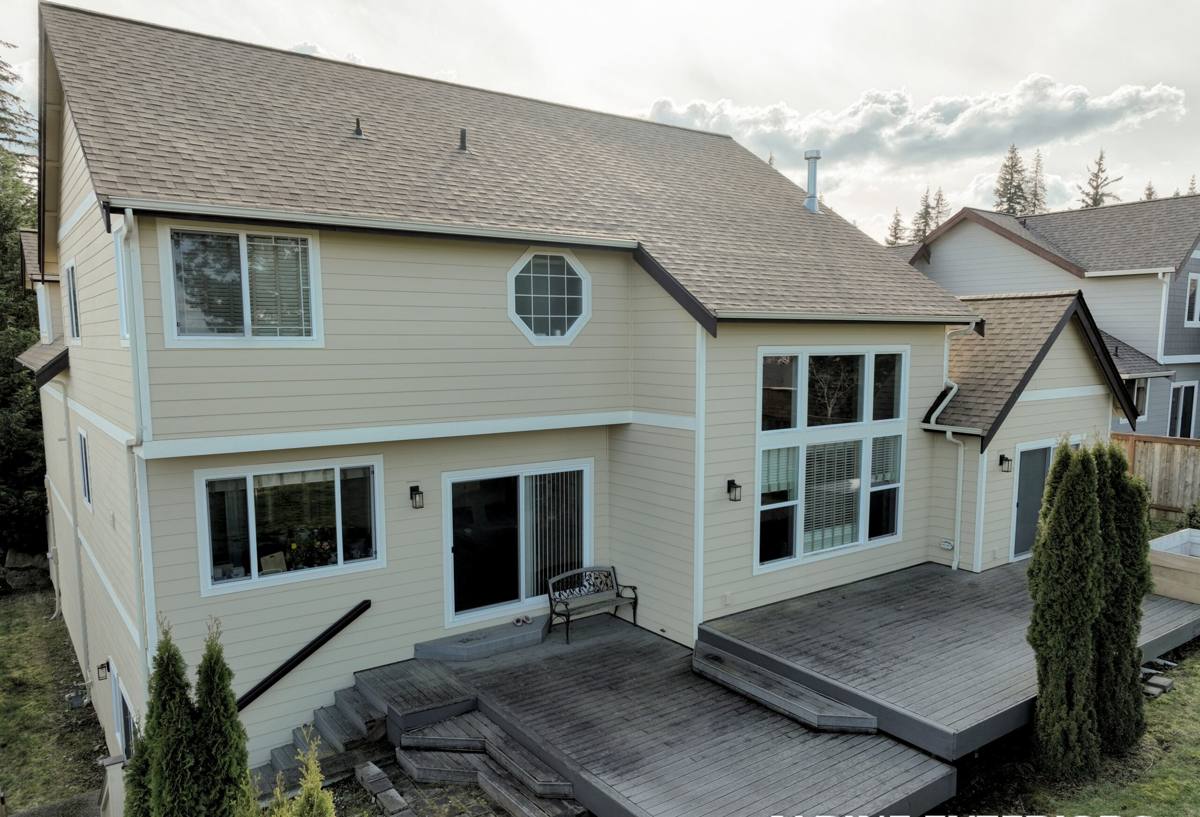
 Sudden Valley Exterior
 Board & Batten in a Whatcom County Climate
Board and batten has been a Pacific Northwest favorite for generations — the vertical lines read as farmhouse, craftsman, or modern depending on trim details, and it hides less of a home's roofline than a heavy lap profile. But the look only holds up if the material underneath is built for what Fairhaven and Sudden Valley actually throw at a house: salt-laden air off the water, long stretches of driving rain, and a moss season that can run from October well into spring. A board and batten wall has more vertical joints and more exposed batten edges than lap siding, which means more places for water to find a way in if the wrong product or the wrong installer is behind it.
This page is specifically about board and batten siding for homes in and around Fairhaven and Sudden Valley — not a generic rundown of the style. If you're weighing this look for a Whatcom County home, here's what actually matters.
What This Climate Does to Vertical Siding Over Time
Three things drive most of the board and batten failures we see in this part of Washington:
Salt air and moisture-driven expansion
Homes closer to the water pick up airborne salt that accelerates corrosion on fasteners and metal flashing, and it also holds moisture against the wall longer than dry inland air would. Wood-based sidings expand and contract with that moisture cycle, which is exactly what opens up gaps at butt joints and batten edges over the years.
Driving rain against vertical joints
Wind-driven rain off the Sound doesn't fall straight down — it hits walls at an angle and works its way sideways and upward under laps, seams, and battens that aren't detailed correctly. Board and batten has more linear feet of vertical seam than most siding styles, so the water-management detailing behind the boards matters more here than it would on a flatter-profile siding.
Moss, algae, and a shaded, damp microclimate
North-facing walls and anything shaded by mature trees stay damp longer through the wet months, which is exactly the environment moss and algae need. Porous or absorbent siding materials hold that moisture and feed the growth; materials that don't absorb water resist it far better.
What a Correctly Installed Board & Batten Job Involves
A lot of the difference between board and batten that looks good for two years and board and batten that looks good for twenty comes down to what's happening behind the boards, not the boards themselves.
Weather-resistive barrier and drainage plane
Every board and batten wall should go over a properly lapped weather-resistive barrier with a drainage gap behind the siding, so any water that does get past the face has somewhere to go besides the sheathing. Skipping or shortcutting this step is the single biggest cause of hidden rot behind vertical siding.
Fastening and spacing
Battens need consistent reveal spacing and fasteners driven at the manufacturer's specified location and depth — not just "close enough." Over-driven or under-driven fasteners are a common source of cracking and water intrusion at the fastener head, especially on a material that isn't engineered to tolerate installation variance.
Corners, trim, and the paint line
Outside corners, window and door trim, and the transition to foundation or roofline all need proper flashing and caulking details — and on this coastline, those details need to account for salt-driven corrosion on any exposed metal. A factory-applied finish that seals the cut edges (when the boards are field-cut correctly) holds up far better here than a field-primed product that depends on the crew to seal every cut and joint by hand.
Board & Batten Material Comparison — Whatcom County Conditions
| Material | Moisture behavior | Moss/algae resistance | Finish durability in salt air |
|---|---|---|---|
| James Hardie fiber cement | Dimensionally stable, doesn't swell or rot | Non-organic surface resists growth | ColorPlus factory finish holds color and seals edges |
| LP SmartSide (engineered wood) | Wood-based; can swell/delaminate if water gets behind it | Organic surface can support growth if damp | Field-applied touch-up needed at cuts; finish wears faster in coastal exposure |
| Vinyl | Won't rot, but battens/panels can warp or bow with heat and cold cycling | Low, but seams and channels can trap grime | Color fades over time, not repaintable in the same way |
| Primed spruce / cedar | Real wood; absorbs and releases moisture constantly | Most susceptible; needs regular treatment | Requires ongoing painting/staining maintenance |
Why We Only Install James Hardie
We get asked fairly often why we don't offer LP SmartSide, vinyl, or a wood board and batten option, since all three have their place and their fans. Here's the honest version:
- LP SmartSide is a legitimate engineered-wood product and performs well in many climates — but it's still wood-based, meaning it can swell, delaminate, or take on moisture damage if the installation isn't flawless or if water finds its way behind a joint over years of exposure. In a climate with this much sustained rain and salt air, that margin for error is thinner than we're willing to build a reputation on.
- Vinyl board and batten is inexpensive and low-maintenance in mild climates, but it's a thinner, more temperature-reactive material — it can warp, oil-can, or crack in wide temperature swings, and it isn't repaintable if you want to change the look down the road.
- Primed spruce and cedar give you real wood grain and a traditional look, but they demand ongoing painting, caulking, and moss treatment to survive a Puget Sound-adjacent climate. That's a maintenance commitment most homeowners underestimate when they choose the material.
James Hardie fiber cement is non-combustible, dimensionally stable (it doesn't expand and contract with moisture the way wood-based products do), and comes with a factory-applied ColorPlus finish that's baked on rather than field-painted — which means better fade and chip resistance and cut edges that are properly sealed when installed to spec. Hardie's HZ product lines are engineered for specific climate zones, including the wet, coastal-influenced conditions we work in throughout Whatcom County. It also carries a strong transferable warranty, which matters if you ever sell the home. That combination is why we standardized on it and stopped offering alternatives — not because the other products don't work anywhere, but because we don't think they're the right call for board and batten on this coastline.
Our Process for Fairhaven & Sudden Valley Projects
- On-site assessment: we look at wall orientation, existing moisture damage, shade/moss exposure, and how the current siding has held up — this tells us a lot about what your specific walls need.
- Detailed proposal: board and batten spacing, trim profile, color, and a clear scope covering the weather-resistive barrier, drainage plane, and flashing details — not just "siding installed."
- Tear-off and inspection: once the old siding is off, we check sheathing for hidden rot or damage before anything new goes up — this is often where issues that caused the original failure get found.
- Weather barrier and drainage plane installation: done to manufacturer spec, with extra attention at windows, corners, and the foundation transition.
- Hardie installation: boards and battens fastened to spec, correct reveal spacing, and factory-finish touch-up only where field cuts require it.
- Final walkthrough: we go over the finished work with you before calling the job done.
Cost Factors for Board & Batten Siding in This Area
Every home is different, but these are the factors that most often move the price on a board and batten project here:
| Factor | Why it matters locally |
|---|---|
| Wall height and complexity | Steep gables and multi-story walls common in the area take more labor and scaffolding |
| Existing damage behind old siding | Hidden rot from years of moisture exposure adds sheathing repair before new siding goes up |
| Trim and corner detail level | More window/door trim and corner boards mean more flashing and finish work |
| Batten spacing and board width | Narrower spacing uses more material and more fastening labor per square foot |
| Access and site conditions | Sloped Sudden Valley lots and tree-lined properties can affect staging and equipment access |
What to Expect for Maintenance After Installation
One of the real advantages of a correctly installed Hardie board and batten system in this climate is how little ongoing work it asks for compared to wood alternatives. A homeowner's yearly checklist should still include:
- Rinsing off accumulated grime and salt residue, especially on walls facing the water or prevailing wind
- Checking shaded and north-facing sections for early moss growth and cleaning it before it spreads
- Inspecting caulking at trim, corners, and penetrations (vents, hose bibs, light fixtures) once a year
- Clearing gutters and downspouts so overflow doesn't run down the wall face
- Keeping vegetation trimmed back from siding to maintain airflow and reduce trapped moisture
Why a Crew That Already Works This Area Matters
Board and batten installation isn't complicated in theory, but getting the water management right in a climate like this one is where experience shows. A crew that's worked Fairhaven, Sudden Valley, and the surrounding Whatcom County waterfront already knows which orientations take the worst weathering, where moss tends to establish first, and how salt exposure changes fastener and flashing choices. That's the kind of judgment that doesn't come from a spec sheet — it comes from having stood on enough of these roofs and walls in this specific climate to know what actually fails and why.
If you're considering board and batten siding for a home in Fairhaven or Sudden Valley, we're happy to take a look and give you an honest read on what your walls need — no pressure, no upsell. Reach out for a free estimate using the form below.