 Sudden Valley Exterior
 Why South Hill Decks Take a Beating
Decks in South Hill and the surrounding Sudden Valley area don't fail because homeowners neglect them. They fail because Whatcom County weather is genuinely hard on exterior wood and fasteners. The combination of driving rain off and on for most of the year, a marine-influenced air that carries moisture even on dry days, and a moss season that can stretch from fall through spring means a deck here is under load almost constantly. Add sun exposure that swings from gray winters to strong summer UV, and you get a structure that expands, contracts, absorbs, and dries out in cycles most decks in drier climates never experience.
That's the backdrop for every deck replacement we do in this neighborhood. It's not just about swapping old boards for new ones — it's about building something that's specifically set up to handle the way water moves through and around a deck in this part of Whatcom County.
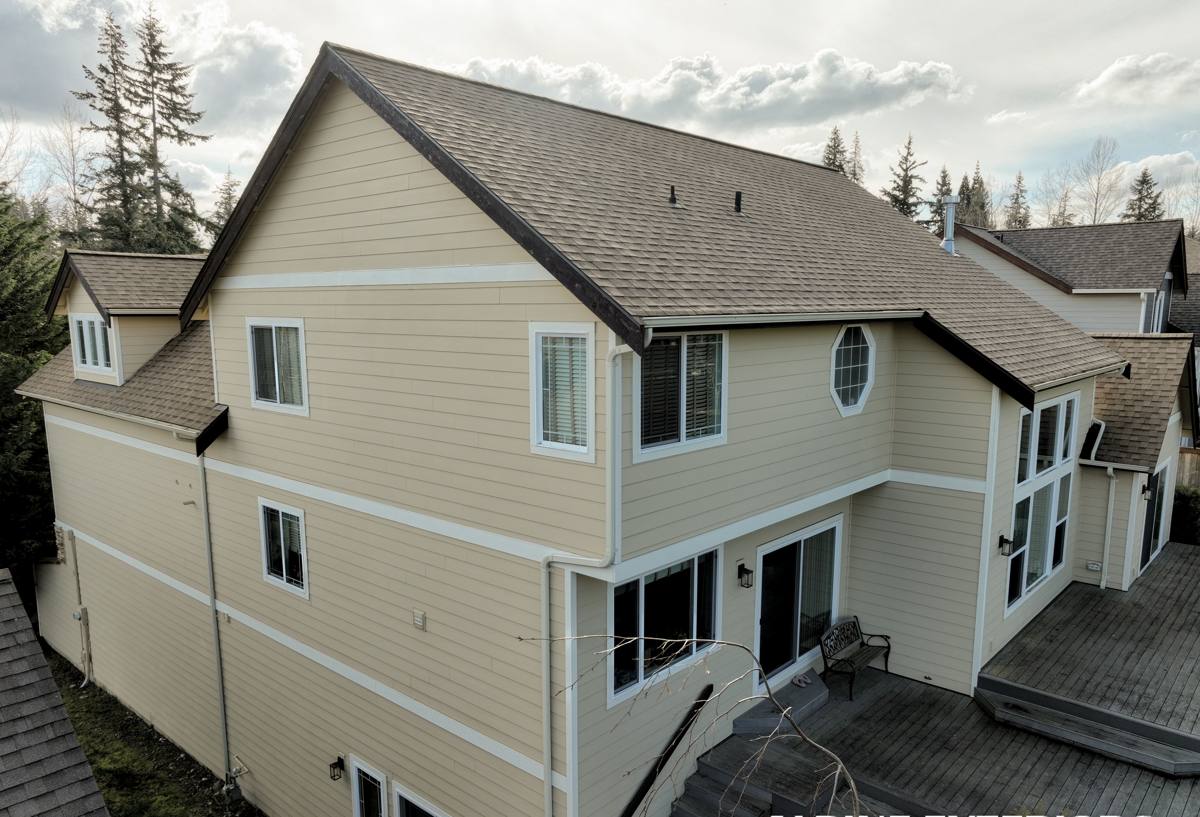
Signs Your South Hill Deck Needs Replacing, Not Just Repair
Not every tired-looking deck needs a full tear-out. But there's a point where patching boards or re-staining stops being worth it, and pushing past that point usually just delays a bigger, more expensive problem. Here's what we look for during an inspection:
- Soft, spongy, or spring-back decking boards, especially near the house or in shaded corners
- Visible rot or dark staining at the ledger board where the deck attaches to the house
- Persistent moss or green growth that comes right back within weeks of cleaning
- Rust streaking from fasteners, or fasteners that back out or spin freely
- Railing posts that wiggle at the base, which usually points to a rotted post or a failed connection below the surface
- Gaps that have widened significantly between boards, or boards that have visibly cupped or crowned
- A deck more than 20-25 years old that has never had the substructure inspected
If you're seeing two or more of these at once, it's usually a sign the framing underneath has been absorbing moisture for a while, not just the surface boards.
What a Correct Deck Replacement Actually Involves
A deck replacement done right is mostly about what's underneath — the parts you won't see once it's finished. That's where corners get cut, and it's also where problems show up years later if they do.
Structure and Framing
Every deck we rebuild starts with the framing: joists, beams, posts, and footings. In this climate, joist spacing and flashing at the ledger board matter more than they might in a drier region, because any gap where water can sit against untreated wood becomes a rot point within a few wet seasons. We use pressure-treated lumber rated for ground contact where it's called for, and we flash the ledger connection properly so water sheds away from the house rather than pooling against it. Footings need to sit below frost depth and bear on solid, undisturbed soil — on sloped or fill-heavy lots in this area, that sometimes means going deeper than the original deck's footings did.
Decking Material Choices
The decking surface is the decision most homeowners spend the most time on, and it's worth getting right for this climate specifically. Here's how the common options actually compare once you factor in year-round rain and moss:
| Material | Moisture Behavior | Maintenance | Typical Lifespan |
|---|---|---|---|
| Cedar (natural wood) | Naturally rot-resistant but still absorbs moisture; needs sealing to stay that way | Annual cleaning and re-sealing or staining | 15-20 years with upkeep |
| Pressure-treated pine | Resists rot when properly treated, but end cuts and fastener holes are vulnerable points | Regular cleaning; staining recommended every 2-3 years | 15-20 years |
| Composite decking | Doesn't absorb water into the board itself; surface can still hold moss if not cleaned | Periodic washing; no staining or sealing | 25-30+ years |
| PVC/cellular decking | Fully moisture-resistant, best performance in constant-damp conditions | Occasional washing | 25-30+ years |
We install all of these depending on budget and the look a homeowner wants, but we're upfront about the trade-off: wood costs less upfront and looks great, but in a climate with this much sustained moisture, it asks for more attention from the homeowner to keep moss and rot from getting a foothold. Composite and PVC cost more initially but take moss and moisture largely out of the maintenance equation.
Railings and Fasteners
Railings fail for the same reason decking does — moisture finding a way into end grain or around a fastener that isn't sealed. We use corrosion-resistant, coated or stainless fasteners rated for treated lumber, and we pay attention to where railing posts bolt through the rim joist, since that's a common weak point if it isn't properly blocked and flashed.
Our Deck Replacement Process
We keep the process straightforward and try not to leave a homeowner guessing what's happening or when:
- Inspection and assessment — we get under and around the existing deck to check framing, ledger condition, and footings before quoting anything, not just the visible boards.
- Scope and material selection — we walk through decking, railing, and structural options with honest pros and cons for this climate and your budget.
- Permitting — most deck replacements in Whatcom County require a permit, especially if the footprint, height, or structure changes; we handle that paperwork.
- Tear-out and disposal — old decking, railings, and any compromised framing come out and get hauled off site.
- Framing and flashing — new or repaired joists, beams, posts, footings, and ledger flashing go in to code.
- Decking and railing installation — boards, fascia, stairs, and railings go on with attention to drainage and airflow underneath.
- Final walkthrough — we cover care and maintenance specific to whatever material you chose before we consider the job done.
Building for Whatcom County Weather
A handful of details separate a deck that holds up here from one that doesn't, and they're mostly invisible once construction is done. Proper spacing between boards lets air move underneath and lets water drain instead of pooling on the surface, which matters enormously during the wetter months. Substructure ventilation — keeping the space under the deck from turning into a permanently damp, shaded pocket — cuts down significantly on the conditions moss and mildew need to establish. And using stainless or coated fasteners throughout, not just at the surface, keeps rust streaking and fastener failure from showing up a few years down the road. None of this is exotic; it's just consistent attention to the details that this specific climate punishes if you skip them.
What Deck Replacement Costs in South Hill
Every deck is different, so we don't quote a number without seeing the site, but these are the main factors that move the price up or down:
| Factor | Effect on Cost |
|---|---|
| Deck size and footprint | Larger square footage means more material, labor, and footings |
| Condition of existing framing | Rotted joists, beams, or posts add rebuild time beyond just the surface |
| Decking material | Wood is generally the lowest upfront cost; composite and PVC run higher but need less upkeep |
| Railing style | Basic wood railing costs less than metal, cable, or composite railing systems |
| Height and access | Elevated decks or difficult site access add labor and sometimes engineering requirements |
| Permit and inspection fees | Set by Whatcom County or the applicable jurisdiction, based on project scope |
Broadly speaking, a straightforward wood deck replacement on an existing footprint tends to land at the lower end of the range, while a larger composite deck with upgraded railing and any structural rework runs toward the higher end. We'll give you an itemized number after we've actually looked at your deck, not a guess based on square footage alone.
Why a Crew That Already Works South Hill Matters
A lot of deck problems in this area trace back to a build that was done correctly for a different climate — a crew using details or spacing that would be fine in a drier region but don't account for how much sustained moisture and moss pressure this part of Whatcom County actually sees. Working in South Hill and the wider Sudden Valley area regularly means we're not guessing at how a deck holds up here; we're seeing the same lots, the same drainage patterns, and the same moss and rot issues repeatedly, and building accordingly from the start. That's less about knowing any specific address and more about knowing what this climate does to a structure over years, not just at the ribbon-cutting.
Keeping Your New Deck in Good Shape
Whatever material you choose, a little seasonal attention goes a long way here:
- Sweep debris and standing leaves off the deck regularly, especially in fall — trapped organic matter is what feeds moss
- Rinse or lightly scrub the surface a couple of times a year to keep moss from establishing, particularly in shaded areas
- Check that gaps between boards stay clear so water can drain rather than pool
- For wood decking, plan on re-staining or sealing every 2-3 years; don't wait until it's visibly gray and dry
- Glance underneath once a year for any signs of moisture staining, rot, or pest activity near the ledger and posts
- Keep gutters and downspouts near the deck clear so roof runoff isn't dumping extra water onto or under it
None of this is a lot of work on its own, but skipping it for a few seasons in a row is usually how small issues turn into deck-replacement-sized ones.
If your deck is showing any of the signs above, or you'd just like an honest opinion on whether it needs replacing or can be repaired, we're happy to take a look. Reach out for a free, no-pressure estimate using the form below.