 Sudden Valley Exterior
 Building Decks in Alger's Wet, Wooded Climate
Alger sits at the wooded, lake-influenced edge of our service area, and it gets a different kind of weather stress than an open, sunny yard closer to town. Heavy tree cover keeps decks shaded and damp for long stretches of the year, driving rain off the Salish Sea soaks into end grain and fastener holes, and the same marine air that carries salt off Bellingham Bay keeps humidity high well inland. Put those together and you get a long moss season — sometimes eight or nine months a year where a deck surface never fully dries out between rains.
None of that makes a deck impossible to build well here. It just means the details that don't matter much in a dry climate — flashing laps, fastener coatings, board spacing, drainage slope — matter a lot in Whatcom and Skagit county conditions. A deck built to a generic national spec will often look fine for two or three years and then start showing soft spots, black streaking, or a loose railing right where water collects. A deck built for this specific climate is designed from the ground up to shed water and resist the moss and mildew that thrive in shade and moisture.
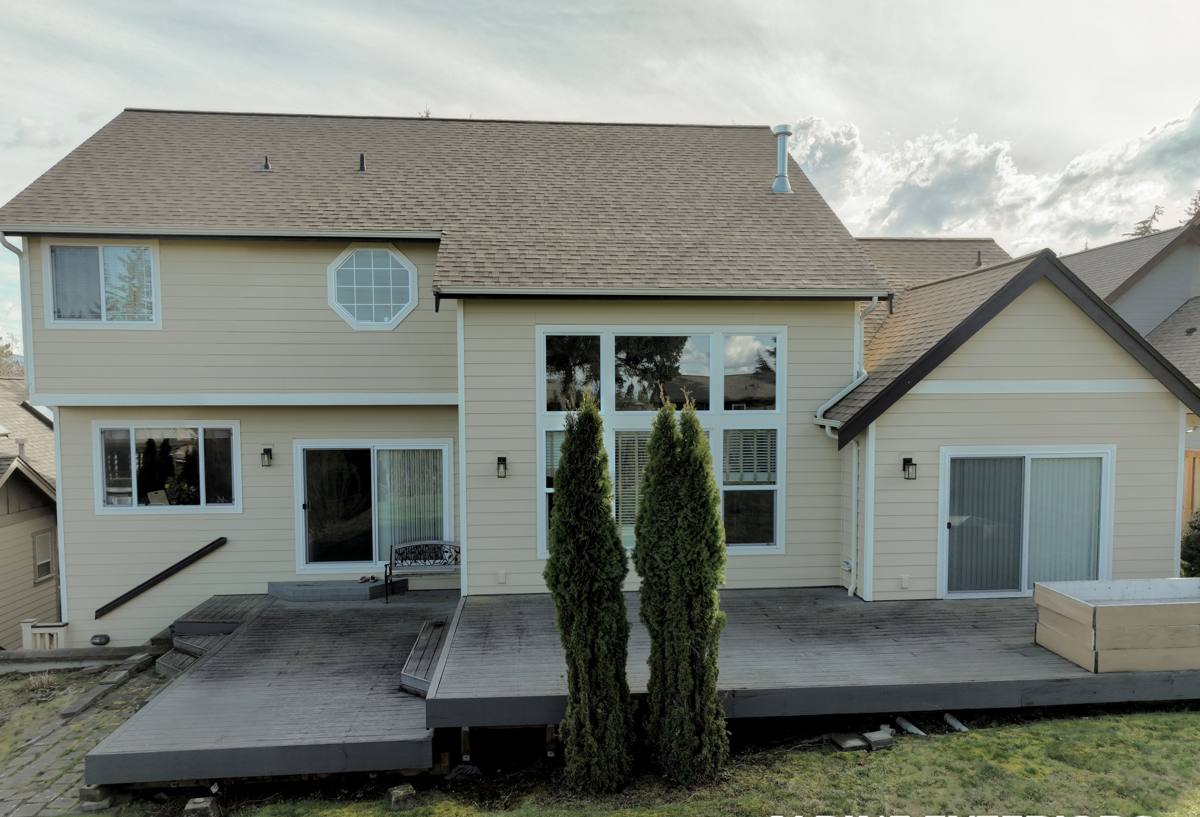
What a Correctly Built Deck Involves Here
Footings and Framing
Everything starts below grade. Footings need to be sized and set to local frost depth and soil conditions, not just poured to whatever looked adequate on the last job. In wooded lots with more organic soil and higher moisture content, we pay close attention to footing bearing and drainage around the post base so water doesn't pool against buried concrete and wood posts. Framing lumber should be rated for ground contact where it's close to grade, and joists need consistent spacing to support the decking material you've chosen without excessive deflection over time.
Ledger Attachment
The ledger board — where the deck attaches to the house — is the single most common failure point on older decks in this region, and it's almost always a flashing problem, not a fastener problem. Water that gets behind an improperly flashed ledger has nowhere to go and rots the house's rim joist from the inside, often long before anyone notices from the outside. A correct ledger installation uses proper flashing that laps over the house's water-resistive barrier correctly, structural lag screws or through-bolts (not deck screws), and a small gap or flashing detail that lets any water that does get in drain back out instead of sitting against the house.
Choosing Decking Material for This Climate
There's no single "best" decking material — there's a best material for your budget, your maintenance appetite, and how much shade and moisture your specific site holds onto. Here's how the common options actually perform under Alger's rain-and-moss conditions:
| Material | Moss/Mildew Resistance | Maintenance | Typical Lifespan Here |
|---|---|---|---|
| Pressure-treated lumber | Moderate — needs regular cleaning and re-sealing | Annual wash, re-stain/seal every 2-3 years | 15-20 years with upkeep |
| Cedar | Good natural resistance, but grey/moss-prone if not maintained | Regular cleaning, oil or stain every 1-2 years | 15-25 years with upkeep |
| Composite (capped) | Very good — non-porous surface sheds moss more easily | Periodic wash, no staining/sealing | 25-30+ years, manufacturer-backed |
| Uncapped composite (older style) | Fair — can hold moisture in the core | Regular washing to prevent surface mildew | Variable, generally shorter than capped |
In a low-sun, high-shade lot like a lot of Alger properties, we lean toward materials with a tight, low-texture surface — deep wood grain patterns and grooved boards look good on a showroom sample but grip moisture and moss in real shaded conditions. That's a maintenance trade-off worth understanding before you pick a board, not after.
Fasteners and Hardware: The Part Nobody Sees
Every piece of metal on a deck — joist hangers, structural screws, post bases, railing brackets — is exposed to the same damp, salt-tinged air as the wood. Standard zinc-coated hardware corrodes faster in this climate than it would somewhere dry, and corroded hardware is a hidden structural risk because it fails quietly, out of sight, under the decking boards. We use hot-dip galvanized or stainless connectors rated for the treated lumber and coastal-influenced conditions common to Whatcom and Skagit county exteriors work, matched to the chemical treatment in the lumber itself — mismatched metals accelerate corrosion rather than prevent it.
Design Choices That Fight Moss and Standing Water
Moss doesn't grow because a deck is "old" — it grows because water sits somewhere long enough for spores to take hold. A handful of design decisions make a real difference over the life of the deck:
- Slope: A deck surface should have a slight pitch away from the house so water runs off instead of pooling.
- Board gapping: Correct spacing between boards lets water drain through instead of sitting on the surface film.
- Joist protection: A membrane or tape over joist tops keeps standing water off structural wood even when the decking above is doing its job.
- Shade management: Where trees can't be trimmed, orienting boards and railing style to allow more airflow helps the surface dry faster after rain.
- Under-deck drainage: On raised decks, a drainage system underneath keeps the space below usable and dry instead of becoming a permanent moss-and-mildew pocket.
Permits, Codes, and Site Prep
Deck permitting depends on your local building department's rules — generally tied to deck height, size, and whether it's attached to the house — and requirements can differ from one jurisdiction to the next even within a few miles. We handle the permit application and inspection scheduling as part of the job so you're not the one chasing down requirements, and we build to the code that applies to your specific lot rather than assuming one county's rules carry over to another. Railing height, guard spacing, and stair geometry are code items inspectors check closely, and getting them right the first time avoids a failed inspection and a delayed project.
What Affects Your Project Timeline and Cost
| Factor | Why It Matters |
|---|---|
| Deck size and shape | More linear footage of framing, decking, and railing directly adds labor and material |
| Height above grade | Taller decks need more substantial footings, stairs, and code-required guardrails |
| Material choice | Composite and premium wood cost more upfront but shift maintenance costs downward over time |
| Site access | Wooded, sloped, or tight-access lots common around Alger can add setup and material-handling time |
| Permit and inspection timing | Local review schedules affect when framing and final inspections can happen |
As a broad range, straightforward deck rebuilds in this region often run somewhere in the low tens of thousands of dollars, with composite materials, elevated structures, or difficult site access pushing costs higher. We'll give you an actual number for your project after we've seen the site — broad ranges are useful for planning, but they're not a substitute for a real quote.
Our Process, Start to Finish
- Site visit and assessment: We walk the property, check drainage patterns, sun/shade exposure, and existing structure condition if you're replacing an old deck.
- Design and material selection: We talk through material trade-offs honestly, based on your budget and how much upkeep you actually want to do.
- Permit handling: We prepare and submit the permit application and coordinate required inspections.
- Demolition (if replacing): Old decking, framing, and any compromised ledger or posts come out and get inspected before anything new goes up.
- Framing and structural inspection: Footings, posts, joists, and ledger flashing go in to code, with inspection sign-off before decking starts.
- Decking, railing, and finishing: Surface material, railings, stairs, and any trim or lighting go in last.
- Final walkthrough: We go over care and maintenance specific to the material you chose before we consider the job done.
Keeping a New Deck Looking Good Season to Season
Even the best-built deck needs some seasonal attention in a climate like this one. A little routine care goes a long way toward preventing the moss buildup and surface staining that shorten a deck's usable life:
- Sweep leaves and debris off the surface regularly, especially in fall — trapped organic material holds moisture and feeds moss growth.
- Rinse or wash the deck surface at least once or twice a year to remove early moss and mildew before it takes hold.
- Check and clear gaps between boards so water keeps draining through rather than pooling.
- Re-seal or re-stain wood decking on the schedule appropriate to that material — don't wait until it's visibly grey and worn.
- Inspect railings and stair connections annually for looseness, which can signal hardware corrosion underneath.
- Trim back overhanging branches where possible to improve sun exposure and airflow.
Why a Crew That Already Works Alger Matters
A deck built by a crew that only works dry, open sites tends to bring dry-climate assumptions with them — standard fastener grades, standard board gapping, standard framing details. Those assumptions don't hold up under Whatcom and Skagit county's rain, humidity, and moss pressure the same way they would in a different climate. Working this region regularly means we're already familiar with the local building department processes, the soil and drainage conditions common to wooded lots, and which material and hardware choices actually hold up here rather than just on paper. That local familiarity shows up later as a deck that still looks and performs well years after the job is done, not just on the day we finish.
If you're planning a new deck or need to replace one that's showing its age, we're happy to come take a look and talk through what makes sense for your property. Reach out for a free, no-pressure estimate using the form below.