 Sudden Valley Exterior
 What Alger's Weather Does to Windows Over Time
Alger sits in the same damp, marine-influenced stretch of Northwest Washington as our home base in Sudden Valley, and the windows on homes out here take a beating that's easy to underestimate. It isn't one dramatic storm that ruins a window — it's years of small exposures stacking up: salt-tinged air drifting in off the water, driving rain that gets pushed sideways by wind instead of falling straight down, and a moss season that runs long enough to feel like it barely ends. Each of those does something specific to a window, and none of it shows up on day one.
Salt air speeds up corrosion on hardware, screen frames, and any exposed metal fasteners that weren't rated for coastal-adjacent exposure. Driving rain finds the weak points in flashing and sealant that a calmer climate would never expose — water doesn't have to fall on a window to get behind it, it just has to be pushed there by wind. And moss and algae that colonize damp wood sills and tracks hold moisture against the frame long after the rain has stopped, which is exactly the condition wood rot needs. None of this is unique to any one house; it's just what Whatcom County weather does to a building envelope, year after year.
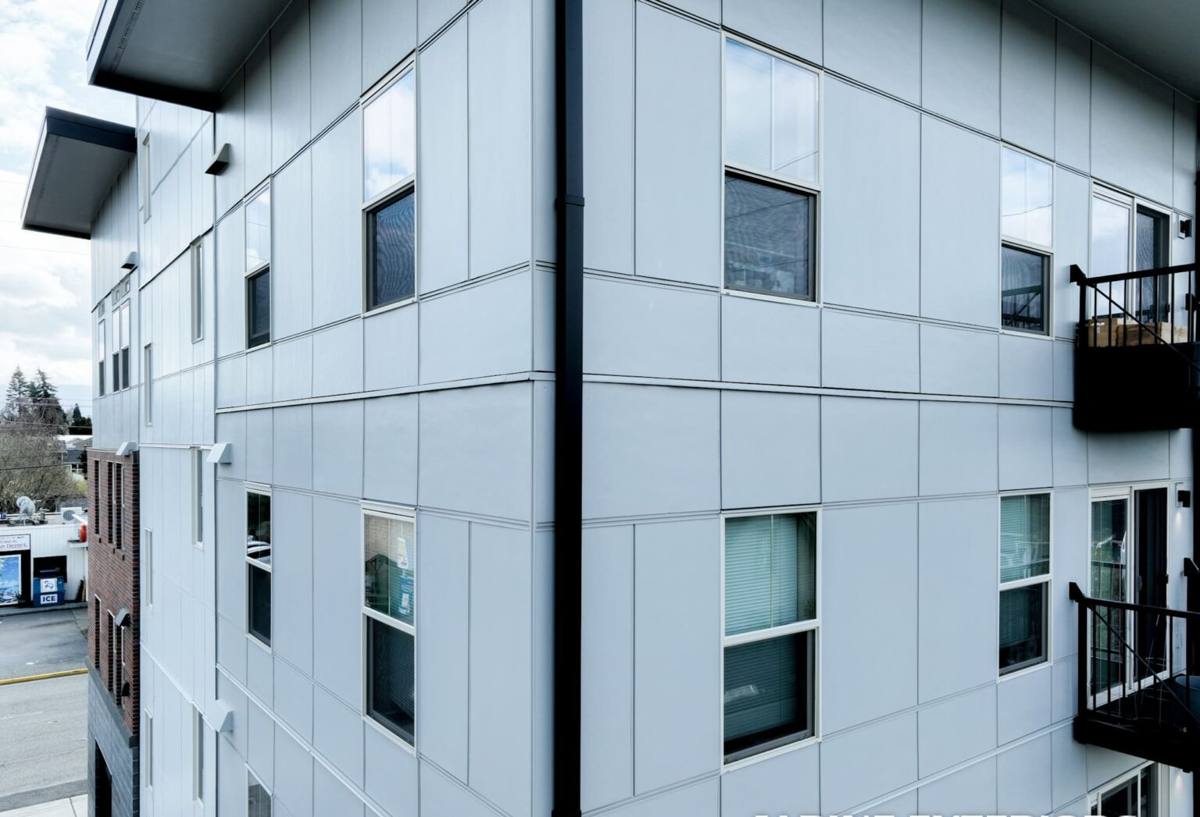
What "Custom" Actually Means on Homes Like These
"Custom windows" doesn't necessarily mean unusual shapes or high-end architectural glass, though sometimes it does. More often on the homes we see in the Alger area, it means the rough openings aren't a standard modern size — the house has settled slightly over the decades, a past remodel changed a wall without matching new construction dimensions, or the trim and siding detail around the opening is specific enough that a stock-size window won't sit right without extra framing and flashing work. Ordering a true custom size, built to the exact opening, avoids the compromises that come with cutting down a stock unit or building out a frame to fake-fit an opening that's slightly off.
Where This Shows Up Most
We run into it most on additions built at a different time than the original structure, on homes where a previous window was clearly not installed level, and on older wood-sash windows being replaced for the first time since the house was built. In each case, measuring for a true custom unit — rather than the closest stock size — is what makes the difference between a window that seals correctly and one that needs recaulking every year.
Choosing Frame and Glass for This Climate
Not every window material handles a damp, salt-influenced climate the same way. We walk homeowners through the real trade-offs rather than pushing one product line, because the right choice depends on the home's exposure, budget, and how much upkeep the owner actually wants to do.
| Frame Material | How It Handles Salt Air & Moisture | Upkeep | General Cost Tier |
|---|---|---|---|
| Vinyl | Won't corrode or rust; performs consistently in damp coastal-adjacent air | Low — occasional cleaning | Lower to mid |
| Fiberglass | Very stable in moisture and temperature swings; holds paint well if a specific color is wanted | Low | Mid to higher |
| Wood or wood-clad | Handsome, but the wood core is vulnerable where cladding is breached or sealant fails; needs vigilant maintenance in a long moss season | Highest — regular inspection and sealing | Higher |
| Aluminum | Prone to corrosion and heat/cold conduction without thermal breaks; we're selective about where we recommend it here | Moderate to high | Varies |
Glass Packages Worth Discussing
For most homes in this area, a dual-pane, low-E, argon-filled unit strikes the right balance of energy performance and cost. Triple-pane adds real insulation value and helps with condensation resistance during cold snaps, but it also adds weight and cost, which matters more on larger openings or homes where the existing frames are already carrying a lot. We size glass packages to the specific opening and its exposure — a window that catches the worst of the wind-driven rain is a different decision than one tucked under an eave.
What a Correct Installation Actually Involves
The window unit itself is only part of the job. In a climate that regularly drives rain sideways, how the window is integrated into the wall is what determines whether it stays dry for the next twenty years or starts leaking in five.
A correct installation includes a sloped sill pan that directs any water that does get past the sash back outside rather than into the wall cavity, proper integration with the home's weather-resistive barrier so water sheds over each layer like shingles, correct shimming so the frame isn't racked or twisted, and sealant chosen and applied for long-term flexibility rather than just a clean bead on installation day. Depending on the scope, egress and energy code requirements also come into play, and permits may be required — that's something we sort out with the homeowner up front, not after the fact.
Signs an Installation Was Rushed
- Visible gaps or uneven caulk lines around the frame exterior
- No flashing tape visible at the corners during a re-side or inspection
- Window operates stiffly or doesn't sit flush in the opening
- Interior trim was caulked heavily to hide a gap instead of fixing the fit
- No mention of a sill pan or sloped sill detail when asked directly
Our Process, Start to Finish
- Walkthrough and measurements — we look at the actual openings, note any settling, rot, or non-standard sizing, and talk through what the home needs versus what's nice to have.
- Product selection — we go over frame material, glass package, and hardware options based on that specific opening's sun and weather exposure.
- Permitting, if required — handled before work starts, not treated as an afterthought.
- Removal and prep — old units come out carefully, and we inspect the framing and sheathing underneath for rot or moisture damage before anything new goes in.
- Installation — sill pan, flashing integration, shimming, and sealant done to hold up through a wet winter, not just look clean on install day.
- Inspection and cleanup — we check operation, weather-seal, and finish work, then clear the site.
Signs Your Current Windows Are Already Losing the Battle
Most homeowners don't replace windows on a schedule — they replace them when the signs get hard to ignore. Worth checking for:
- Fogging or a milky haze between panes, which means the seal has failed
- Soft, spongy, or discolored wood at the sill or lower frame corners
- A window that's difficult to open, close, or lock without extra force
- Noticeable drafts near the frame even when the window is fully closed
- Moss, algae, or dark staining building up on the sill or exterior trim
- Paint or finish bubbling and peeling near the frame edges
Any one of these on its own might just need attention. Several at once, especially on a window that's original to an older home, usually means the frame and seal are past the point where repair makes more sense than replacement.
Cost Factors for Custom Window Projects
There's no single number that applies to every home, but the same handful of factors drive the estimate on most jobs we quote in the Alger area.
| Factor | Why It Moves the Price |
|---|---|
| Opening size and shape | True custom sizing and non-rectangular shapes cost more to manufacture than standard sizes |
| Frame material | Vinyl, fiberglass, and wood-clad sit at different price points, as shown above |
| Glass package | Triple-pane and specialty coatings add cost over standard dual-pane low-E |
| Number of openings | Whole-house projects typically bring a better per-window cost than one-off replacements |
| Condition behind the old window | Rot or moisture damage found during removal adds repair time before the new unit can go in |
| Access and removal complexity | Upper-story or hard-to-reach openings take more labor time |
Maintenance That Actually Matters in This Climate
A well-installed custom window still needs a little seasonal attention out here. Clear debris and moss from sills and weep holes so water has somewhere to drain instead of sitting against the frame. After stretches of wind off the water, a quick rinse of exterior frames and hardware helps limit salt residue buildup. And it's worth a yearly look at exterior sealant for cracking or gaps — catching a small sealant failure before a wet winter is far cheaper than dealing with what it lets in over several rainy seasons.
Why Local Experience in the Alger Area Matters
A crew that already works this part of Whatcom County knows which direction the wind-driven rain tends to come from on an exposed lot, which older window types show up again and again in homes of a certain era, and what a permitting office will and won't ask for on a given project. That familiarity shows up in fewer surprises during the job — not because the work is fundamentally different from anywhere else, but because the judgment calls on flashing details, sealant choice, and product selection are informed by having done this same job, in this same weather, many times before. It also means someone is nearby if a warranty question comes up down the road, rather than a phone number tied to a crew that's moved on to a different region.
If you're weighing whether your windows need attention or you're ready to talk through options for a custom window project, we're happy to take a look and give you a straightforward, no-pressure estimate. Use the form below to get started.