 Sudden Valley Exterior
 Why Yew Street Roofs Wear Differently
Yew Street sits inside a stretch of Sudden Valley where the roof over your head is doing more work than most homeowners realize. Whatcom County weather isn't dramatic in any single storm, but it's relentless over time — salt-laden air drifting in off the water, driving rain that comes in sideways during winter fronts, and a moss season that seems to start earlier and last longer every year. None of these things destroy a roof by themselves. Together, over ten or fifteen years, they wear down materials, loosen fasteners, and quietly rot the wood underneath a roof that still looks fine from the driveway.
We've replaced enough roofs in this specific pocket of Sudden Valley to know the failure patterns aren't generic. North-facing slopes hold moisture longer and grow moss faster. Roofs shaded by mature trees stay damp for days after a storm passes everywhere else. Homes with poor attic airflow show shingle curling and premature granule loss years before they should. A roof replacement here isn't just "put new shingles on" — it's addressing the specific way this climate attacks a roof, on this street, with this tree cover and this exposure.
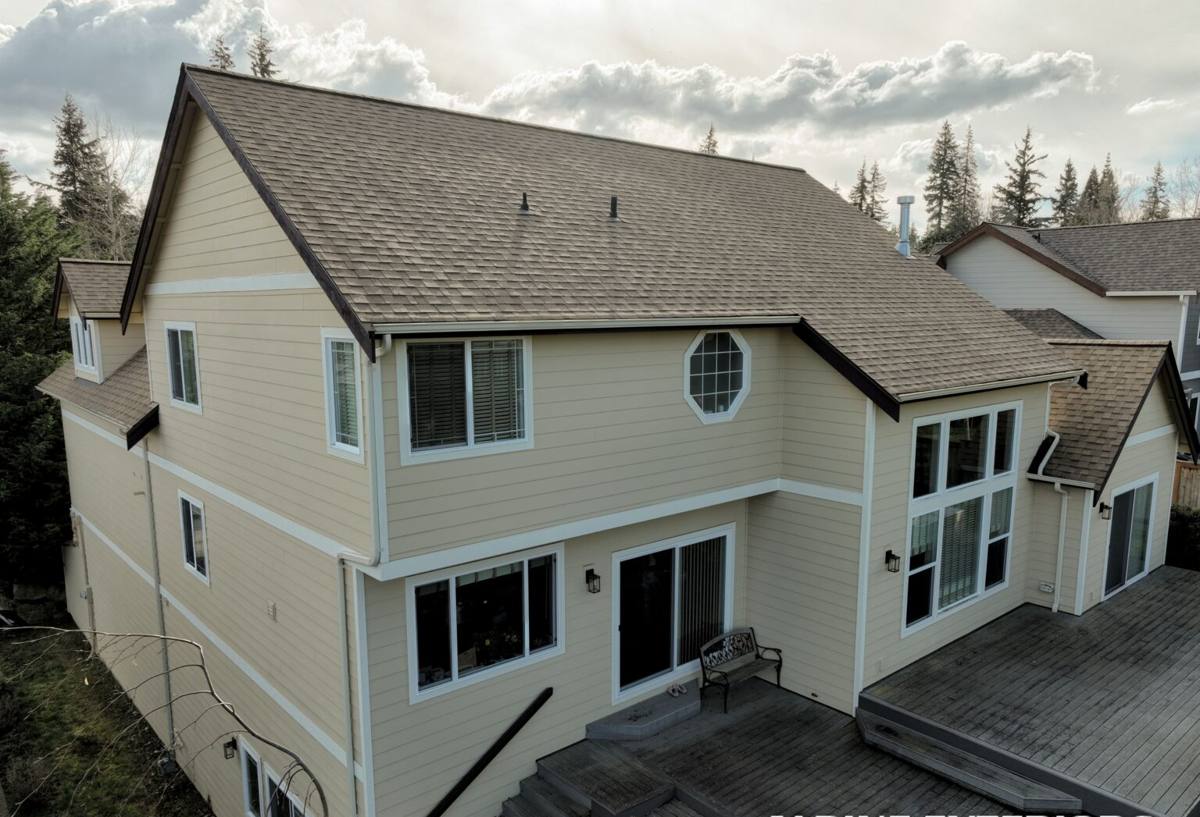
What Local Homes Actually Need From a Roof Replacement
A roof replacement done right for Yew Street has to solve four problems at once: keep driving rain out even when wind pushes it uphill under the shingle line, resist moss and moisture without relying on chemical treatments alone, move humid air out of the attic before it condenses on the underside of the deck, and hold up to salt-influenced air without accelerating corrosion on fasteners and flashing.
Skipping any one of these is how you end up with a roof that looks new for five years and then fails at the details — a rotted fascia board, a moss-choked valley, rusted nail heads bleeding through shingles, or soft plywood you don't discover until a leak shows up on the ceiling. The materials matter, but the underlying system matters more.
Moss Isn't Cosmetic
Moss on a roof is often treated as an appearance issue, and homeowners put off dealing with it. In this climate, that's a mistake. Moss holds water against the shingle surface for days at a time, lifts shingle edges as it grows, and traps debris that keeps the surface wet even between storms. On an aging roof, a heavy moss season can be the difference between another five years of service and a replacement moving up the calendar by half a decade.
Salt Air and Metal Components
Salt-influenced air corrodes exposed metal faster than it would further inland — nail heads, flashing, gutter fasteners, and vent stacks. A roof spec that ignores this and uses standard-grade fasteners or bare metal flashing will show rust streaks and early failure points long before the shingles themselves wear out. This is a materials decision, not an upgrade sell.
What a Correct Roof Replacement Involves
A roof replacement is only as good as what happens before the new material goes down. Anyone can lay shingles fast. A correct job slows down at the steps that don't show up in a driveway inspection.
Full Tear-Off and Deck Inspection
We remove the existing roofing down to the deck rather than layering over it. This is the only point in the whole project where the plywood or plank decking underneath is actually visible. Soft, delaminated, or water-stained sections get replaced before anything new goes on — covering rotten decking with a new roof just hides the problem and shortens the life of everything installed on top of it.
Underlayment and Ice-and-Water Protection
Given how much driving, wind-blown rain this area sees, underlayment choice isn't a place to cut corners. Self-adhered ice-and-water barrier belongs at eaves, valleys, and around every penetration — the spots where wind-driven rain actually finds a way in, regardless of how new the shingles above look.
Ventilation Before Aesthetics
A roof that traps humid attic air will fail from underneath, no matter how good the shingles are. Balanced intake and exhaust ventilation keeps the deck dry, controls condensation in our damp winters, and is one of the most overlooked parts of a roof replacement bid. We size and place ventilation based on the actual attic, not a one-size-fits-all vent count.
Flashing and Fastener Grade
Given the salt-air exposure common around Sudden Valley, we spec corrosion-resistant flashing and fasteners as standard, not as an add-on. This is a small material cost difference that has an outsized effect on how the roof looks and performs ten years out.
Material Options and Cost Factors
There's no single "best" roofing material for Yew Street — the right choice depends on your roof's shade exposure, slope, budget, and how long you plan to stay in the home. Here's how the common options actually compare for this climate, honestly, including their trade-offs.
| Material | Moss Resistance | Salt-Air Durability | Typical Lifespan | Maintenance Burden |
|---|---|---|---|---|
| Standard asphalt composition shingle | Moderate — needs periodic cleaning | Good with corrosion-resistant fasteners | 20-25 years | Low to moderate |
| Algae-resistant (AR) composition shingle | Better — copper-infused granules slow moss/algae growth | Good with corrosion-resistant fasteners | 25-30 years | Low |
| Standing seam metal | Excellent — moss struggles to grip smooth metal | Depends on coating; needs marine-grade fasteners | 40-50+ years | Low |
| Cedar shake | Poor without diligent upkeep — holds moisture | Fair; fasteners need corrosion resistance | 20-30 years with maintenance | High |
We don't install cedar shake as a standard recommendation on shaded, moss-prone lots. It's not that cedar is a bad product in the right setting — it's that under sustained moisture and shade, it demands a maintenance schedule most homeowners don't keep up with, and we'd rather be upfront about that than sell a roof we know will disappoint in this specific exposure. Algae-resistant composition shingle is our default recommendation for most Yew Street homes because it balances upfront cost, moss resistance, and a warranty structure that actually holds up to how this roof will be used.
Our Process, Start to Finish
- On-site assessment — we walk the roof and attic, not just the ground. Slope, shade pattern, existing moss or moisture damage, and ventilation all get checked before we write a number.
- Written estimate — a clear scope covering tear-off, decking allowance, underlayment, material, flashing, and ventilation, so there's no ambiguity about what's included.
- Scheduling around weather — we work with realistic dry-weather windows rather than promising a date we can't guarantee, given how unpredictable rain timing can be here.
- Tear-off and deck repair — old material off, deck inspected, any soft or damaged sections replaced before anything new goes down.
- Underlayment, flashing, and ventilation install — the parts of the job that determine how the roof performs in year eight, not just year one.
- Final material installation — shingles, metal, or your chosen material installed to manufacturer spec, not shortcuts.
- Walkthrough — we go over what was done, what was found underneath, and what to expect going forward.
Signs a Yew Street Roof Is Ready for Replacement
Not every roofing issue means a full replacement, but these are the signals that repair is no longer the more economical option:
- Granule loss heavy enough that gutters collect noticeable grit after every rain
- Shingles curling, cupping, or cracking, especially on shaded or north-facing slopes
- Moss or dark streaking returning within months of a cleaning
- Soft spots underfoot or visible sagging in the roof deck
- Daylight visible through the attic roof boards
- Rust streaking around nail heads, flashing, or vent stacks
- Interior ceiling stains that reappear after being painted over
- Roof age past 20-25 years, regardless of visible condition
If you're only seeing one or two of these, a targeted repair or a moss treatment plan may still buy you time. If several show up together, that's usually the deck telling you it's past patching.
Why a Crew That Already Works Yew Street Matters
Roofing crews that mainly work drier, inland areas tend to spec roofs for average conditions — average moisture exposure, average fastener grade, average ventilation. That approach under-serves a street dealing with sustained salt air, wind-driven rain, and an extended moss season. A crew that already works this specific area knows which slopes hold moss longest, which tree-shaded lots need extra ventilation, and which fastener and flashing grades actually hold up here rather than in a manufacturer's generic spec sheet.
That local familiarity also shows up in smaller, practical ways — knowing realistic weather windows for scheduling, understanding which HOA or neighborhood expectations apply, and having already seen how a given roofing product performs three, five, and ten years into this exact climate rather than guessing from a brochure.
Protecting Your Investment After Replacement
A new roof still benefits from basic upkeep in this climate. Keep gutters clear so water isn't backing up under the eaves. Trim back overhanging branches where practical to reduce shade and debris buildup, which slows moss growth. Have the roof looked at after major windstorms, and address small issues — a lifted shingle tab, a gap in flashing sealant — before they become bigger ones. None of this requires a maintenance contract, just attention a couple of times a year.
If your Yew Street roof is showing its age, or you just want an honest read on whether repair or replacement makes more sense for your specific situation, we're happy to take a look. There's no pressure and no obligation — just a straight assessment and a written estimate you can use to make the call on your own timeline. The form below gets you a free estimate started.